

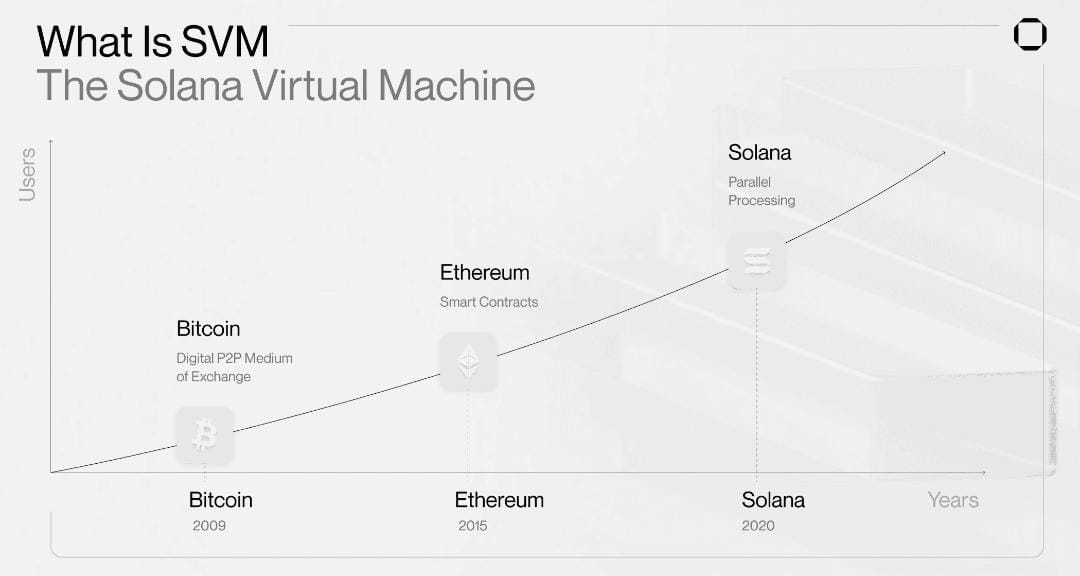
 When most people evaluate a new Layer-1, they start with speed. How fast is consensus? How low is latency? How high is throughput? That instinct is understandable. Performance metrics are easy to repeat and easy to compare. But they rarely explain durability.
What makes Fogo strategically interesting is not that it is fast. It is that it chose to build on the Solana Virtual Machine — and then made base-layer decisions around how that engine behaves under stress.
That distinction matters.
An execution engine defines how applications run. A base layer defines how a network survives.
Fogo’s decision to adopt the Solana Virtual Machine (SVM) is not about copying performance headlines. It is about importing a production-proven execution philosophy. SVM is built around parallelism, explicit state management, and concurrency discipline. It rewards builders who think in terms of throughput under load rather than simple sequential logic.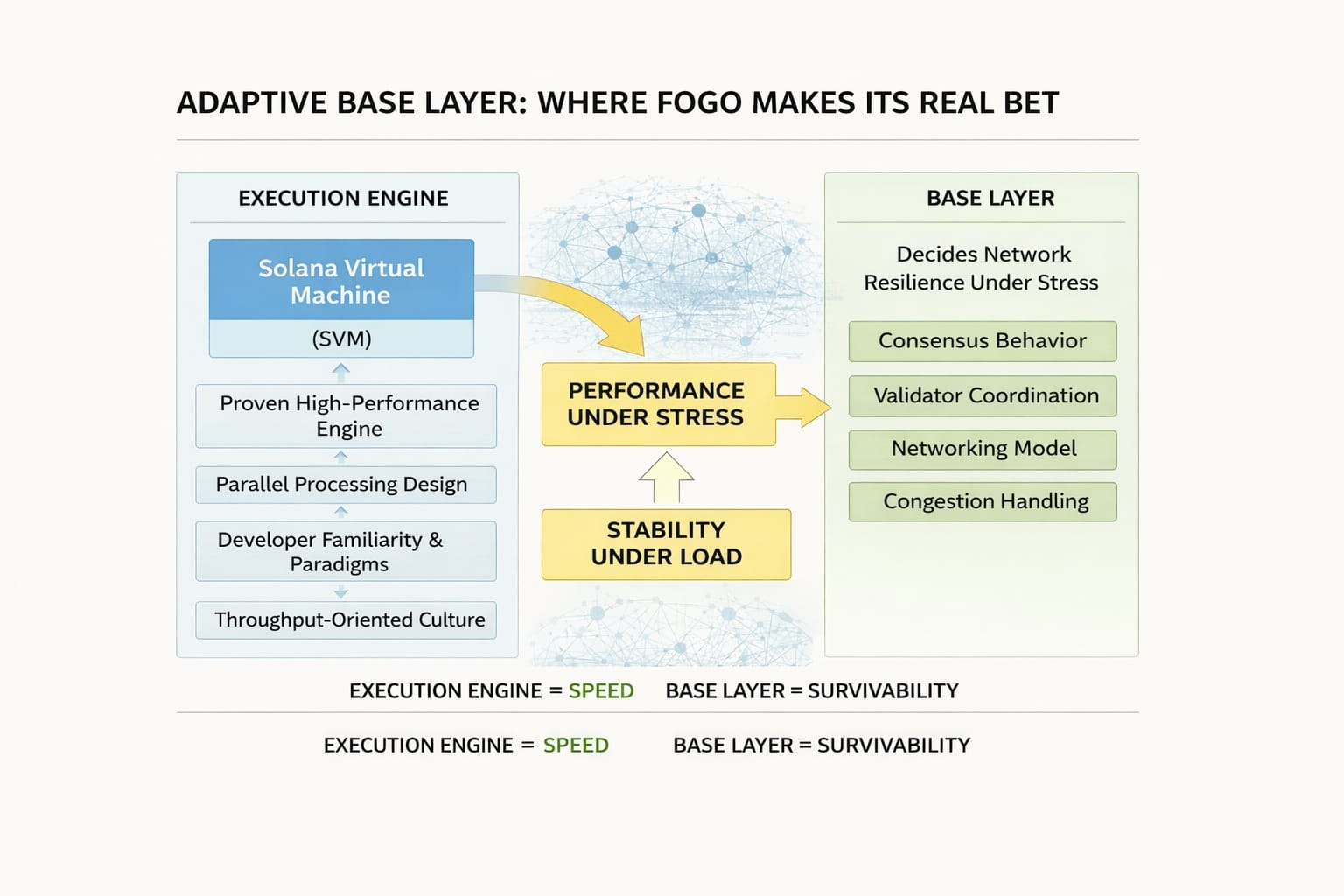
Over time, that shapes culture.
Developers working in an SVM environment do not just write contracts that function. They write contracts that must behave predictably when thousands of transactions hit at once. They think about contention. They think about state conflicts. They think about how design decisions will impact execution at scale.
By choosing SVM as its execution layer, Fogo is not merely selecting tooling. It is importing a performance-first builder mindset from day one.
That changes early probabilities.
Most new Layer-1 chains suffer from the cold-start problem. Developers hesitate because there is no liquidity. Liquidity hesitates because there are no applications. Users hesitate because there is no activity. It becomes a self-reinforcing loop of emptiness.
An SVM foundation compresses that timeline.
Even if contracts cannot be deployed one-to-one without adaptation, the mental model transfers. The development instincts transfer. The understanding of high-throughput architecture transfers. That reduces friction for the first wave of serious deployments.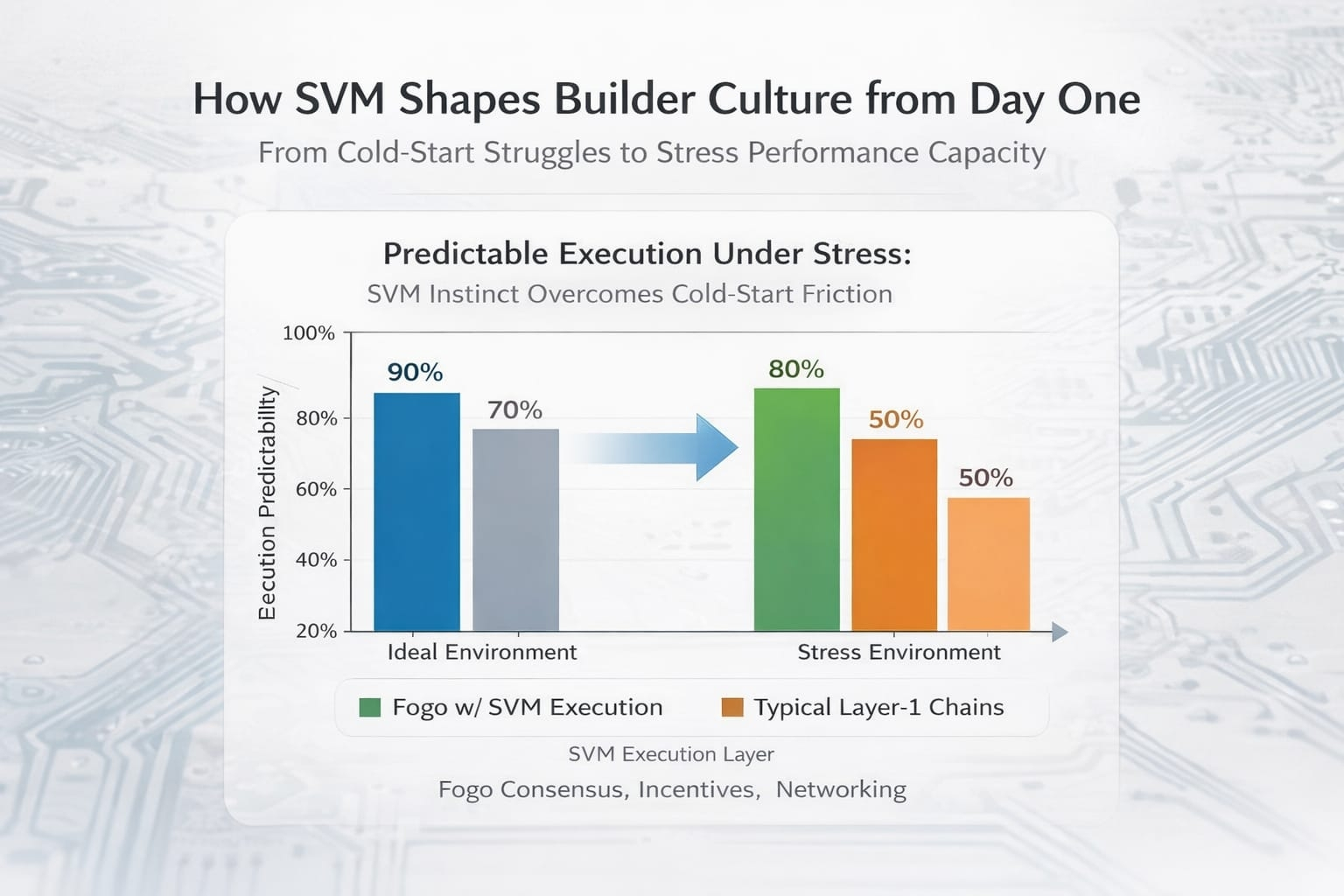
And first waves matter.
However, execution compatibility alone does not create an ecosystem. Liquidity does not teleport. Trust does not migrate automatically. Users do not move because a bridge exists.
This is where the base-layer design becomes decisive.
Two networks can run the same execution engine and behave very differently under real pressure. Consensus configuration, validator incentives, networking design, congestion handling, and transaction inclusion policies determine how a chain behaves when activity spikes.
Performance in calm conditions is marketing.
Performance under stress is infrastructure.
The real question for Fogo is not whether it can post impressive metrics in ideal environments. It is whether it can maintain predictable latency, stable inclusion, and consistent execution when demand becomes chaotic.
In high-frequency trading environments, a few hundred milliseconds can alter outcomes. In arbitrage and market-making contexts, inconsistent inclusion behavior can distort strategy assumptions. In automated systems, unpredictable latency can cascade into failed transactions.
If SVM is the engine, then base-layer design is the chassis.
And the chassis decides survivability.
Composability is another dimension where SVM provides leverage. Dense ecosystems create second-order effects. When multiple high-throughput applications share an execution environment, routing efficiency improves. Liquidity depth improves. Market spreads tighten. Execution quality feels stable rather than fragile.
This is not abstract theory. In high-activity networks, liquidity depth compounds as application density increases. Builders benefit because their applications plug into existing flows. Traders benefit because execution pathways multiply.
The result is a self-reinforcing ecosystem rather than isolated experiments.
But none of that materializes without reliability.
Builders do not stay because a chain is fast. They stay because it behaves predictably. Users do not remain because a network promises innovation. They remain because it feels stable.
Fogo’s SVM choice accelerates ecosystem formation by lowering the cognitive barrier for developers already familiar with concurrency-first design. But ecosystem durability will depend on how the network handles edge cases, congestion, validator coordination, and operational transparency.
In practice, what should observers watch?
Consistency of performance during traffic spikes.
Validator stability metrics.
Transaction inclusion predictability under load.
Fee behavior when demand increases.
Developer retention across deployment cycles.
Liquidity growth that reflects real trading rather than short-term incentives.
These signals reveal whether an execution advantage is translating into structural strength.
It is easy to dismiss SVM adoption as imitation. That view misses the deeper dynamic. Execution engines are not differentiators by themselves. They are accelerators.
The real differentiation lives in how the base layer manages stress.
History in crypto shows that ecosystems form not around theoretical throughput but around reliability under pressure. Traders gravitate toward venues where execution feels clean. Builders gravitate toward platforms where failures are rare and debugging is transparent.
If Fogo’s base-layer decisions preserve performance characteristics during chaotic periods — rather than only in calm conditions — then the SVM foundation becomes more than compatibility. It becomes time compression toward maturity.
That is the hidden advantage.
Time compression reduces the distance between “new chain” and “serious deployment environment.” It lowers the cost of experimentation. It increases the probability that early applications survive long enough to create liquidity density.
And liquidity density is what converts narratives into ecosystems.
Fogo is currently priced like a speculative asset. Its token trades around micro-cap volatility levels. That is typical for early-stage Layer-1 networks. Market pricing reflects uncertainty.
But infrastructure value does not emerge from token charts alone.
It emerges from whether the network becomes a place where serious builders choose to deploy repeatedly.
The difference between a clone and a contender is not whether they share an engine. It is whether the vehicle remains stable when driven hard.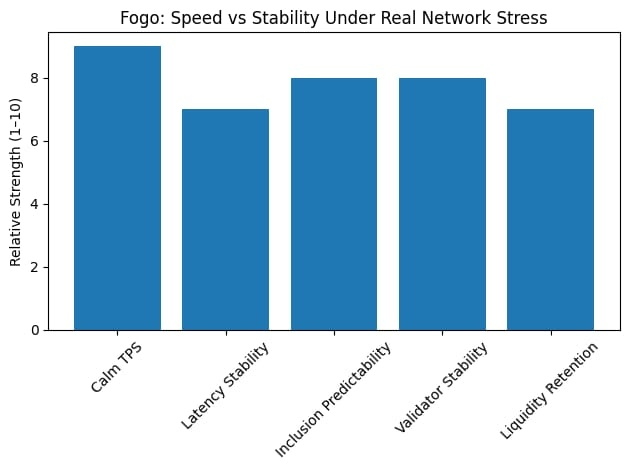
If Fogo maintains execution consistency during real stress, if builders treat it as production-grade rather than experimental, and if liquidity begins to cluster rather than scatter, then the SVM foundation will have done its job.
Because the real upgrade is not speed.
It is stability under pressure.
And in Layer-1 competition, stress reveals truth faster than marketing ever can.