
I’ve noticed a pattern in crypto: when a new technology gets attention, a wave of projects shows up that’s basically a thin layer on top of someone else’s system. With AI, that wrapper approach is especially tempting. In ordinary software, a wrapper can be legitimate—a layer between a user and a model API that shapes inputs and outputs so the tool fits a specific job. The trouble starts when that thin layer is presented as the core. A token and a chain are supposed to provide a shared record that other programs can build on. Yet many AI-and-crypto products still work like this: the chain handles payments and ownership, while the “thinking” happens off-chain in a hosted service. If the provider changes pricing, throttles access, or updates behavior, the system shifts with it, and users may not be able to audit what changed or why. That gap feels sharper now that people are trying to build agents—systems that watch for events, decide what to do, and then act with less human supervision—and mainstream reporting notes that agents can drive much higher inference demand than simple chat.
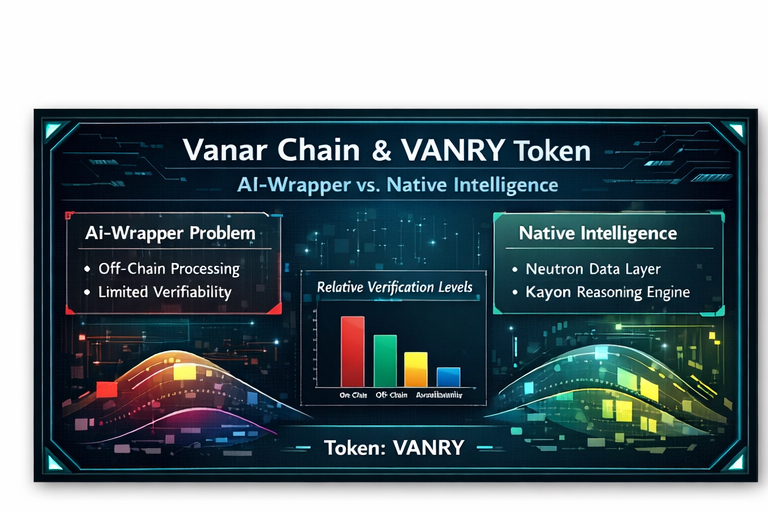
I find it useful to treat this as a trust problem more than a convenience problem. If a bot is going to trigger a contract, it matters whether its reasoning can be checked after the fact. That’s why verifiable approaches like zkML and verifiable inference are getting more attention: do heavy computation off-chain, but return a proof that ties the output to committed inputs and a specific model, so the chain can verify the result instead of trusting a black box.
It’s also why people have become harsher on hype. When an on-chain investigator dismisses most “AI agent tokens” as wrapper grifts, it lands because it puts blunt language on a pattern many observers already sense.
This is the backdrop for Vanar’s push for what it calls native intelligence. I used to assume that meant “we added an AI feature,” but their claim is more structural: build a stack where data, memory, and reasoning are treated as first-class parts of the chain rather than bolt-ons. Vanar describes a setup that includes a semantic data layer called Neutron Seeds and a reasoning layer called Kayon, with the idea that the system can query, validate, and apply logic—like compliance rules—using on-chain data.
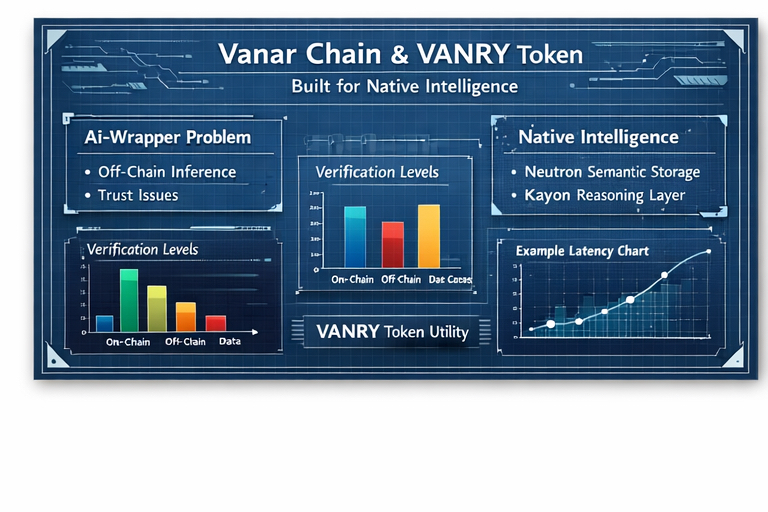
They also market Neutron as a compression-and-structure layer that turns larger files into smaller, verifiable on-chain objects, and they position the base chain as supporting AI-style querying with features like vector storage and similarity search.
None of this magically solves the hard parts. Even an AI-native design still has to answer where compute happens, how models get updated, what gets verified, and which tradeoffs you accept between cost, speed, and decentralization. But the underlying point feels coherent: if crypto really wants autonomous systems that coordinate value in public, it can’t keep outsourcing the intelligence and hoping the rest of the stack feels “on-chain” enough. That’s the debate I keep watching, and it isn’t settled.
@Fogo Official #fogo #Fogo $FOGO
