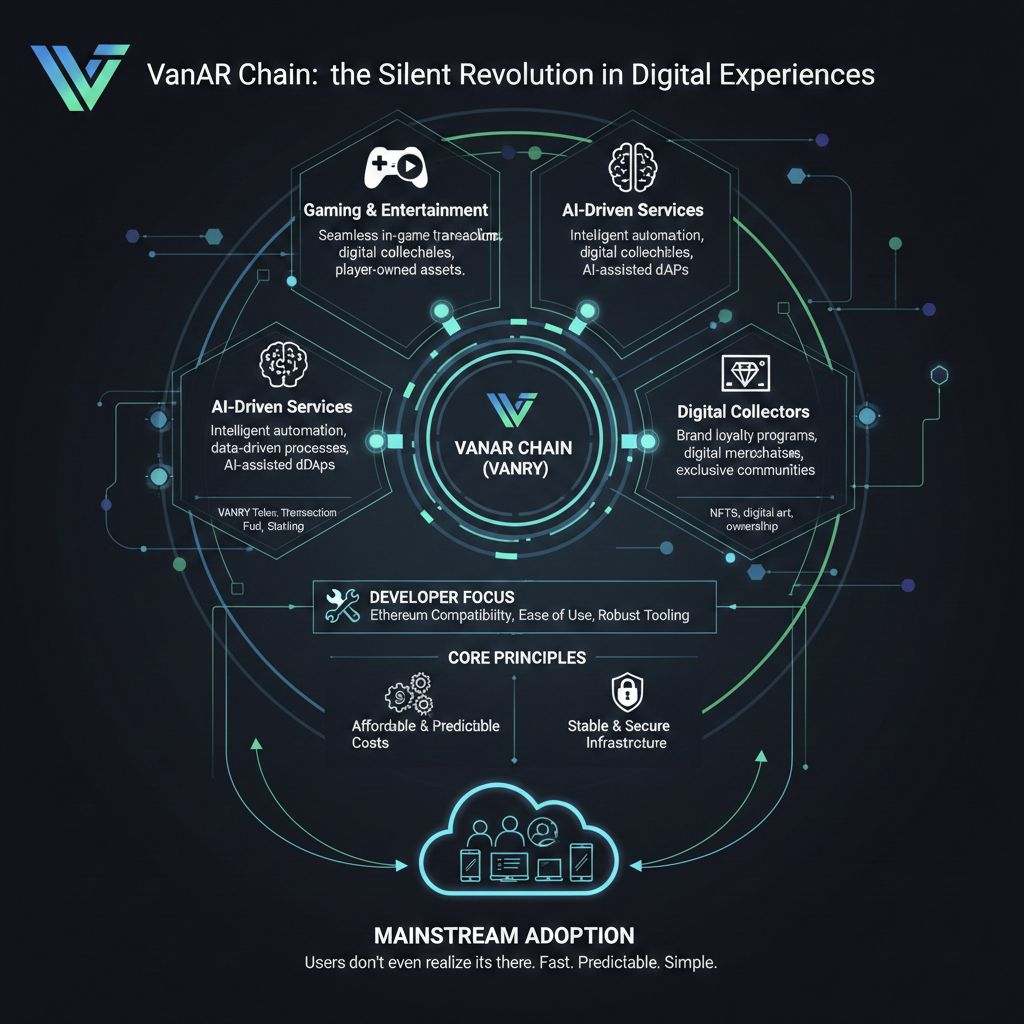
In the blockchain world, I’ve started to notice two kinds of projects. The first group makes a lot of noise — bold promises, dramatic language, endless talk about disruption. The second group works more quietly, focusing on the fundamentals most people overlook. Vanar Chain, at least from what I’ve observed after studying it closely, seems to fall into the second category. It doesn’t try to stage a spectacle. Instead, it places its attention on a basic issue developers often underestimate: ease of use.
And that’s not a small issue.
If blockchain is meant to serve millions of ordinary users — gamers, digital collectors, online communities — then complexity becomes the real obstacle. Most people don’t want to manage multiple wallets, calculate fluctuating transaction costs, or worry about network congestion. They want a normal digital experience. Fast. Predictable. Simple.
Vanar’s core idea appears to revolve around this frustration. Rather than competing to be the most experimental chain, it aims to become infrastructure that quietly supports applications in gaming, entertainment, AI-driven services, and branded ecosystems. The philosophy feels grounded: if the underlying system is stable and affordable, developers can focus on building products people actually enjoy using.
Think about it for a moment. If a teenager is playing an online game powered by blockchain technology, should they need to understand gas mechanics? Should they worry about transaction confirmations? Of course not. The smoother the background layer, the more natural the experience becomes. In my view, the real success of blockchain will come when users don’t even realize it’s there.
One of the more practical decisions Vanar has made is maintaining compatibility with Ethereum standards. Personally, I see this as a smart move. Developers already familiar with Ethereum tools can transition without relearning everything from scratch. Creating entirely new systems might sound innovative, but it often slows adoption. Respecting existing developer knowledge lowers friction — and friction is usually what stops infrastructure from scaling.
The project’s shift from the Virtua ecosystem into a dedicated Layer 1 chain is also worth reflecting on. Mujhe personally inka Virtua se Layer 1 par shift hona kaafi bold move laga. Moving from an application-focused environment into base-layer infrastructure requires confidence and long-term commitment. It suggests the team wanted deeper control over performance, cost structure, and scalability rather than relying on external networks. That kind of transition signals ambition, but it also raises expectations.
Of course, ambition alone does not secure adoption.
A fair question remains: can Vanar realistically compete with established Layer 1 networks that already have large developer ecosystems and strong network effects? Infrastructure is one of the toughest arenas in crypto. Even technically sound chains struggle if applications and users don’t follow. Execution, not positioning, will ultimately determine its trajectory.
The integration of AI-related tools within the ecosystem adds another layer to consider. Businesses today increasingly rely on automation and data-driven systems. If blockchain infrastructure can support not just asset transfers but also intelligent processes, it could open practical commercial pathways. But here, caution is important. AI is often mentioned more than it is meaningfully implemented. The real test will be whether developers find tangible utility in these tools rather than treating them as secondary features.
At the center of the network sits the VANRY token, functioning as the operational fuel for transactions, staking, and ecosystem participation. Its role is straightforward. In a market where token models are sometimes unnecessarily complex, clarity can be a strength. Infrastructure works best when incentives are transparent and aligned with network security and long-term sustainability.
After reviewing Vanar carefully, I don’t see a project attempting to redefine finance overnight. I see a team trying to address a practical challenge: how to make blockchain usable for everyday digital experiences. That’s less glamorous than promising transformation, but arguably more difficult to achieve.
If blockchain is ever going to reach mainstream adoption, it won’t happen because the technology becomes louder. It will happen when it becomes seamless — when users engage with games, digital assets, or brand ecosystems without thinking about the underlying chain at all.
Now the real question is whether Vanar can truly deliver the kind of “silent revolution” it seems to be aiming for — or whether it will simply become another Layer 1 in an already crowded space. Only time will tell.