
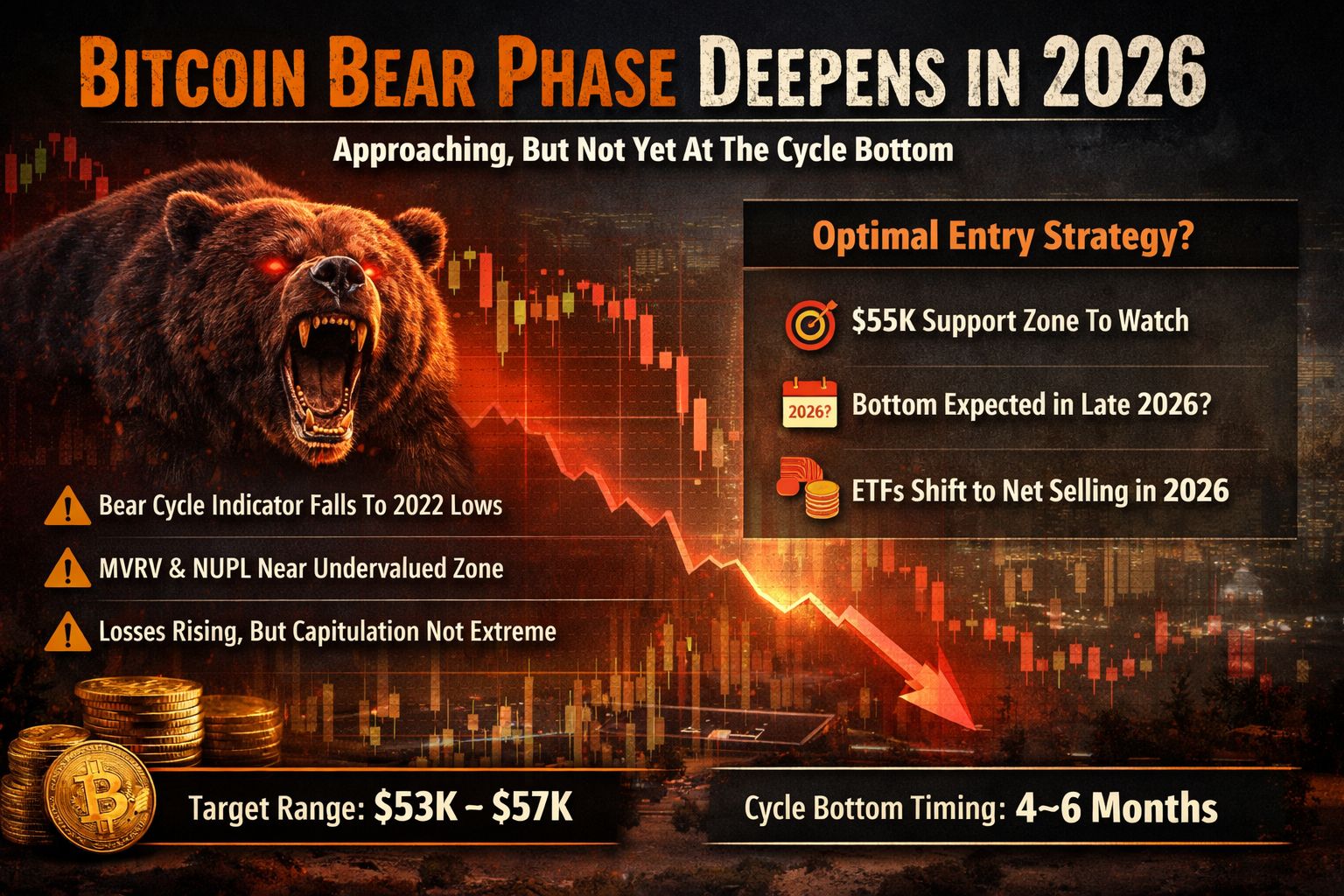
 Recent on-chain data suggests that Bitcoin has officially entered a bearish phase in 2026, but analysts believe the market may not have reached a true cycle bottom yet.
According to data insights from CryptoQuant, key indicators show weakness, though not the extreme conditions typically seen during final capitulation stages.
The Bull–Bear Cycle indicator has dropped to its most negative level since the 2022 crash linked to FTX. However, it remains in a “Bear” phase rather than the deeper “Extreme Bear” zone that historically marks major reversals.
Other valuation metrics, including MVRV and NUPL, are approaching undervalued territory but have not yet reached levels commonly associated with long-term bottoms. While billions in losses have recently been realized, the overall capitulation appears milder compared to previous cycle washouts.
What Could Be the Optimal Entry?
Analysts are watching the $55,000 level closely, as it aligns with Bitcoin’s realized price — an area that has previously acted as strong support during market bottoms. If higher support levels break, some projections place a potential accumulation zone between $53,000 and $57,000.
Historically, Bitcoin bottom formations take several months of sideways consolidation. Some market observers suggest the final capitulation phase could extend into late 2026.
Institutional behavior is also a key factor. U.S. spot Bitcoin ETFs have reportedly shifted to net selling this year, creating reduced demand compared to 2025. A stronger recovery signal may require ETF flows to stabilize or turn positive again.
For now, data suggests caution — the market may still need time before a confirmed cycle bottom forms.$BTC
#MarketRebound #HarvardAddsETHExposure #Binance #BTC走势分析 #TRUMP