
Something remarkable happened in December 2025 that didn't quite get the attention of a lot of people. Fragment, an NFT marketplace built on the TON blockchain and primarily known within the Telegram ecosystem, generated $2.83 million in revenue within a 24 hour period.
During that window, it ranked as the third highest revenue generating protocol in crypto, behind only Tether and Circle, and briefly surpassed Hyperliquid. Its daily revenue was roughly twenty times higher than OpenSea.
This outcome is worth studying in context. Don't you think?
These usernames represent identity within one of the largest messaging platforms in the world, offering direct and practical utility to users who already operate inside that environment.
It is important to acknowledge the structural advantage here. Fragment is tightly integrated with Telegram mini apps and benefits from native demand that already exists at scale.
This is in contrast to how the conventional NFT market has historically formed. For much of its history, attention and liquidity have been largely driven by speculative cycles, often centred on digital art and profile picture collections.
We are now at a point where the NFT market must be more intentional about the kind of attention it attracts and the direction liquidity flows. Getting this right will help determine which digital assets are worth trading in the first place.
That naturally leads to more grounded questions.
→ Which digital assets do people already use in their day to day digital lives?
→ Which of them benefit from being tradable, ownable, and verifiable onchain?
→ And which blockchains are structurally capable of supporting these assets at scale?
_________________________________
From Speculation to Utility
The decline in global NFT sales from the 2021 peak to more stable volumes in 2025 has shown a period of consolidation. Rather than a rebound, the market entered 2025 in a continued downtrend, with activity contracting across chains and concentrating around a limited set of intellectual properties and a few incentive-driven ecosystems.
Most collections and verticals experienced minimal organic demand, as users became increasingly selective with the collections that drive the flow of their liquidity.
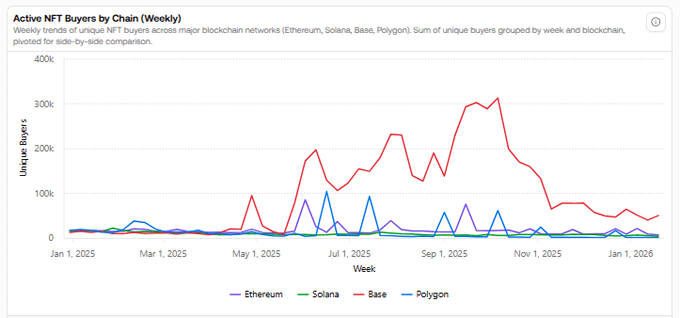
Data shows a total annualized NFT trading volume of approximately $5.5 billion in 2025, with capital and attention increasingly flowing toward assets that demonstrated repeat usage, integration, or relevance within active digital environments.
Within this context, the NFT ecosystem expresses value through distinct asset categories that reflect different usage behaviours:
1. Speculative and cultural NFTs: These circulate through communities and marketplaces, with value shaped by attention, narrative, and social momentum.
2. Functional and utility-driven NFTs: They derive value from use, operating as access tools, identity markers, or programmable components within digital systems.
These categories help explain how attention and liquidity move through the market today. Identity-based digital assets operate within this framework of sustained use.
For example, a premium Telegram username functions as a persistent digital identifier, which supports recognition, and branding within that environment.
One area that showed a clear product-market fit and strong monetization was Pokémon trading cards. Marketplaces like Collector Crypt and Courtyard used crypto to let people trade, own, and play fun games with both real and digital Pokémon cards.
________________________________
A Glimpse into the Current Market
Ethereum became the main centre of NFT activity in 2025, accounting for about 74.6% of total trading volume, as remaining liquidity concentrated where infrastructure and tooling were already mature and where assets could be settled and reused efficiently.
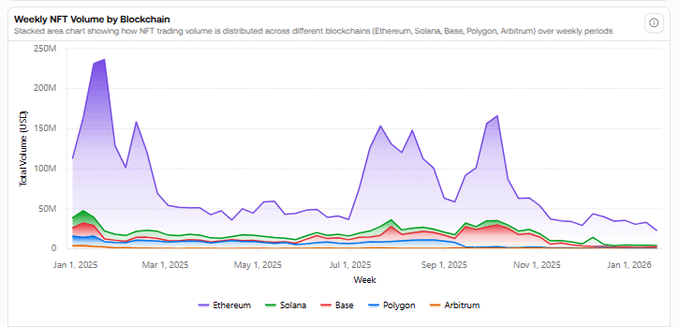
Marketplaces, wallets, lending protocols, and social layers on Ethereum are expanding the range of NFT use cases, creating an environment where NFTs can actually sustain value.
Capital no longer just flows in and out of collections; it circulates across applications, moving from trading to lending, to social and utility-driven contexts. This circulation is what allows NFTs to function as an active asset.
Base, Solana, and Polygon form a second tier, each capturing between 7% and 9% of total volume.
At the same time, creators and platforms moved their reliance on NFTs as the sole primitive and business model. Zora, for example, moved away from NFT-based posts toward ERC-20 post assets that can be accumulated, traded, and used as an incentive system.
Major marketplaces, most notably OpenSea and Magic Eden, also began to position themselves as asset venues by expanding beyond NFT listings into token trading and general market features.
___________________________________
Where are we headed from here?
What continues to compound is the use of NFTs as programmable objects within products, such as ownership, access, identity, inventory, and rights management. The following use cases will thrive this year and moving forward.
→ NFTs as programmable assets
Tokenised positions, evolving content formats, and identity-linked assets all fall into this category. Programmability enables composability at the product layer. NFTs that carry executable logic can interact with multiple platforms without requiring each platform to rebuild integration from scratch.
A character NFT that stores attributes, equipment, and progress on-chain can theoretically be recognised by different games using the same standard. A loyalty NFT from one brand can trigger discounts in another's ecosystem if both honour the same protocol.
So utility becomes the anchor, and price becomes a side effect rather than the purpose. Secondary markets will still exist, but they no longer define how NFTs are designed or why they are used.
→ Gaming as the distribution engine
Gaming remains a good and viable path to scale, for operational reasons rather than narrative ones. It consistently adopts whatever improves retention and monetisation.
By design, games already revolve around ownership, progression, and tradable value. Players understand inventories, rare items, and the idea that what is earned in one session carries forward into the next. NFTs extend these familiar mechanics by making inventories portable, items persistently owned, and progression verifiable outside the game itself.
As standards mature, gaming becomes a major driver of on-chain activity, reflecting where adoption typically emerges first: inside products people already use every day.
→ Identity and access users understand
Crypto-native projects grow from communities already familiar with digital assets and comfortable with the risks involved, but mainstream brand customers, by contrast, understand loyalty programs, limited releases, and fan experiences, but they do not expect these to involve blockchain. As a result, announcements of NFTs from traditional brands can be met with scepticism.
Access-based NFTs can offer a more practical solution. A good use case is a ticket that grants entry to an event, a membership that unlocks content or early access, or a credential that proves status or identity.
These NFTs do not need rising prices or active trading to be useful. They work even if they are never resold. The buyer receives something they already understand: access, proof, or permission.
In this model, the entire blockchain stack is abstracted, and value comes from what the NFT does, not what it might be worth later.
→ IP Strategy and Brand Control
The maturation of NFT projects has brought intellectual property into focus. Prior to this moment, ownership of an NFT did not always include clear rights to the underlying image, character, or brand. Some projects granted full commercial rights to holders, while others reserved all rights for the creators.
Today, projects that aim to create long-term value are adopting IP strategies similar to those used in traditional media. They define who owns what, clarify which rights transfer with token ownership, and outline how the brand can be used commercially.
This means considering licensing opportunities, maintaining narrative continuity, and controlling distribution. It means thinking like a franchise, and we are off to a good start.
_________________________
How to Build an NFT Collection That Lasts
The future of NFTs will be driven by utility rather than hype. Collections that survive long term will be the ones that connect directly to real use cases. NFTs should function as tools for access, ownership, credentials, or distribution within products and platforms.
When a token supports practical outcomes instead of speculation alone, it has a stronger reason to exist and a better chance of retaining value.
Longevity also depends on the full user experience. Projects need to design beyond visuals and minting mechanics. This includes secure infrastructure, reliable systems, and ongoing user support.
Each NFT should deliver clear and measurable value to the holder, and that value must remain relevant as the product evolves.
Clear communication is just as important as technical design. Projects must be able to explain what their NFTs do, why they matter, and who they are for. This applies to users, partners, and regulators alike. Trust is built through clarity and consistency. NFT collections that focus on utility, transparency, and real-world relevance are more likely to build lasting communities