
When a new blockchain launches, the first question is almost always the same: how fast is it? Speed has become the default metric, as if higher transactions per second automatically translate into better markets. In my view, that framing misses what Fogo is actually trying to build.
Fogo is built on the Solana Virtual Machine (SVM), which means developers can reuse familiar tooling and adapt existing Solana programs with minimal friction. That continuity matters. It removes migration drama and lets the conversation shift away from raw TPS and toward something more important: how the chain behaves under real trading conditions.
Speed, in this context, feels more like a by-product than the mission.
Built for Global Markets, Not a Single Time Zone
One of the most distinctive design choices is Fogo’s multi-local consensus model. Instead of relying on a static validator distribution, leadership rotates across three eight-hour windows aligned with global trading activity: Asia, the Europe/U.S. overlap, and the U.S. afternoon.
This “follow-the-sun” approach reduces physical distance between validators and major liquidity centers during peak hours. Early validator clusters were positioned close to large exchange infrastructure in Asia, with other regions ready as backup. The intent is not cosmetic decentralization. It is time-zone alignment with market flow.
Markets are temporal systems. Liquidity, volatility, and order flow are not evenly distributed across 24 hours. Aligning consensus with global trading windows reframes the blockchain as infrastructure that adapts to market reality rather than ignoring it.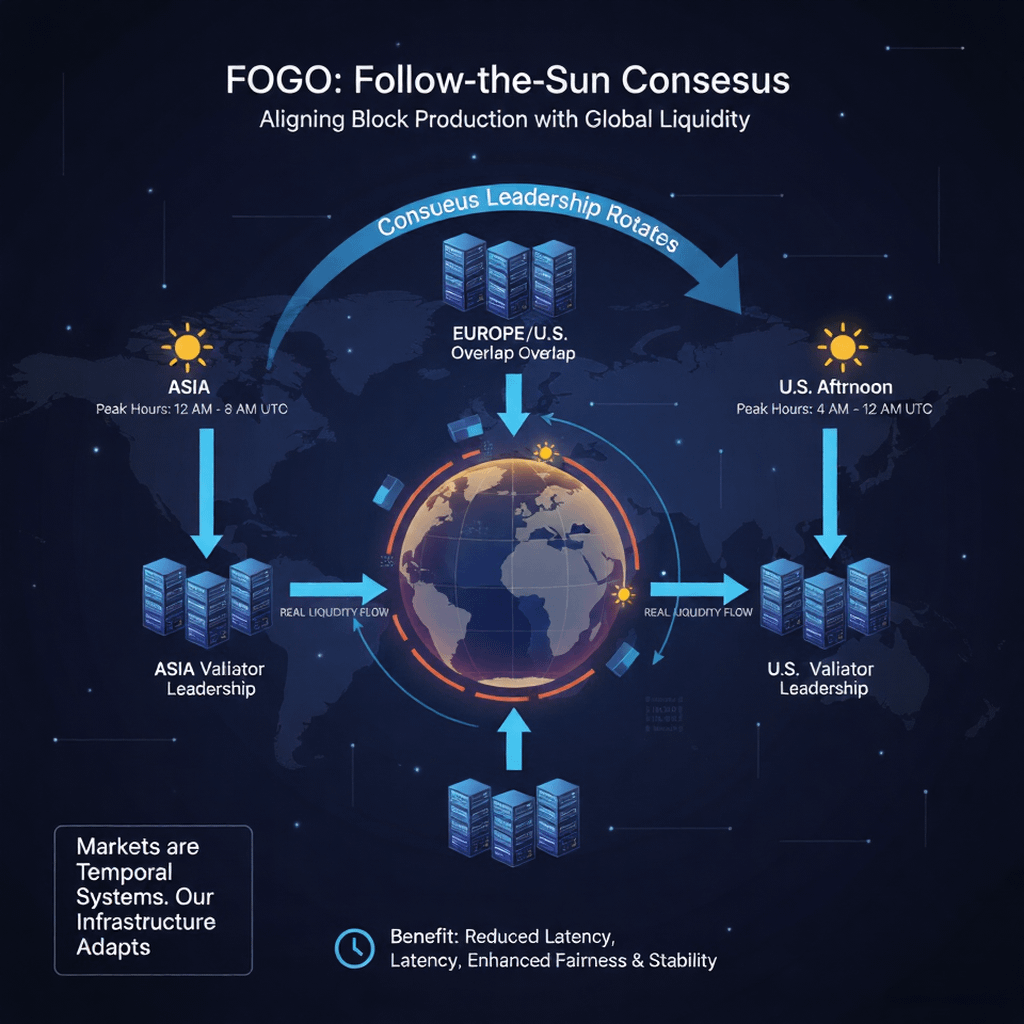
Dual-Flow Batch Auctions: Competing on Price, Not Latency
The moment I stopped viewing Fogo as a “fast chain” was when I understood Dual-Flow Batch Auctions (DFBA).
Through Ambient, a perpetual DEX operating on Fogo, DFBA batches trades within a block and clears them at a common oracle-derived price at the end of that block. Every participant in that batch receives the same clearing price. The race is no longer about who can hit the network first by milliseconds. It becomes about who can quote the best price.
This has two important implications:
MEV extraction becomes more difficult because intra-block ordering advantages are reduced.
Traders may receive price improvement if the batch clears in their favor.
Because the SVM executes quickly, these auctions function as standard smart contracts rather than relying on off-chain coordination. On slower chains, this design would struggle. Here, performance enables market structure reform.
That is a fundamentally different narrative from “we process X TPS.”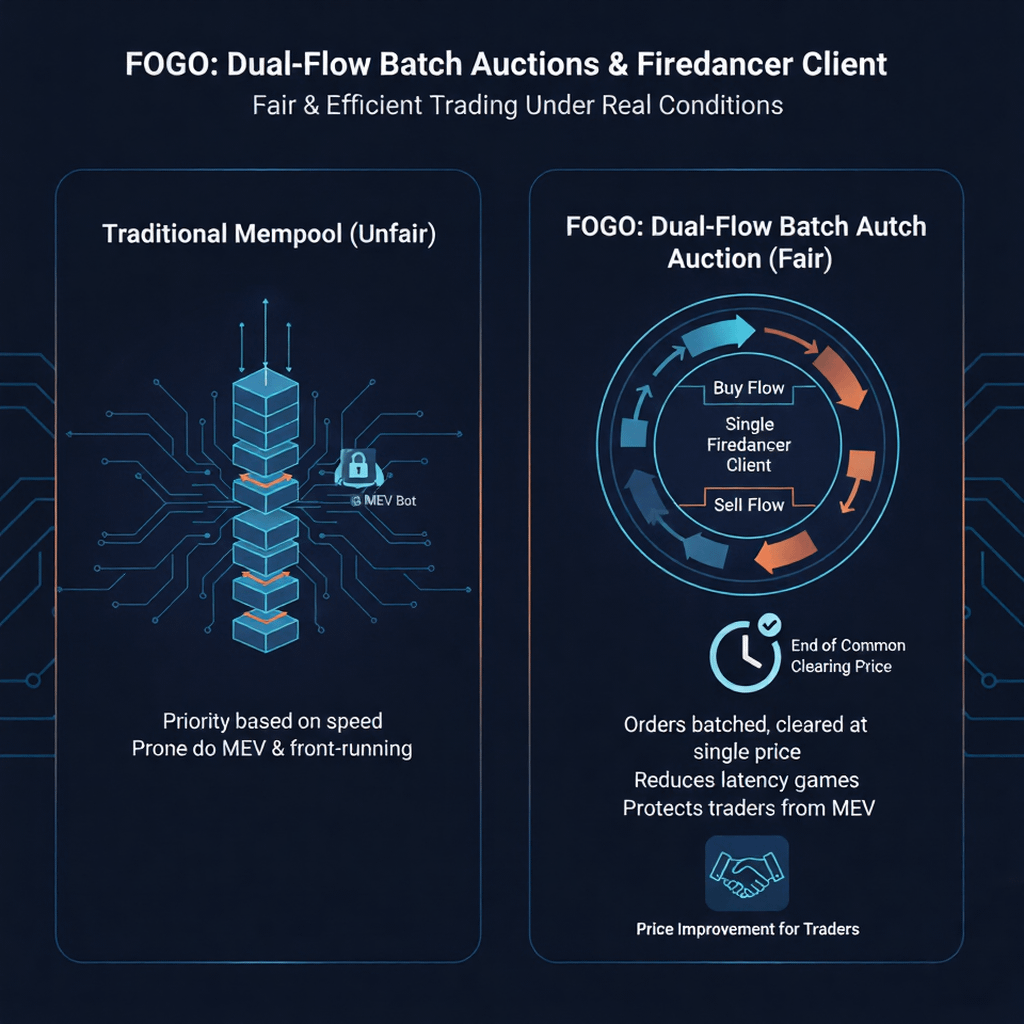
Sessions and Gasless UX: Closer to Exchange Behavior
Fogo Sessions introduce a permission-based interaction model. Users can restrict how much capital or which tokens an application may access, or grant broader permissions to trusted dApps. In addition, dApps can sponsor gas fees.
For traders, this reduces friction. Instead of repeated wallet confirmations, the experience becomes closer to centralized exchange interaction—while retaining self-custody. It is not just a convenience feature. It acknowledges that high-frequency or active traders require predictable interaction flows.
User experience is part of market infrastructure. Friction changes behavior. Behavior changes liquidity.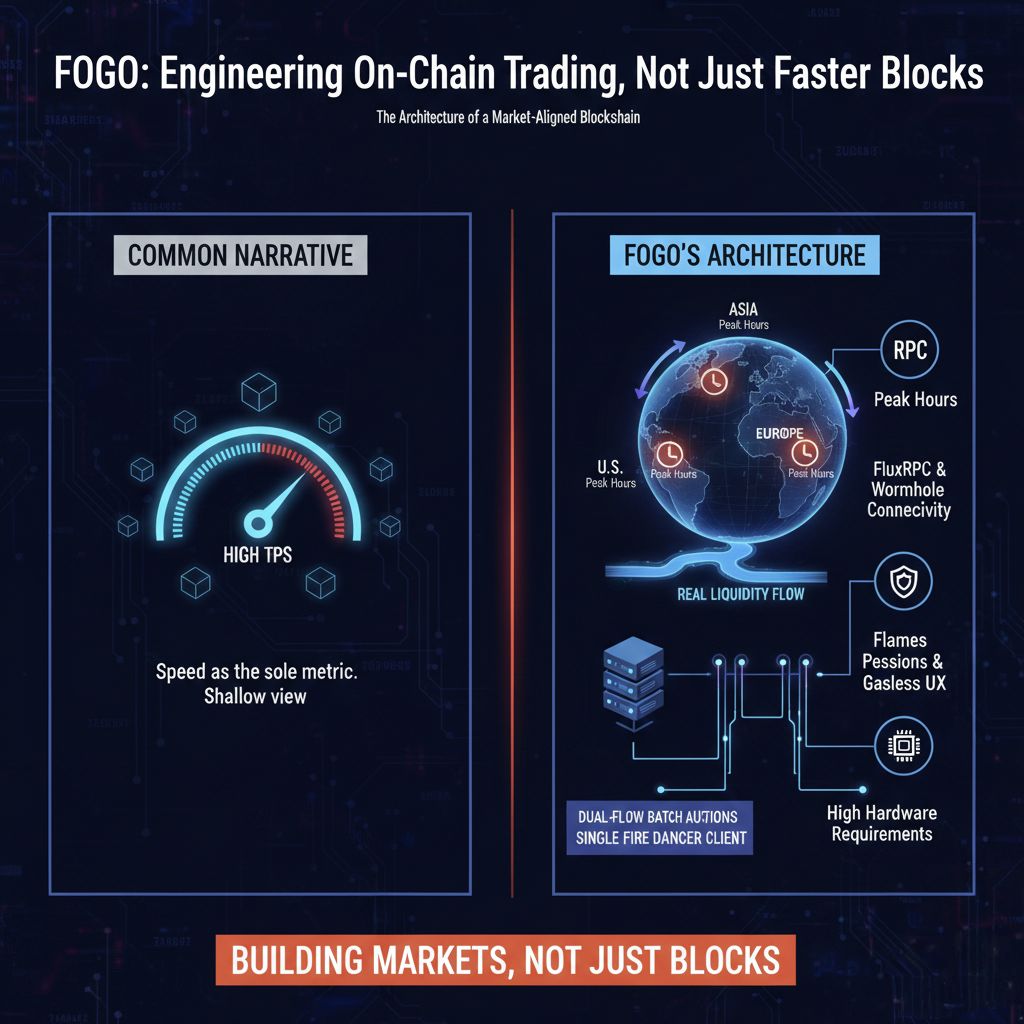
Cross-Chain Connectivity as a Core Layer
A trading-focused chain cannot be isolated. Capital must move quickly and predictably.
Fogo integrates a dedicated RPC layer (FluxRPC), bridges through Wormhole and the Portal Bridge, and provides visibility through Fogoscan. It also integrates with oracle infrastructure such as Pyth Lazer and indexing services like Goldsky.
This stack—RPC, bridges, oracle, explorer, indexing—forms an operational toolkit. Fogo is not presenting itself as a minimal base layer. It is assembling the components necessary for trading systems to function without constant improvisation.
The difference is subtle but meaningful: instead of saying “developers will build the tools,” Fogo bundles the tools as part of the infrastructure thesis.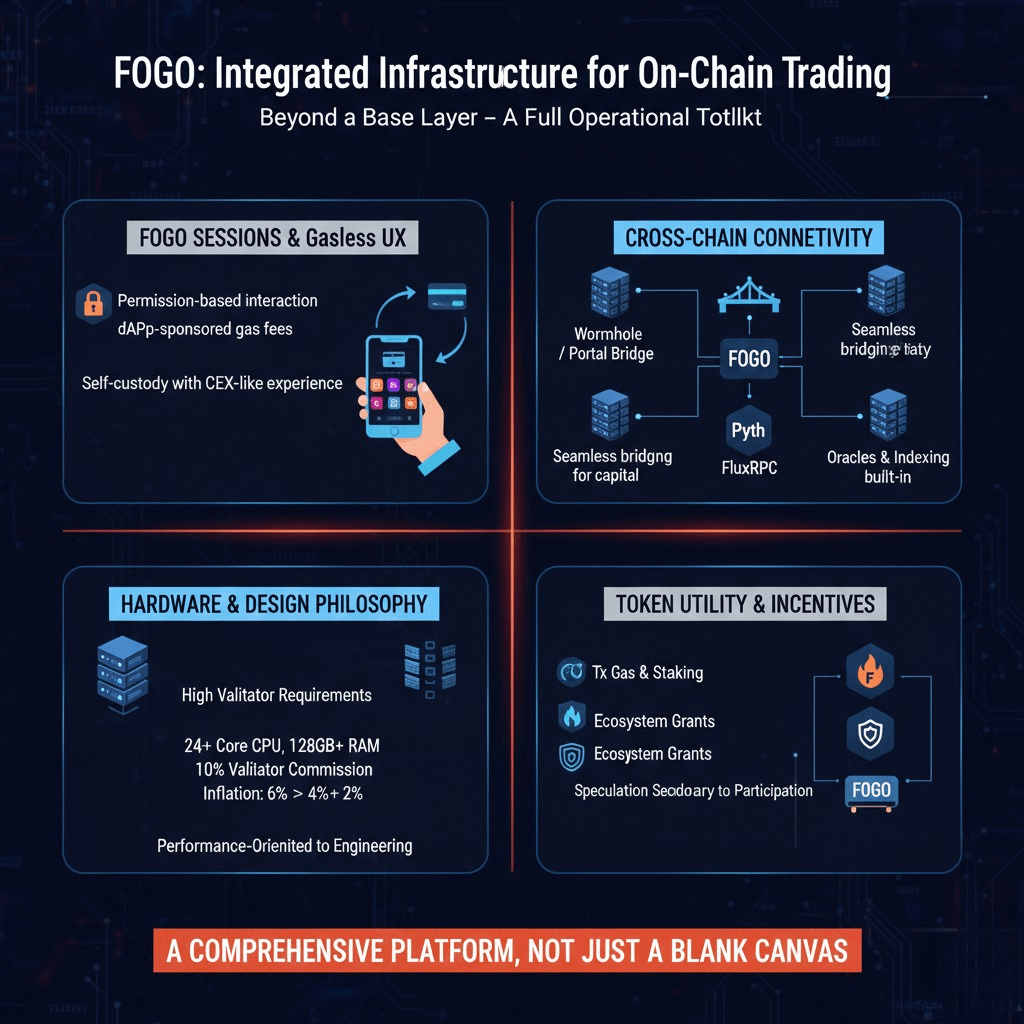
Hardware Requirements: Performance by Design
Fogo’s hardware requirements are high. A 24-core CPU, 128 GB RAM, and fast NVMe storage are considered minimum, with recommended configurations far above that. Validator commission is set at 10%, and inflation declines from 6% to 4% to 2% over time to balance incentives.
This design narrows participation in the early phase, and critics will argue that it consolidates control. That concern is valid. However, the trade-off is explicit: if the chain aims to support fast networking and heavy trading traffic, every validator must meet performance standards.
This is not ideological decentralization. It is performance-oriented engineering. Over time, the validator set may broaden, but the starting point prioritizes stability and throughput under stress.
Token Design and Incentives
The $FOGO token is not positioned purely as a speculative vehicle. It is used for gas, staking, and ecosystem grants. Validator rewards secure the network, and economic activity feeds back into token demand.
Fogo Flames, the points program, incentivizes user participation without directly promising token conversion. The ability to modify or halt the interface reduces regulatory and expectation risk. It is a behavioral layer rather than an implicit airdrop contract.
In this structure, speculation is secondary to participation. Whether that balance holds will depend on execution.
Risks and Responsible Usage
Fogo remains a young and evolving network. Client updates, infrastructure adjustments, and validator scaling may introduce volatility. The hardware-intensive validator model improves performance but reduces geographic and hardware diversity in early stages.
Bridging carries inherent risk across all DeFi ecosystems. Users should operate with limited-capital wallets, verify transactions through Fogoscan, and configure Sessions with clear limits rather than unlimited permissions.
Infrastructure ambition does not eliminate network risk. It simply reframes it.
Conclusion: A Different Objective
Fogo is not trying to win a TPS leaderboard. It appears to be trying to redesign on-chain trading around fairness, temporal alignment, and execution quality.
Follow-the-sun consensus aligns block production with global liquidity cycles. Dual-flow batch auctions reduce latency games and shift competition toward price discovery. High validator standards prioritize performance under load. Integrated tooling lowers operational friction.
This is not a hobbyist experiment. It is an attempt to treat a blockchain as trading infrastructure.
That ambition carries risk. It may prove difficult. But if on-chain markets are to compete seriously with professional environments, reliability and fairness will matter more than raw speed.
In that sense, Fogo’s speed is not the headline.
It is the side effect of engineering a chain for markets first.
