

@Fogo Official I’ve been watching a quiet change in Solana development talk: fewer arguments about “the Solana chain,” and more about “the Solana toolchain.” That distinction matters because it’s what makes Fogo feel timely. Fogo presents itself as an SVM-compatible network where I can keep the same everyday Solana workflow and just repoint the plumbing to a different RPC endpoint.
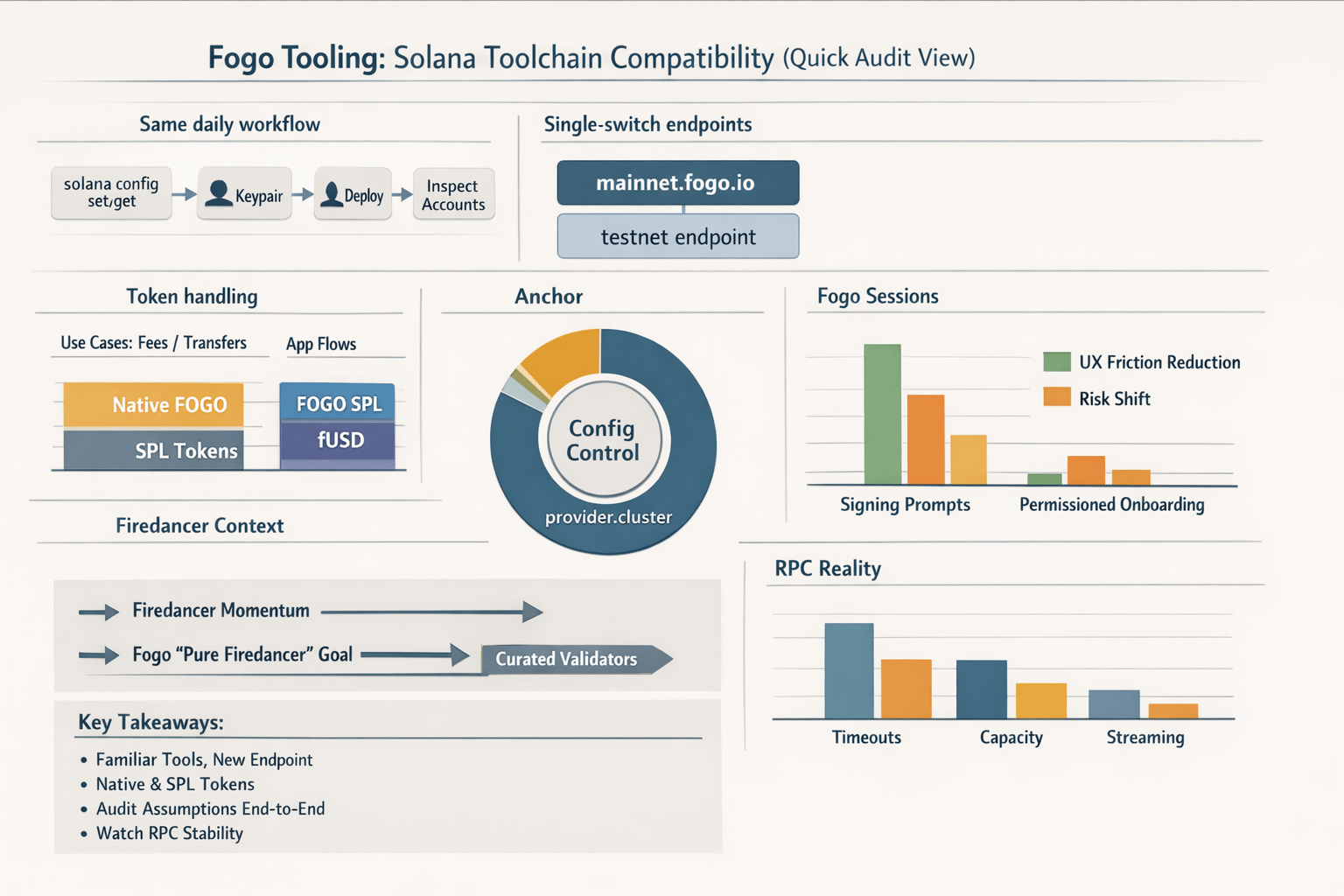
The reason it’s trending now isn’t only that a new chain exists. Jump Crypto’s Firedancer, a separate validator client written in C and built for throughput, has been treated as a looming upgrade for years, and the recent pace of updates has brought it back into practical discussions. Fogo leans into that moment, and earlier reporting described it as aiming to run “pure Firedancer” with a curated validator setup. I don’t take that as a promise; I take it as motivation to look closely at what “compatibility” means in day-to-day work.
When I skim Fogo’s docs, what I like is the lack of ceremony. The “Building on Fogo” guide basically says: if you can deploy a Solana program today, you can deploy it here without rewriting, because the execution layer is meant to match what your program expects. So instead of debating it, I’d rather run a small program, inspect accounts, and see whether the chain behaves the way my tools assume it will.
My starting point would still be the Solana CLI, because that’s where I validate the basics before I trust any higher-level framework. Fogo’s “Using Solana Tools” page has you set your CLI URL to mainnet.fogo.io, and from there the standard rhythm applies: check solana config get, confirm your keypair, deploy a program, and read the output. Solana’s own docs emphasize that config loop for a reason: most “mysterious” failures are really just the wrong cluster or wallet. The nice part is that on Fogo, the habit transfers cleanly. I don’t need a new mental model; I need new endpoints.
Token handling is where I expect people to stumble, mostly because “FOGO” can mean different things depending on context. Fogo runs a public testnet faucet and explicitly offers both native FOGO and SPL-token variants, plus an fUSD token. In practice, that means I keep two instincts separate. If I’m paying fees or doing the simplest transfer, I’ll think “native token.” If I’m building app flows, I’ll think “SPL token,” because that’s where Solana-style token accounts and standards are strongest. Fogo’s docs include mint addresses for their SPL tokens, which lets scripts be explicit instead of magical.
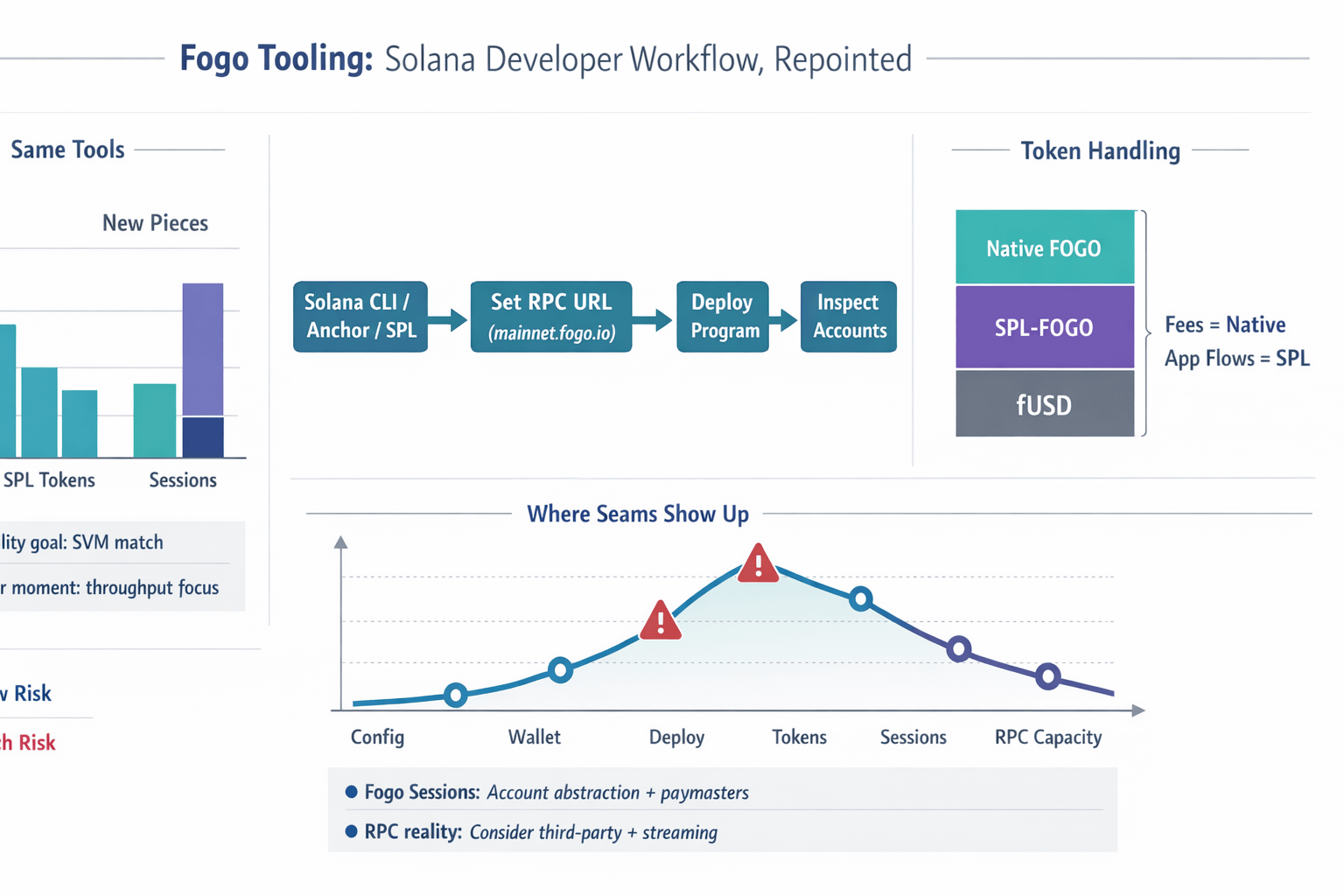
Anchor is the other big checkpoint. Fogo shows the provider cluster in Anchor.toml set to the Fogo RPC URL, then the same anchor build and anchor deploy commands you’d run anywhere else. Anchor’s reference docs reinforce that the provider section is the single switch that determines where commands run and which wallet pays, so once that’s correct, the rest of the workflow stays predictable.
The truly different piece is Fogo Sessions. Their documentation describes it as a chain primitive combining account abstraction and paymasters so users can interact with apps without signing each transaction or paying gas directly. I’m cautious here, because smoother UX often shifts risk somewhere else, and the docs acknowledge that some steps (like paymaster onboarding) are still permissioned. Still, it’s a useful signal about where SVM UX might be headed if more apps want to behave like trading interfaces instead of wallet demos.
If I had to summarize what “Fogo tooling” means, it’s this: I’m not learning a new toolset so much as stress-testing a familiar one in a new operational environment. Fogo Mainnet being live with a public RPC makes that possible today. The smart move, in my view, is to treat the first week as an audit of assumptions: deploy something small, trace it end-to-end, and watch where the seams show up.
One last thing I’d pay attention to is RPC reality. Fogo sponsors foundation RPC endpoints for testnet and mainnet, and it also acknowledges that serious apps may need third-party RPC capacity and features like streaming. If my app can’t survive a brief timeout, it’s not ready yet, no matter how elegant the program is.