


Early blockchain ecosystems often celebrate liquidity the moment it arrives. TVL climbs, dashboards look healthy, and discussions shift toward growth narratives. But history shows that raw liquidity alone doesn’t build durable networks. What matters much more is how efficiently that liquidity moves once it enters the system.
This is where FOGO is beginning to show something interesting.
The conversation around liquidity usually focuses on size — how much capital is sitting inside protocols. Yet capital that stays idle doesn’t strengthen an ecosystem. It only creates optics. Real strength appears when liquidity moves through different layers while maintaining its utility.
FOGO’s early structure increasingly reflects this idea.
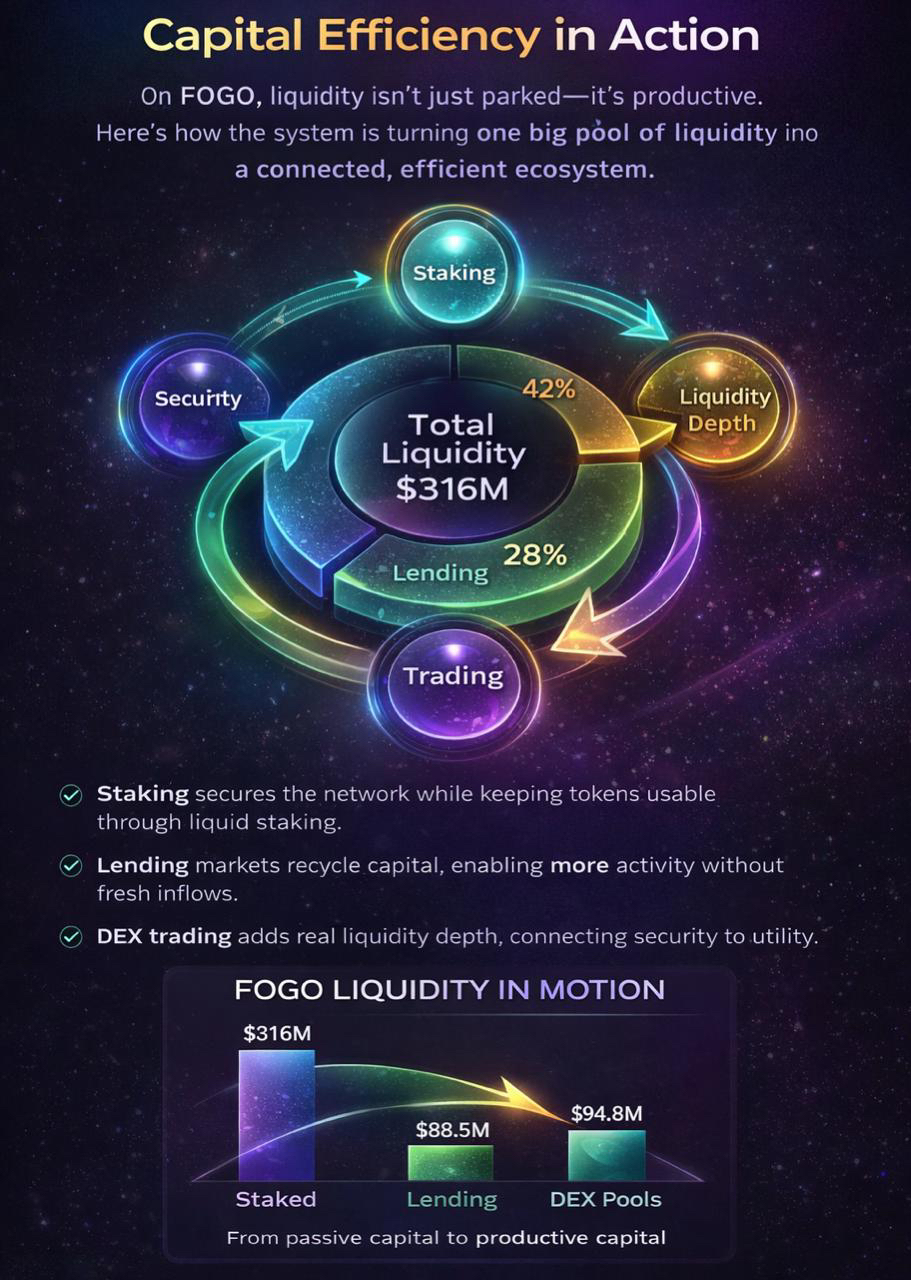
Tokens that enter staking don’t simply disappear into passive vaults. Through liquid staking mechanics, that same capital stays active. It secures consensus while remaining usable inside DeFi. Lending markets allow users to deploy it again. DEX pools create pricing depth. Each interaction adds another layer of efficiency rather than fragmenting liquidity.
That circulation changes the character of the network.
When capital can move without losing its role, ecosystems become more resilient. One action reinforces another. Staking strengthens validators. Lending creates demand. Trading supports liquidity depth. None of these activities exist in isolation. Together, they create an economic loop that can sustain itself beyond short-term incentives.
This is important because early ecosystems often struggle with fragmentation.
Liquidity spreads across too many protocols with little connection between them. Capital becomes trapped in isolated pools. Yield looks attractive for a short period, but once incentives fade, activity slows and depth disappears.
FOGO’s direction suggests a different trajectory.
Instead of separating security and utility, it links them. Capital supporting consensus can also support applications. That alignment improves capital efficiency, which quietly becomes one of the strongest long-term advantages any network can build.
Efficiency also influences behavior.
When users realize their capital can remain productive across multiple layers, they tend to stay longer. Participation shifts from chasing rewards toward optimizing strategy within the system. That shift turns users into long-term participants rather than short-term visitors.
Another overlooked effect is stability.
Capital that moves efficiently creates smoother market conditions. Liquidity depth reduces sharp price swings. Borrowing markets function more predictably. Slippage decreases. All of this builds confidence for larger participants who value reliability over speculation.
We’re still early in FOGO’s lifecycle, which makes these patterns even more meaningful. Structures formed during the early stages often define how a chain behaves years later.
If liquidity continues to circulate efficiently across staking, lending, and trading layers, FOGO’s growth won’t just be measured by bigger numbers. It will be measured by stronger economic cohesion.
And cohesion is where ecosystems mature.
Many networks focus on attracting capital. The next step is learning how to keep that capital productive. FOGO’s emerging design suggests it understands that distinction.
In the end, capital efficiency isn’t a headline metric. It doesn’t create instant hype. But it quietly determines whether liquidity becomes temporary fuel — or permanent infrastructure.
And right now, FOGO looks like it’s building for the second outcome.