
When you look at most blockchain projects, you see claims about speed, throughput, and "next-gen performance." FOGO absolutely has all of that sub-40 millisecond block times, SVM compatibility, and a trading-first execution layer but there's a deeper infrastructure truth emerging as the ecosystem matures that most observers aren't talking about yet. FOGO is quietly positioning itself not just as a fast chain, but as a complete financial infrastructure for real-time Web3 markets, with actual ecosystem activity, exchange integration, governance models, and community incentives now forming around it.
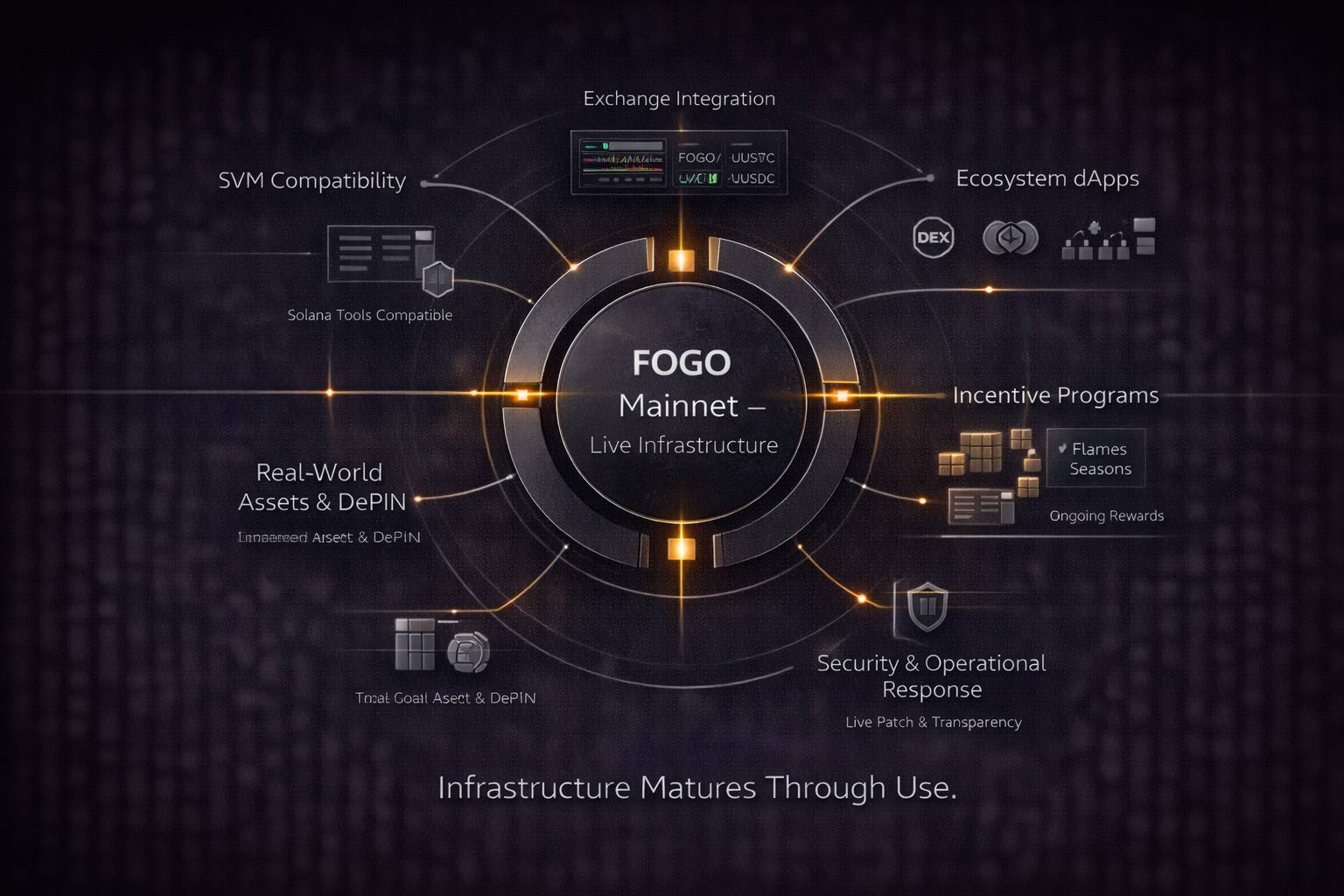
FOGO's mainnet launch on January 15, 2026 marked a transition from laboratory claims to real network behavior. It wasn't just a green light for block production it also meant live trading activity, ecosystem applications, and friction tests under real conditions. Apps like FogoFishing and ValiantTrade already stress-testing block times show that this is not theoretical infrastructure; it is being used. This matters because performance in isolation doesn't validate adoption; real usage does.
Another dimension that's only now becoming visible is FOGO's integration with major exchanges and what that means for liquidity and utility.
Beyond Speed: The Real Utility Is Reliable Execution Under Load
One reason this matters is the difference between "fast in ideal conditions" versus "fast when the network is busy." Most blockchains proclaim speed in benchmarks or testnets, but FOGO's architecture -- especially the geographic validator zone concept -- explicitly targets performance even when block production is under real load across users and apps. Validators are colocated to reduce physical latency, and consensus mechanisms are tuned to maintain tight timing even as transaction volume rises.
This plays into a structural advantage for on-chain derivatives, real-time auctions, and prediction markets -- applications that struggle on high-latency networks because delays introduce risk and inefficiencies. Now projects are deploying prediction markets in FOGO's ecosystem and testing how latency affects real user behavior. According to some ecosystem airdrop portals, testnet users can already participate in prediction market tests with simulated tokens, signaling early experimentation with more advanced financial primitives.
FOGO Flames and Community Participation -- A New Engagement Model
A less talked-about feature that reveals how FOGO is building ongoing engagement is the Fogo Flames program. Originally launched as a trader points program, it has now evolved into a multi-season incentive model where users can earn points ("Flames") by interacting with ecosystem dApps -- ranging from decentralized exchanges to liquidity deployments, lending markets, and more.
This is significant because it moves beyond the traditional single airdrop approach (which can feel like a one-off marketing event) and toward continuous participation incentives that drive ongoing activity across the network. The fact that hundreds of millions of FOGO are being distributed over weekly periods, and users can even earn referral bonuses for active participation, shows a shift from "claim and forget" to rewarded participation over time.
This multi-season design could be a new engagement model for chain ecosystems. Instead of relying solely on initial airdrop hype and then hoping for organic growth, FOGO is incentivizing real activity like liquidity provision, trading, staking, and referral growth. That's a narrative shift from giving tokens away to earning them through real network contribution.
Ecosystem Expansion and Risk Management -- Early Reality Check
With adoption comes scrutiny. Shortly after launch, a minor vulnerability was reported in the Flames EVM wallet, which the team disclosed proactively, committing to a fix within 24 hours. This kind of transparent vulnerability handling matters because as networks grow, security becomes more than a slogan -- it becomes a direct measure of trust. Real users -- especially institutions and builders -- pay attention to how a project handles issues, not just whether it claims to be secure.
Because FOGO has already triggered stress tests through real apps and ventures into early ecosystem tooling, the development community is closely watching how security practices and live patches unfold. This is a sign that FOGO is entering the operational maturity stage, where community trust is built not by marketing claims but by incident response and infrastructure reliability in real conditions.
The Broader SVM Ecosystem Is Becoming a Multi-Chain Landscape
The rise of FOGO also hints at a shift in the broader Solana Virtual Machine (SVM) ecosystem. Originally, many envisioned Solana as a single fast chain; now we see parallel high-performance chains emerging that are compatible with Solana tooling but specialized in different niches. FOGO's trading-centric design, combined with its ecosystem growth mechanisms, suggests an emerging multi-chain future within the SVM family where each chain differentiates not just by speed but by utility and economic design.
This means developers no longer ask: "Should we build on Solana?" The question becomes: "Which SVM-based chain fits our purpose -- trading, gaming, financial primitives, oracles, prediction markets, etc.?" FOGO is one of the first to define that question for institutional and high-frequency financial use cases.
Real-World Asset Tokenization and New Use Cases
Another emerging narrative is FOGO's potential role in real-world asset (RWA) tokenization and decentralized physical infrastructure networks (DePIN). According to some market analysis, FOGO's optimized performance and parallel execution capabilities make it a viable candidate for high-volume RWA settlement and time-sensitive DePIN contracts. This bridges not just digital finance but tokenized physical contracts, such as real estate payments or IoT-linked conditional agreements.
If that narrative materializes in practice -- with real assets settling at blockchain speed under programmable conditions -- it could be one of FOGO's most important value propositions. It would mean FOGO isn't competing solely within crypto markets; it's also positioning itself as a backbone for next-generation financial and contractual infrastructure.
Price Behavior, Volatility, and Market Psychology
FOGO's early trading tells a story worth dissecting. Initial listings on prominent exchanges brought volatility, which is expected. Trading volumes have seen periodic spikes tied to specific ecosystem campaigns and broader market sentiment, but the price action also reflects how markets absorb new supply, token unlocks, and liquidity provisions.
The token's price range and market cap (mid-eight figures as of February 2026) show that while FOGO is still early, it already exists in real trading ecosystems with real speculators, builders, and liquidity providers. Early unlocks and circulating supply dynamics make short-term price swings possible, but the deeper story is how those swings reflect structural behaviors rather than random hype loops.
My Thesis: FOGO's Value Will Be Defined by Real Usage, Not Headlines
If you strip away the buzz about "fastest blockchain ever," what remains is a set of narratives grounded in real ecosystem behavior: mainnet usage, exchange integration, security responsiveness, engagement programs, and emerging use cases like RWA and prediction markets. Performance is not irrelevant -- it underpins everything -- but it is no longer the whole story.
FOGO is transforming from a theoretical performance layer into a multi-purpose financial infrastructure designed for real market interaction, continuous participation, and risk-aware growth. Whether it turns into a long-term backbone for high-frequency Web3 applications will depend on sustained developer engagement, ecosystem diversity, and real world financial use cases that go beyond speed alone.