
Being a creator and trader, I have experimented months using the copy trading service offered by Binance.
This article talks about what copy trading is, why it is attractive to new and busy traders, recent features that Binance has introduced, and its effective utilization. I will take you through examples of calculations, fee and risk management and my personal guidelines of selecting a lead trader.
What is copy trading?
Copy trading allows you to copy the trades of an advanced trader. You do not make independent choices but, automatically, your account will mimic the buys and sells of a more experienced trader. Binance lists include traders whose information is on their performance, their risk level, and their trading history. You select a trader, select the amount of capital to deposit and the platform does the same trades on your account. It is not totally hands-off since you can decide when to stop copying, whether to increase or decrease your allocation, or even switch risk-setting.
Why people use it
To my mind, copy trading has four primary advantages:
1. Ease of entry
New traders will treat professionals as guides and watch them and their strategies, risk management, and implementation.
2. Time saving
Analysis and placement of order is automated and is hence appealing to busy people.
3. Diversification
You can also enter into several traders that have contrasting strategies to distribute the risk among various styles.
4. Automation and control
Although trades are replicated, you retain total control over parameters, like stop -loss levels and have the ability to stop copying at any point.
The copy trading is not a silver bullet. It has significant risks: even the expert traders lose; over-reliance can be formed by just following other people; and the performance can be lowered by selecting the wrong platform and trader. Perceive the concept of copy trading as a learning tool as opposed to an automatic source of profits.
Finding out about Binance copy trading functions
Binance introduced new spot copy trading instruments that enable the service to be more powerful and transparent. What stands out:
- Auto-Invest to copy trade
Schedule auto copy trades by dollar amount, frequency and percentage of stop loss. Your portfolio automatically updates avoiding missed trades and lack of consistency in entries.
- Lead Trader Comparison Tool
Compare several lead traders to each other, their ROI, win, profit-sharing ratio, copiers, most traded tokens and overall PnL. Make data‑driven decisions.
- Mock Spot Copy Trading
It is a risk free mode of simulation where you mimic traders using virtual money. Enter as many as ten imaginary portfolios, follow performance under Spot Overview, and with the touch of a button make a live portfolio out of a successful simulation
Suppose that a mock portfolio has earned +5 % PnL, Binance will reward you with 1 USDC
- Spot Failed Orders Tab
See the failed trade orders, the active and closed positions in every copy portfolio. This transparency allows diagnosing the non-execution of orders.
- Lead Trader Portfolios
Lead traders may open portfolios by invitation only, to a limited number of people who view the strategies. As a copywriter you can be invited to join a secret club with more profit-sharing conditions.
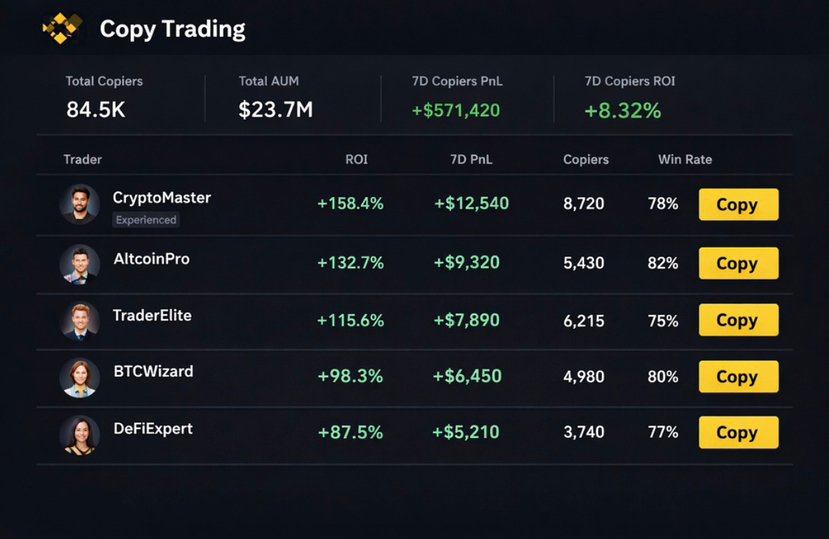
Conceptual representation of the Binance copy-trading dashboard. The dark interface has a list of lead traders including their 7-day PnL, ROI and risk, and includes quick-copy button. The following is a graphically explanatory representation of a Binance screenshot (not a real one)
These improvements indicate that Binance strives to make users have more control, transparency, and educative value. I especially love the comparison tool and simulated trading since it makes one think and learn without putting actual capital at risk.
Copy trading strategies: Fixed Ratio vs Fixed Amount.
In defining a portfolio, there are two manners of reflecting the orders: Fixed Ratio and Fixed Amount. The option will be a decision on how the system is going to compute the order sizes against the lead trader.
Fixed Ratio mode
Fixed Ratio mode proportional the size of your order to the size of the order of the lead trader. As an example, when a lead trader is holding 1,000 USDT and buys 500 USDT (50% of his holdings), and you choose to copy him, 250 USDT (50% of your holdings) will be allocated.
In the same manner, when the lead trader has 1 $BTC and sells 20 percent (0.2)BTC and you have 0.6BTC, the system will sell 20 percent of your (0.12) BTC. Due to the proportionality of the orders, slippage/partial fills may reduce the actual size slightly. Fixed Ratio: Use Fixed Ratio when it is desired to replicate the weightings of the trader as opposed to fixed dollar amounts.
Fixed Amount mode
Fixed Amount mode requires a cost per order and a fixed amount to invest. Simply put, when you have a cost per order of 20 USDT and a total amount allocated of 60 USDT, the system will duplicate the new order 20 times up to the point where your 60USDT is spent (three orders in this instance). On sell side, when a lead trader sells 20% of his 1BTC position, you have invested 0.6BTC, the system will sell you 0.12BTC (20%). Fixed Amount Select when you want specific dollar values on orders and have a more detailed exposure control.
It has a minimum balance requirement 10USDT to open a Fixed Amount portfolio and 100USDT to open a Fixed Ratio portfolio and can copy a maximum of ten portfolios at the same time.
Copy trading charges and share in profits
Binance Spot Copy Trading has a profit-sharing platform. You are a copy trader and you have to pay a lead trader 10% of the profits of copy trades and 10% of your trading fee. Settlement is weekly. The profit share and commission is recorded and the system distributes the profits and commission before the end of Monday. Profit shares are issued on the ceasing of copying, when the lead trader on your portfolio closes up or on withdrawal of profits. These fees should be considered when you are determining your net returns particularly when you follow traders who make high turnover.
How to copy trade in Binance (an example): Step-by-step.
Copy trading is not a process of clicking on the copy button and watching your money growing; you have to prepare your account and risk management. This is my usual process of establishing a new portfolio.
1. Sign up and fund your account
When you are new on Binance, it is necessary to register, verify identity, and then add money.
2. Click on the Copying Trading
In the Trade menu, there is a section of Copy Trading where one can select either Spot or Futures. The dashboard displays lead traders that include all the necessary statistics, such as the history of their performance, the level of their risks, and the strategy of their trading.
3. Select a lead trader
I rely on the comparison tool to evaluate ROI, win rate, profit sharing ratio, number of copiers and most traded tokens. I will also examine the drawdowns of the trader and seek a steady track record as opposed to high returns that are not even.
4. Select the copying option and parameters
Choose Fixed Ratio or Fixed Amount and then choose your allocation, stop-loss limit, maximum slippage and your personal preference of the pairs. I frequently use Fixed Ratio mode I at first allocate a small part of my portfolio in Fixed Amount mode I at first set my cost per order (e.g., 20USDT) low to have a test of the trader.
5. Profits sharing and review fees
Do not forget 10% profit share and 10% commission; be sure your projected profits are worth such expenses.
6. Monitor and adjust
Copy trading is not a load and leave kind of strategy. I just pick my copied trades periodically, evaluate their PnL, and either change my allocation or stop copying when the performance becomes poor. I also diversify by investing with several traders to have a risk spread.
7. Trade on mock during uncertainty
I use Mock Spot Copy Trading to practice trades using imaginary money when I desire to test a new strategy or lead trader. In the case where the mock portfolio does well, I transform it into a live account.
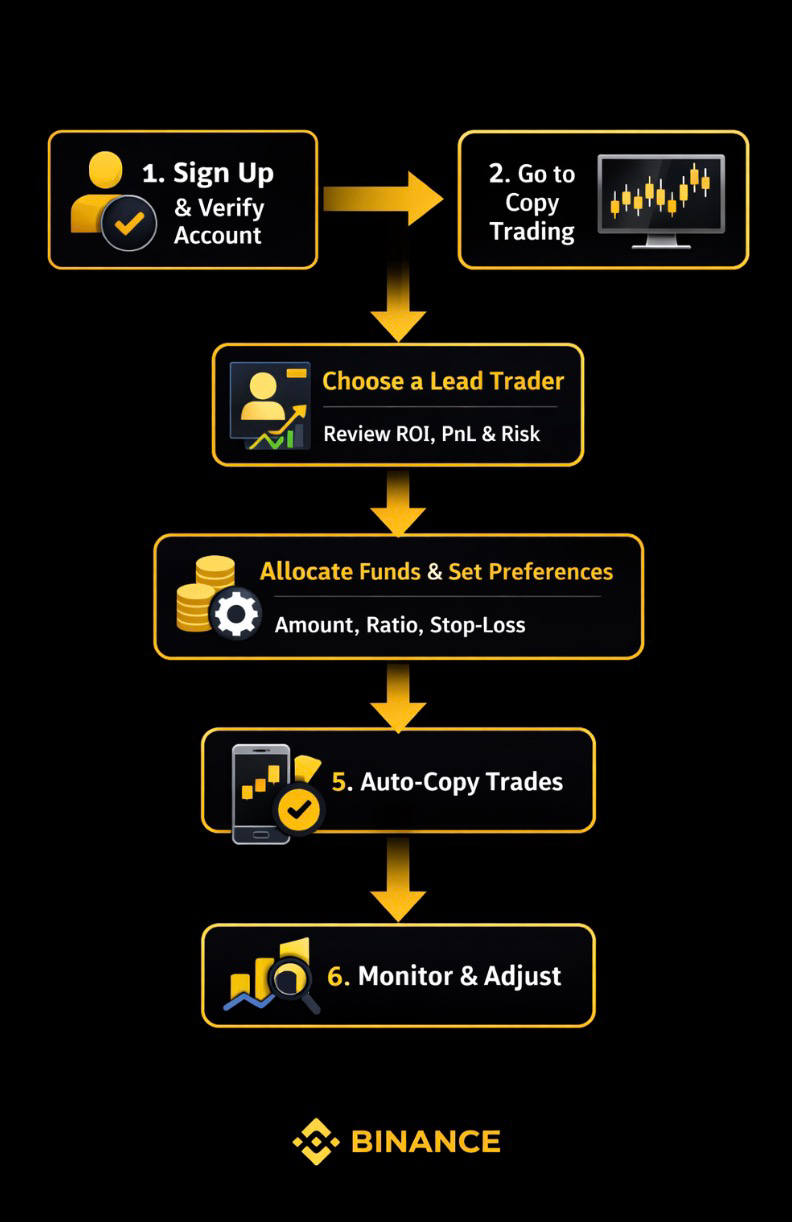
Flowchart Overview of the copy-trading process. It underlines the process which I undertake: it includes signing up, going to the copy-trading area, then choosing a lead trader, making a deposit and customization, letting the trades run automatically and tracking the portfolio. This can be used as a guide when creating your own copy portfolio.
Example calculation
Consider a scenario (where 500 USDT is given to me to use in copy trading) that I choose to invest in a lead trader with 1000 USDT and I request him to buy 500 USDT (half of the capital) of a stock.
Under Fixed Ratio mode the system orders 250 USDT (50 percent of my allocation). When the trader then sells 20 per cent of his 1 BTC, the system will sell 0.12 BTC of my 0.6 BTC.
In Fixed Amount mode, when I have the cost per order rate as 20 USDT and 60 USDT as the total allocation, the system would run three different 20 USDT orders. Once those orders are filled, that is, no more trades are replicated until I upsize my allocation. This is a capped approach to exposure and is suitable during the testing of new lead traders.
How I select a lead trader
The most crucial decision is the right choice of the lead trader. I have my own checklist that consists of:
1- Consistent ROI and win rate
I will use traders that have moderate, consistent returns over those with large, random returns and large losses.
2- Reasonable percentage ratio in profit sharing
Majority of lead traders charge 10 percent of profits; do not pay huge amounts of money to managers or ones who require huge portions of the profits.
3- Risk metrics
I consider maximum drawdown (MDD), Sharpe ratio and PnL volatility of the trader. High ROI and high MDD is associated with greater risk.
4- Liquidity and trading strategy
Comparing to liquid pairs (BTC/USDT, ETH/USDT), which are more frequently trade by lead traders, it is simpler to copy them due to quick filling of orders. I am not attracted to deal with traders who sell illiquid tokens with micro-cap that may result to slip or order discontinuation.
5- Communication and transparency
Lead traders that communicate to their followers whether they change strategies or what they expect in the market keep me posted. The new failed-orders tab also assists in the measurement of the quality of the execution.
I will never have more than 20 per cent of my portfolio with one lead trader. The lack of concentration in strategies (trend following, arbitrage, grid trading, etc.) helps to mitigate the effects of errors of a single trader.
Simulating copy trading by mocking a copy trader
Mock Spot Copy Trading comes in handy in case you are new to copy trading, or trying a new lead trader. It allows you to simulate premiums using virtual money, track up to ten lead traders, and track real-time performance without risking money. I have been able to test out various allocation procedures and stop-loss configurations with it. It is important to remember that the kind of profit that is realised in mock portfolios do not translate into actual gains, but the learning experience is priceless.
WRAPPING IT UP
The copy-trading platform by Binance is now at a more advanced stage of its development, as it provides the tools that can suit both the novice and the seasoned traders. The automation of trade execution combined with the ability to have control over allocation, stop-loss and slippage follows a balance by being convenient yet providing risk management. The Auto-Invest feature, comparison tool, and mock mode of trading allow learning and choosing the appropriate lead traders. But, the copy trading is not without risks: the losses might be made, the commissions will lower the income, and the excessive dependence on others can be expensive. Trade in copy, trade in a variety of strategies, and have a regular check on your portfolios. A well-understood and disciplined copy trading could be a useful addition to your crypto arsenal.