
Fogo caught my attention not because of loud announcements, but because of how it approaches a simple question: what if a blockchain was built specifically for execution efficiency instead of trying to be everything at once? After spending time reading through how it works and following updates from @Fogo Official , I’ve started to see it less as another Layer 1 and more as an attempt to refine a very specific part of the stack.
At its core, Fogo is built around the Solana Virtual Machine. That matters because SVM has already proven that parallel execution can dramatically increase throughput when designed properly. Instead of reinventing the environment developers are used to, Fogo leans into compatibility. Developers who understand Solana’s tooling can work within a familiar structure. That lowers friction. It also means the chain doesn’t have to convince builders to learn something completely new just to experiment.
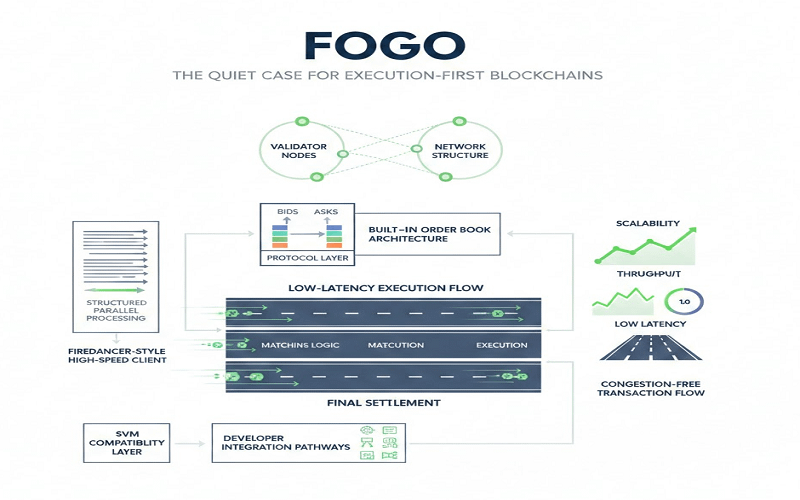
The central idea behind Fogo is execution consistency. Many general-purpose blockchains aim to support every type of application equally. In practice, that often creates congestion. When NFT minting spikes, trading slows down. When one DeFi protocol grows rapidly, everything competes for block space. Fogo approaches this differently. It is trading-native in its architecture.
Think of execution layers like highways. On most blockchains, every type of traffic shares the same road. Trucks, motorcycles, emergency vehicles, all merging at once. Fogo tries to design lanes specifically for high-frequency trading style applications, where latency and predictable ordering matter. Built-in order book integration plays a role here. Instead of forcing decentralized exchanges to simulate order books through smart contracts alone, the architecture considers market structure at a lower level. That reduces overhead and shortens the path between intent and settlement.
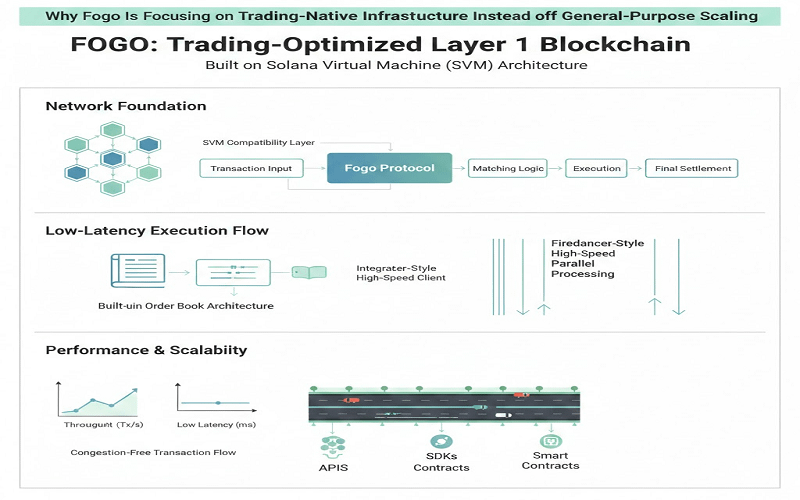
This is also where its performance philosophy comes in. The client architecture draws inspiration from Firedancer-style designs, which focus on optimized networking and parallel processing. The idea is not just high peak throughput, but stable throughput. Markets do not only care about maximum transactions per second. They care about how the system behaves when activity spikes. Consistency during volatility matters more than headline numbers.
Today, while watching broader crypto markets fluctuate and seeing liquidity rotate between ecosystems, I noticed how narratives shift quickly. Speed and scalability are always discussed, but rarely in terms of market microstructure. Fogo, and by extension $FOGO , seems positioned around that narrower question: how do we make trading infrastructure more efficient at the base layer instead of patching it at the application layer?
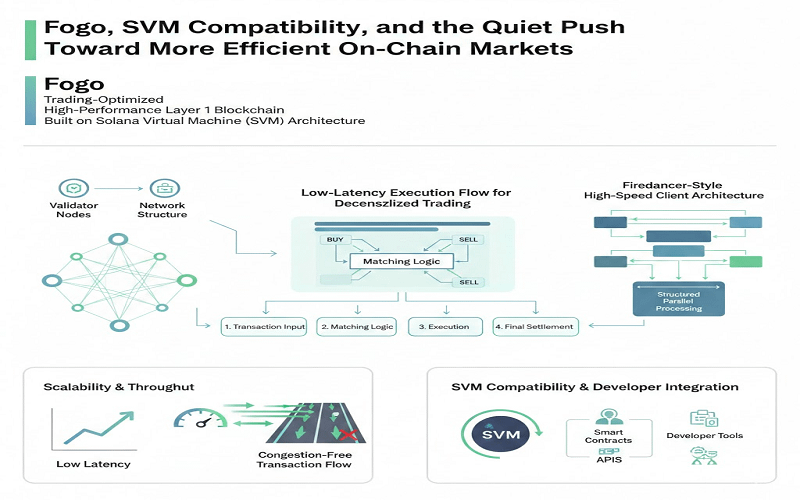
Of course, the limitations are clear. Competition among SVM-based chains is increasing. Being compatible with Solana’s virtual machine is both an advantage and a challenge. It lowers the barrier to entry, but it also means standing out requires more than raw speed. Validator decentralization is another area to watch. High-performance systems sometimes require stronger hardware assumptions, which can narrow validator participation. That balance between performance and decentralization is not trivial.
Ecosystem maturity is also a factor. A chain designed for trading efficiency still needs liquidity, integrations, and real usage to prove its model. Architecture alone does not create activity. Over time, adoption will likely depend on whether projects see measurable improvements in execution reliability compared to other SVM environments.
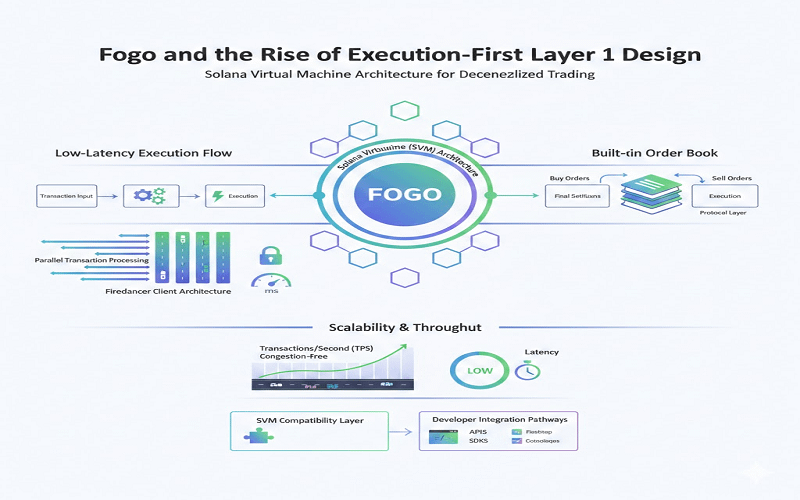
What I find interesting about #Fogo is that it does not try to redefine blockchain ideology. It narrows the focus to execution and market structure. In a space where many projects expand outward, Fogo contracts inward, refining one specific layer. Sometimes specialization is quieter than ambition, but it can be just as meaningful.
After following #fogo discussions and reviewing how $FOGO fits into this framework, I’m left thinking less about price and more about infrastructure design. The market tends to chase narratives quickly, but underlying architecture usually reveals its value slowly.