

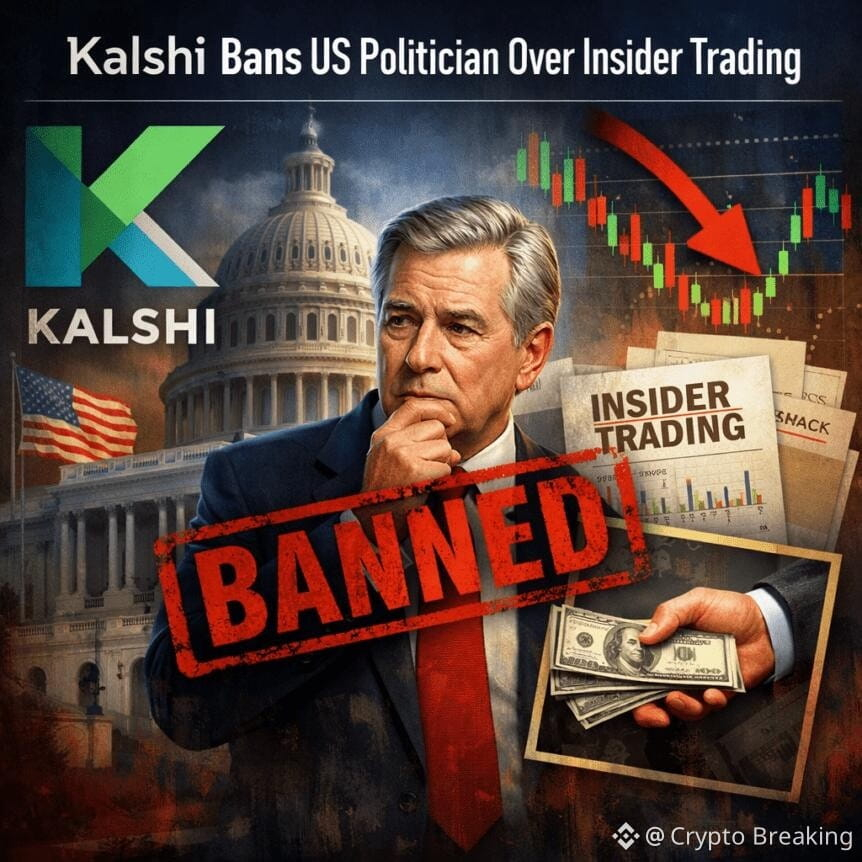
A regulatory spotlight has intensified around prediction markets after Kalshi, a Commodity Futures Trading Commission-regulated platform, banned a high-profile political candidate for trading on his own candidacy. The case underscores how even modest bets on real-world outcomes can trigger fast discipline when they intersect with insider-trading rules, and it comes as lawmakers and agencies sharpen their focus on the speculative-use cases that have quietly grown alongside the crypto ecosystem.
Key takeaways
Kalshi issued a five-year ban plus a $2,000 penalty after a former California gubernatorial candidate wagered on his own bid and publicized the action on social media, violating platform rules.
The politician’s actions align with reports that the description matches Kyle Langford, who has shifted from a Republican to a Democrat run for California’s 26th Congressional District; Kalshi noted he is no longer seeking the governorship and is pursuing Congress instead.
In a May 25, 2025 X post, Langford showed a Kalshi bet of $98.76 on the odds of his victory, a detail Kalshi disclosed as part of the enforcement case and the public record surrounding the incident.
Separately, a YouTube editor—widely reported as Artem Kaptur of MrBeast notoriety—tolerated a roughly $4,000 accumulation on YouTube stream markets between August and September 2025, resulting in a two-year penalty and about $20,000 in fines for insider-trading violations.
Kalshi has signaled a broader crackdown, stating it has investigated around 200 cases, frozen several flagged accounts, and now operates with a surveillance audit committee and a partnership with Solidus Labs to detect market abuse as prediction markets scale.
Market context: Kalshi’s enforcement actions occur as prediction markets move toward greater mainstream participation and face intensified regulatory scrutiny. The company has pointed to internal surveillance capabilities and industry collaboration to curb abuse, while lawmakers have floated bills to curb insider trading among government insiders on these venues. The evolving framework aims to balance innovation with investor protection in markets that resemble, in some respects, both traditional trading and decentralized crypto ecosystems.
Why it matters
For traders and ordinary users, the Kalshi cases emphasize a core truth of prediction markets: information asymmetry and improper access carry legal risk. When a participant leverages privileged information—whether real-time, non-public data or an enhanced awareness of an opponent’s strategy—the odds of a fair outcome are eroded. Kalshi’s enforcement actions demonstrate that even seemingly modest bets can become substantial violations if they breach platform rules or disclosures, and they highlight the tension between the novelty of prediction markets and established securities-like expectations of fairness and compliance.
The enforcement framework also signals to other platforms that regulators and market monitors will pursue insider-trading and market-manipulation cases with visible penalties. Kalshi’s public disclosures about the Langford case and the YouTube-creator episode reveal a broader ambition: to deter participants from exploiting private information or unusual access to information channels, whether through social media disclosures, behind-the-scenes connections, or content-driven data streams. The platform’s stance can be read as a commitment to strict governance as prediction markets integrate with mainstream media, political events, and high-profile personalities.
From a policy perspective, the incidents sit at an intersection of financial-market integrity and digital-age governance. The industry has long argued that prediction markets offer useful foresight on real-world events, yet skeptics warn about the potential for manipulation and the overhang of regulatory risk. The Kalshi actions echo broader conversations in Washington about how to supervise new betting formats that blend real-world outcomes with digital platforms, while ensuring that insiders do not gain unfair advantage or profit from information unavailable to the broader public.
Beyond Kalshi, the regulatory mood has grown louder. Congressional discussions and CFTC-led efforts point to a growing taxonomy of enforcement priorities—insider trading, information leakage, and market abuse—that now extend to online prediction platforms with real-money stakes. In parallel, related coverage around Polymarket and other venues has amplified calls for clear guardrails, while public officials outline steps to harmonize the rules with ongoing crypto-market developments. The tension between innovation and accountability remains central to the evolving narrative around prediction markets and crypto-linked financial ecosystems.
In this environment, enforcement actions that surface publicly—such as the Langford-related ban and the YouTube-creator incident—serve as high-profile reminders for participants to treat prediction-market markets with the seriousness they deserve. Kalshi’s leadership has framed these cases as part of a broader discipline strategy, noting that its surveillance apparatus, governance enhancements, and third-party partnerships are designed to identify, investigate, and address market abuse before it becomes systemic.
What to watch next
Follow Kalshi’s ongoing enforcement docket for new cases and the status of active investigations, including any additional penalties or account suspensions.
Monitor the CFTC’s predicted shift toward formal advisory collaboration with industry players on prediction-market integrity and insider-trading enforcement.
Watch for any legislative developments in the United States that would constrain or guide insider trading in prediction markets, especially in relation to government insiders.
Track updates on the Kalshi-surveillance partnership with Solidus Labs and how their joint framework shapes market abuse detection across listings and events.
Observe related coverage around high-profile figures and content creators involved in prediction-market activities, including how platforms handle disclosures and potential MNPI issues.
Sources & verification
Kalshi’s enforcement case page documenting the governance action and penalties tied to the California candidate case.
Public X posts by Kyle Langford referencing his Kalshi bet and candidacy status.
Reports surrounding Artem Kaptur and the YouTube-stream-market enforcement action, including Kalshi’s disclosures and penalties.
Kalshi’s statements on expanding surveillance and partnering with Solidus Labs to address market abuse.
CFTC leadership statements and the establishment of a prediction markets advisory to coordinate enforcement efforts.
Kalshi enforcement actions highlight insider-trading risk in prediction markets
A political candidacy became the focal point for a broader discussion about market integrity after Kalshi announced a five-year ban and a $2,000 penalty on a former California gubernatorial hopeful who bet on his own bid and publicized it on X. The company said the individual placed a wager of about $200 on his candidacy, and Kalshi emphasized that the account did not generate profits from the trade. The public references tied to this case align with a broader pattern in which prediction-market platforms maintain strict prohibitions against insider trading, and violations are met with tangible penalties and disqualification from the platform.
The athlete-candidate narrative quickly shifted to a widely discussed possible match to Kyle Langford, who has since pivoted to a bid for California’s 26th Congressional District. Kalshi confirmed that the description fits Langford, noting he is no longer pursuing the governorship and has turned his ambitions toward Congress. A May 25, 2025 post on X shows Langford sharing a video of himself placing the Kalshi bet—specifically $98.76 on the odds of victory. Kalshi stated that this account did not withdraw profits, and the case was reported to the CFTC for further review. The company’s decision to publicize the enforcement action underscores its commitment to transparency in maintaining a level playing field for all users.
In a separate enforcement action that drew public attention, Kalshi flagged a YouTube editor for insider-trading-like activity across YouTube stream markets during August and September 2025. The editor traded approximately $4,000 on Kalshi markets in ways that violated Kalshi’s internal rules, resulting in a two-year penalty and roughly $20,000 in fines. The platform described the trading as statistically anomalous, pointing to an unusually high success rate on markets with low odds. Kalshi’s investigators concluded that the individual likely had access to material non-public information, though the specific identity was not disclosed in the company’s public release. The coverage in mainstream media has widely identified the implicated party as Artem Kaptur, a member of MrBeast’s team, highlighting how public content creators can intersect with financial-market activity in novel ways.
Kalshi’s broader enforcement program is not limited to these cases; the platform has publicly disclosed investigations into around 200 cases and has frozen several flagged accounts. Earlier in the month, Kalshi announced the creation of a surveillance-audit committee and a collaboration with Solidus Labs to bolster its ability to detect market abuse and insider trading across its prediction markets. The aim is to raise the bar for governance, promote integrity, and deter would-be insiders from exploiting information asymmetries for personal gain as these markets continue to attract participation from a broader audience, including institutions and highly-visible public figures.
The intensified regulatory posture surrounding prediction markets is also reflected in political developments. US lawmakers introduced a bill aimed at curbing trading by government insiders after a Polymarket user earned more than $400,000 on bets tied to Venezuelan President Nicolás Maduro—trades executed hours before U.S. authorities captured Maduro in Caracas. In response, the CFTC chair signaled that the agency would not hesitate to pursue violators, stating that a new advisory group would work with industry participants to identify and address insider trading in prediction markets. The combined signal from Kalshi, policymakers, and regulators suggests a turning point for how these markets are policed as they move from niche experiments to potential mainstream financial instruments.
As this environment evolves, the line between innovation and enforcement becomes more pronounced. Kalshi’s actions, the high-profile cases, and the regulatory dialogue reflect a broader industry shift toward more robust surveillance, clearer governance, and stricter penalties for those who undermine market integrity. For users, developers, and participants in the growing ecosystem around event-based markets, these developments serve as a reminder to prioritize compliance, transparency, and responsible trading practices—an essential framework if prediction markets are to achieve scalable trust and sustainable growth.
This article was originally published as Kalshi Bans US Politician Over Insider Trading on Crypto Breaking News – your trusted source for crypto news, Bitcoin news, and blockchain updates.