
Not marketing slides.
Not theoretical TPS.
Actual third-party data.
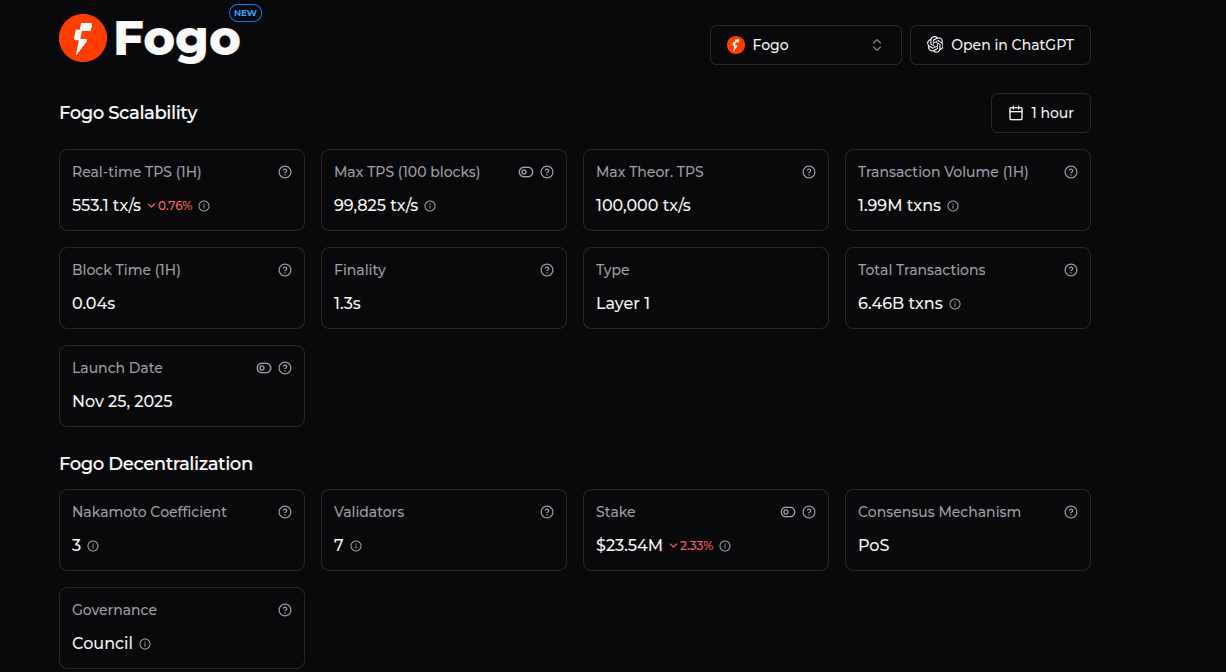
According to public analytics platform Chainspect (which tracks live performance metrics like TPS, block times, and finality across dozens of chains), @Fogo Official recorded a peak of 99,825 transactions per second on mainnet.
That’s not a whitepaper number.
That’s observed throughput during a live spike.
Here’s what the data shows:
• Peak TPS recorded: 99,825
• Average block time: ~40 milliseconds (blocks produced every 0.04s)
• Finality: ~1.3 seconds (meaning transactions become irreversible in just over a second)
For context, peak TPS means the highest burst the network handled over a short window (like the max across 100 blocks). It doesn’t mean the chain runs at 99k TPS all day. Typical activity is much lower often in the hundreds, similar to other high-performance chains like Solana or ICP.
But here’s why it matters.
Fogo is a Layer 1 built to be SVM-compatible, meaning it runs the same environment as Solana. That makes it optimized for low-latency use cases especially on-chain trading and financial apps where speed actually affects outcomes.
Holding the #1 spot on Chainspect’s throughput ranking (based on observed peak TPS) since mainnet launch shows one thing clearly:
When pushed, the network can scale.
And in trading environments, bursts are what matter most.
Volatility doesn’t warn you before it arrives.
Important to note:
Peak TPS numbers fluctuate depending on network load and testing conditions. They show capacity, not constant everyday usage.
But capacity during stress?
That’s what defines performance ceilings.
The real question isn’t “Can it hit 99k TPS all day?”
It’s:
When volatility hits and everyone rushes in at once…
can the chain handle it?
That’s the part that actually counts.