As blockchain ecosystems mature, the limits of execution focused scaling are becoming more visible. Transactions can be processed faster, fees can be reduced, and throughput can improve, but data does not disappear. Every interaction generates state, metadata, and historical context that applications depend on long after execution finishes. Walrus exists because this data problem grows quietly until it becomes impossible to ignore.
Walrus is not designed as a general storage marketplace or a permanent archive. It is built as decentralized storage infrastructure meant to support applications that continuously generate and update data. This distinction matters. Many early Web3 applications relied on centralized cloud services to store user state, metadata, and assets while using blockchains only for settlement. That approach scales quickly but compromises decentralization and censorship resistance.
By anchoring its design to Sui, Walrus aligns storage with an execution environment optimized for parallelism and object based state management. Sui allows independent objects to be updated without forcing every interaction through global consensus. Walrus uses this model to track storage references and ownership efficiently, avoiding the performance bottlenecks that storage heavy interactions can create on traditional blockchains.
From a systems perspective, Walrus separates responsibility clearly. The blockchain handles verification, permissions, and payments. The storage network handles encrypted data distribution and availability. This separation reduces long term state bloat while maintaining strong guarantees around data integrity. It also reflects how modern distributed systems are built outside of crypto, where control planes and data planes are intentionally distinct.
One of the most important technical decisions behind Walrus is the use of erasure coding rather than full data replication. Data is divided into fragments that are distributed across independent nodes. Recovery remains possible even if some fragments are unavailable. This reduces storage overhead while preserving fault tolerance. It is not designed for perfect conditions. It is designed for realistic network behavior where nodes can fail or disconnect.
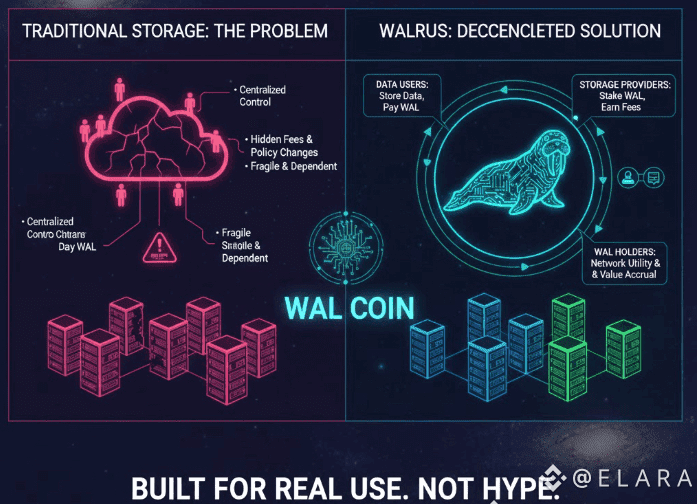
The WAL token is integrated directly into this infrastructure. Storage costs are paid using WAL. Node operators are incentivized to maintain availability and reliability. Penalties enforce commitments. This creates an economic system where reliability is rewarded and failure is discouraged. WAL derives relevance from usage rather than governance narratives.
Walrus also fits naturally into broader discussions around modular blockchain architecture. Execution layers handle logic. Storage layers handle persistence. Data availability and verification are treated as separate concerns. This mirrors trends seen across Web3 as systems grow more complex and specialized.
As applications become more interactive and data heavy, decentralized storage stops being optional. Walrus is designed for that phase of adoption, not the experimental phase. That makes it quieter than many projects, but also more durable as infrastructure.