
On January 11, 2009, the first Bitcoin transaction was sent to Hal Finney (an early user) from Satoshi Nakamoto (the original inventor), officially creating a peer-to-peer network:
- Follow our account @DrZayed for the latest crypto news.
The story of the first Bitcoin transaction is not merely a footnote in financial history; it is a narrative of intellectual curiosity, unwavering optimism, and the quiet birth of a revolution. On January 11, 2009, a simple transfer of ten digital tokens occurred between two people who, at the time, were the only active participants in a network that would eventually change the global perception of money. One was the mysterious creator, Satoshi Nakamoto, and the other was a brilliant developer and legendary cypherpunk named Hal Finney.
To understand the weight of that first transaction, one must first look at the world into which Bitcoin was born. The late 2000s were defined by the Great Financial Crisis. Trust in centralized institutions was at an all-time low. It was against this backdrop that Satoshi Nakamoto released the Bitcoin whitepaper in late 2008, proposing a system that allowed for electronic payments without a middleman. While many in the cryptography community were skeptical—having seen dozens of digital cash attempts fail over previous decades—Hal Finney was different. He saw the spark of genius in Satoshi’s code.
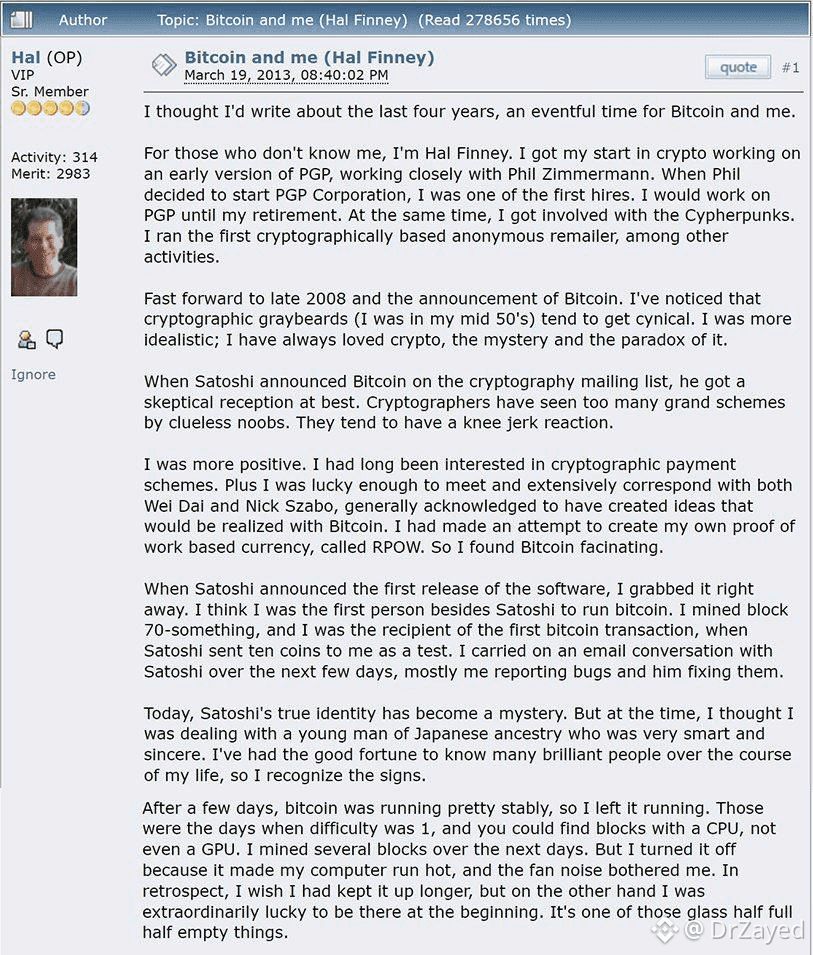
Hal Finney was no stranger to the world of privacy and cryptography. He had been a lead developer at PGP Corporation, working on the world’s most widely used email encryption software. He was a regular on the Cypherpunks mailing list, a group of activists and programmers who believed that strong cryptography was the key to personal liberty in the digital age. When Satoshi announced the release of the Bitcoin software on January 9, 2009, Hal was the first person outside of Satoshi to download it and begin running the code.
On January 11, Satoshi sent Hal ten bitcoins as a test. This was recorded in Block 170 of the Bitcoin blockchain. It was the moment that peer-to-peer digital cash transitioned from a theoretical paper to a functioning reality. In the years following that moment, Hal would write a moving and inspiring account of those early days, a story he titled Bitcoin and Me. His perspective offers a rare, human glimpse into the nascent stages of a technology that is now worth trillions of dollars.
Hal recalled that when Satoshi first announced the software, he was immediately fascinated. He had previously experimented with his own digital currency ideas, such as Reusable Proofs of Work (RPOW), and he recognized that Satoshi had solved the double-spending problem—the holy grail of digital cash—that had stumped others for years. Hal described Satoshi as a brilliant but elusive figure. Their interactions were strictly professional and conducted via email. Satoshi was the master architect, and Hal was the eager apprentice, identifying bugs and suggesting improvements in those first few days.
In his account, Hal noted how lonely the network felt at the beginning. For a brief period, he and Satoshi were essentially the only two people mining. Hal’s computer, which was quite powerful for its time, was generating several blocks an hour. At that point, Bitcoin had no market value; the coins were literally worth zero. For Hal, the motivation wasn't profit. It was the pure, intellectual joy of seeing a beautiful system function as intended. He famously tweeted "Running bitcoin" on January 11, 2009, a two-word message that has since become a sacred relic in the history of the internet.
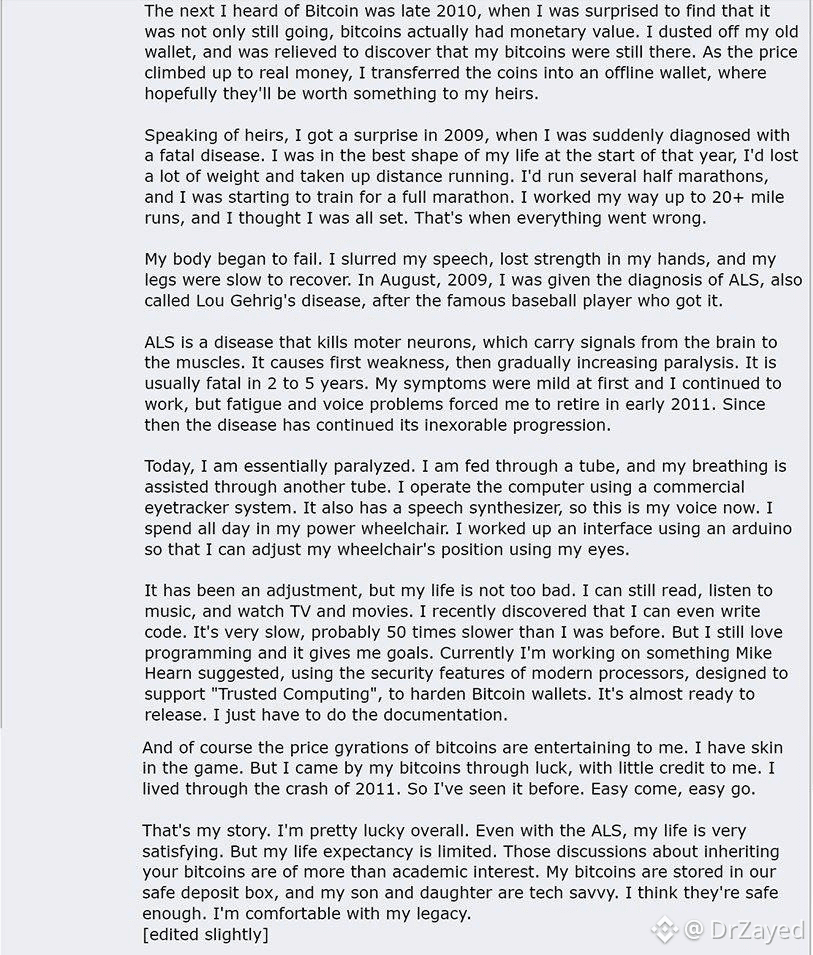
However, the story of Hal Finney is also one of profound personal courage and tragedy. Just as Bitcoin began to gain its first traces of mainstream attention, Hal was dealt a devastating blow. In August 2009, he was diagnosed with Amyotrophic Lateral Sclerosis (ALS), also known as Lou Gehrig’s disease. It is a progressive neurodegenerative disease that slowly paralyzes the body while leaving the mind fully intact.
The way Hal responded to his diagnosis is perhaps even more inspiring than his contributions to Bitcoin. He did not retreat into bitterness. Instead, he continued to code. As his muscles failed him and he lost the ability to use his hands, he used specialized eye-tracking software to write programs and interact with the Bitcoin community. He remained active on forums, offering advice to new developers and sharing his wisdom with a grace that left a lasting impact on everyone who encountered him.
In his final post on the Bitcointalk forum, written in 2013, Hal reflected on his journey. He talked about how he had to adjust his life as his condition worsened. He described how he was "lucky" to have lived long enough to see Bitcoin take off. He mentioned that despite his paralysis, he was still working on a piece of code to improve Bitcoin’s security, specifically focusing on a way to use the specialized security features of modern processors to protect digital wallets. He wrote with a sense of peace, noting that his bitcoins were stored in a safe deposit box for his heirs, and that he hoped they would one day be a significant legacy for his family.
Hal’s story is inextricably linked to the mystery of Satoshi Nakamoto. Because Hal lived in the same small town as a man actually named Dorian Satoshi Nakamoto, and because his writing style shared some similarities with the Bitcoin whitepaper, many people speculated that Hal himself was Satoshi. Hal always denied this, and his personal emails with Satoshi—later released to the public—strongly suggest they were indeed two different people. Hal viewed Satoshi with genuine respect and curiosity, often wondering about the creator's true identity just as much as everyone else.
The first transaction between Satoshi and Hal represented more than just a movement of data. It represented a transfer of trust and a shared vision. Satoshi provided the vision, but Hal provided the first validation. Without Hal’s early support and technical feedback, it is entirely possible that Satoshi might have grown discouraged or that the software’s early bugs would have proven fatal to the project's reputation. Hal was the bridge between the academic theory of the cypherpunks and the practical reality of the modern crypto-economy.
Hal passed away in August 2014, but his story did not end there. In a final act that reflected his lifelong belief in the power of technology to overcome human limitations, he chose to have his body cryopreserved by the Alcor Life Extension Foundation. He hoped that one day, medical technology would advance far enough to cure ALS and restore his body, allowing him to see the future he had helped build. This choice was perfectly in character for a man who always looked toward the horizon, whether in cryptography or in life.
Today, in 2026, the legacy of that January 11 transaction is visible everywhere. Bitcoin has grown from a hobbyist’s experiment on two computers into a global asset class held by millions of people, institutional investors, and even sovereign nations. The peer-to-peer network that Hal helped nurture now processes billions of dollars in value every day. Yet, for all its complexity and scale, the heart of Bitcoin remains the same as it was in Block 170: a decentralized ledger that allows individuals to interact directly with one another without needing permission from a central authority.
When we read Hal Finney’s words today, we are reminded of the importance of being an early believer. It is easy to support a successful technology once it has changed the world, but it requires a special kind of vision to support it when it is nothing more than a few lines of code and a dream. Hal’s optimism was not blind; it was informed by a deep understanding of math and a belief in the necessity of financial privacy. He understood that the world needed a way to exchange value that was as open and borderless as the internet itself.
The story of Satoshi and Hal also serves as a reminder of the pseudonymity and humility that defined Bitcoin’s early days. Neither man sought fame or personal glory during the crucial founding years. Satoshi eventually vanished, leaving the project in the hands of the community, and Hal continued to contribute as a "peer" even as he faced his own mortality. They embodied the ideal of the "sovereign individual"—people who use their skills and tools to create a better world, regardless of the obstacles in their path.
In reflecting on that moment in 2009, one can almost imagine the scene: a quiet room in California, the hum of a computer tower, and a notification on a screen indicating that ten digital coins had arrived from a stranger across the digital void. For the rest of the world, it was just another Sunday. But for Hal Finney, it was the start of a journey that would define his legacy and the future of global finance.
The first transaction was a spark. Hal Finney was the one who tended that spark, ensuring it didn't go out in the cold winter of 2009. His life and his story remain a beacon for anyone who believes in the power of innovation to expand human freedom. He was a coder, a thinker, a father, and a visionary. Most importantly, he was the first person to truly understand what Satoshi Nakamoto had given the world. As we look back from the vantage point of 2026, we can see that the transaction between Satoshi and Hal was not just the birth of a network; it was the birth of a new era of human collaboration.
