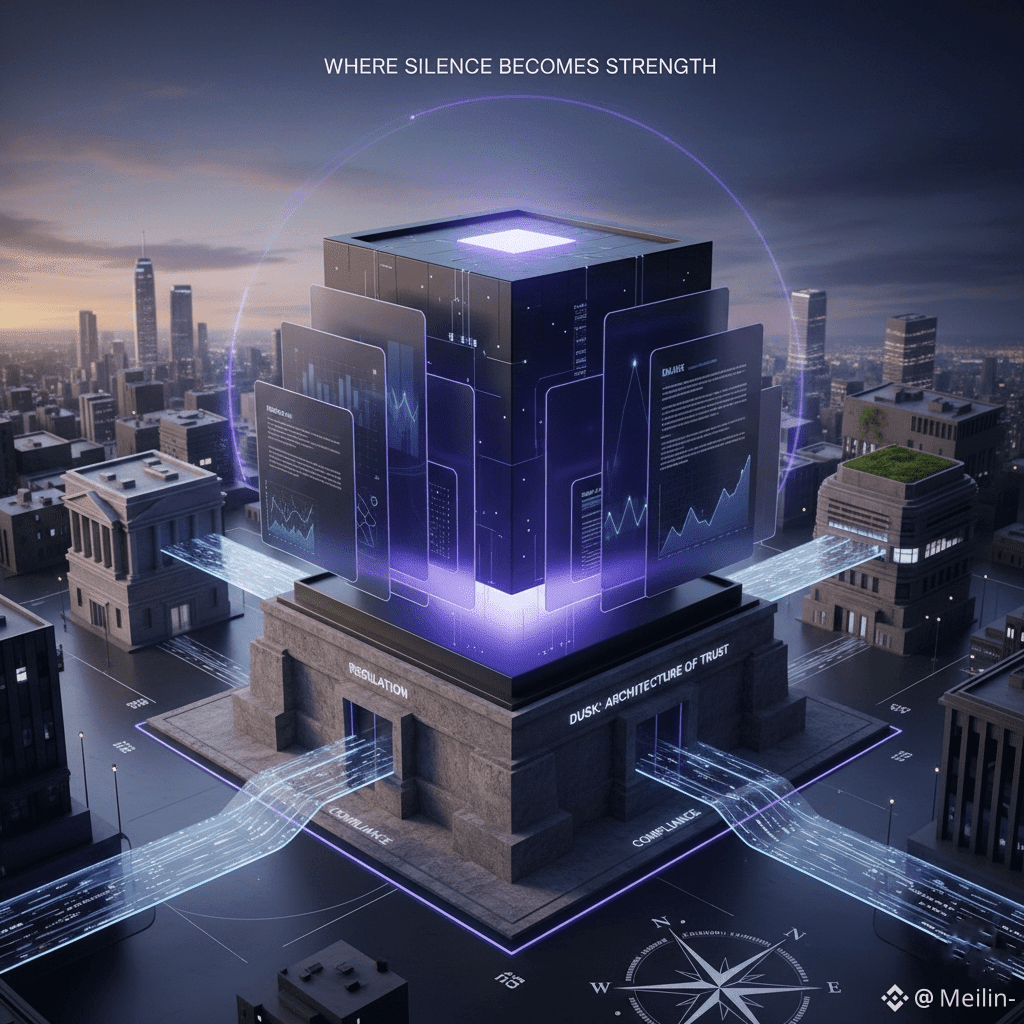
In a digital era obsessed with speed noise and constant visibility there is something quietly radical about building systems that value discretion as much as transparency. That quiet radicalism is where Dusk was born. Founded in 2018 Dusk did not emerge to chase trends or dominate headlines. It emerged to solve a problem most blockchains were not equipped to handle how to bring privacy regulation and institutional trust into the same financial reality without forcing any of them to compromise their core principles.
At its heart Dusk represents a shift in how financial infrastructure is imagined. Instead of assuming that openness must come at the cost of confidentiality or that regulation must suffocate innovation Dusk approaches finance with a more mature understanding of how real markets work. Financial institutions do not operate in absolutes. They exist in gradients of disclosure accountability and risk management. Transactions often need to be private yet provable. Data must be protected yet auditable. Dusk’s design speaks directly to this tension not by ignoring it but by embracing it as the central challenge of modern finance.
The idea of a layer 1 blockchain designed specifically for regulated environments is more profound than it first appears. Most foundational blockchain networks were built with ideological purity in mind prioritizing radical openness or complete permissionlessness. Dusk by contrast was shaped by realism. It acknowledges that the future of blockchain adoption depends not only on cryptography and decentralization but on compatibility with legal systems compliance frameworks and institutional governance. This realism does not dilute its ambition. It sharpens it. By focusing on regulated and privacy focused financial infrastructure Dusk positions itself not as a rebellion against existing systems but as their evolution.
What truly sets Dusk apart is its modular architecture which feels less like a technical specification and more like a philosophical stance. Modularity allows financial applications to be built with intention enabling developers and institutions to assemble systems that meet specific regulatory operational and privacy requirements. This flexibility is crucial in a world where financial rules vary across jurisdictions and evolve over time. Instead of forcing a single rigid model onto every use case Dusk provides a foundation that adapts allowing innovation to coexist with compliance rather than collide with it.
Privacy within Dusk’s ecosystem is not treated as secrecy for secrecy’s sake. It is treated as a functional necessity. In traditional finance confidentiality protects competitive strategies client identities and sensitive transactional data. Dusk carries this understanding into the digital realm embedding privacy directly into its infrastructure rather than layering it on as an optional feature. Yet this privacy does not come at the expense of oversight. Auditability is built alongside it ensuring that transactions can be verified and validated when required without exposing unnecessary information. This balance is not merely technical. It is ethical. It reflects a belief that responsible financial systems must protect individuals and institutions while still remaining accountable to regulators and stakeholders.
The implications of this design philosophy become especially powerful when applied to tokenized real world assets. Tokenization promises to transform how value moves through the global economy but only if it can be trusted. Assets tied to real world legal claims such as securities property or financial instruments demand clarity enforceability and compliance. Dusk provides an environment where these assets can be represented digitally without losing their legal integrity. It enables faster settlement improved liquidity and more inclusive participation all while respecting the regulatory structures that give these assets their legitimacy in the first place.
Compliant decentralized finance is another area where Dusk quietly reshapes expectations. Early DeFi experiments proved that financial logic could be automated and decentralized but they also revealed the limits of systems that ignored regulation entirely. Dusk’s approach suggests a different future one where decentralized mechanisms operate within defined legal boundaries allowing institutions to participate without abandoning their obligations. This opens the door to financial products that combine the efficiency of decentralized systems with the safeguards required by law creating a space where innovation feels sustainable rather than reckless.
There is a certain emotional gravity to this vision. For builders and institutions alike Dusk offers relief from the false choice between innovation and responsibility. It suggests that financial technology can grow up that it can move beyond experimentation into infrastructure that supports real economies and real people. The thrill here is not explosive disruption but quiet confidence. It is the sense that something solid is being built beneath the surface something designed to last.
Dusk’s story is ultimately about trust. Trust that privacy can be preserved without enabling abuse. Trust that regulation can be respected without stifling creativity. Trust that blockchain can serve not just idealists and early adopters but the institutions that underpin global finance. In choosing silence over spectacle Dusk makes a bold statement the future of finance does not need to shout to be transformative. Sometimes the most powerful revolutions are the ones that happen quietly ledger by ledger building a world where discretion and accountability finally stand on the same foundation.