

@Walrus 🦭/acc sets out to address a challenge widely acknowledged in the crypto space but rarely solved in a practical way: enabling decentralized storage of large datasets without sacrificing speed, affordability, or reliability. In today’s digital world, the vast majority of data is hosted on centralized cloud platforms. While these services offer efficiency and ease of use, they also demand trust. Providers can restrict access, remove content, change policies unexpectedly, or even lose data entirely. Earlier decentralized storage solutions attempted to remove these risks but often introduced new problems, such as high costs, slow access times, or complicated workflows. Walrus takes a different route. Rather than chasing theoretical perfection, it prioritizes real-world usability for developers, businesses, and everyday users, while still upholding principles like data ownership, privacy, and network resilience.
At its foundation, Walrus is a decentralized storage protocol built on the Sui blockchain. This choice is intentional, as Sui is engineered for high transaction throughput and rapid finality, both of which are essential for applications that depend on active, frequently accessed data rather than long-term archives. Walrus divides responsibilities between the blockchain and the storage layer. The chain manages ownership records, payments, and storage obligations, while the data itself is stored off-chain in large, encrypted objects. This architecture prevents blockchain congestion while maintaining verifiability and minimizing trust requirements. To users, Walrus feels similar to a decentralized version of cloud storage, but its guarantees are enforced by cryptography instead of centralized providers.
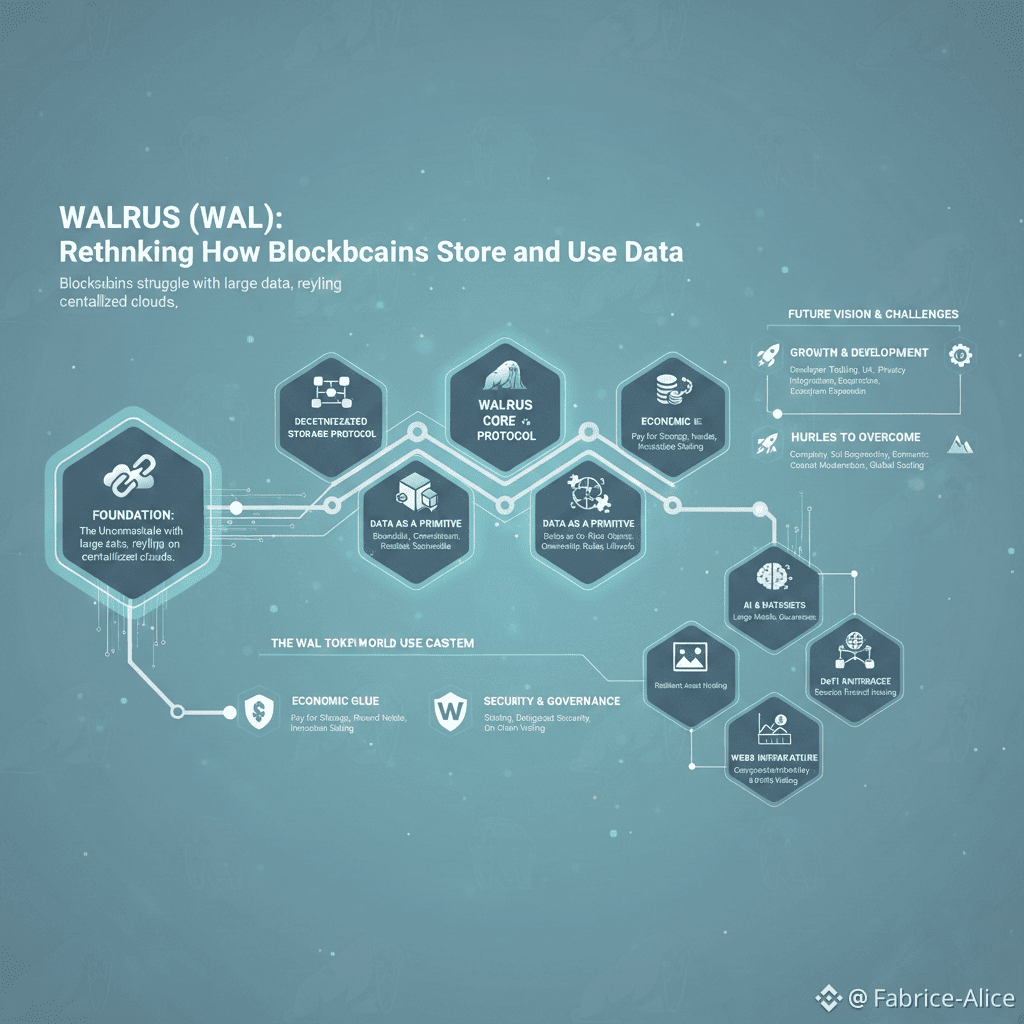
The core innovation behind Walrus lies in how it handles data durability and efficiency. Instead of duplicating entire files across many nodes, the protocol uses erasure coding. This method splits data into fragments that can be recombined as long as a sufficient portion is available. Walrus enhances this approach with a two-dimensional encoding model, where each storage node holds specific fragments from different axes of the data structure. This design significantly increases fault tolerance. Even if a substantial number of nodes fail or go offline, the original data remains recoverable. At the same time, it reduces overall storage overhead compared to full replication. This efficiency directly impacts economics, lowering costs for users while allowing storage providers to earn sustainable rewards.
Walrus is also built with the unpredictable nature of decentralized networks in mind. Nodes regularly enter and exit the system, and Walrus treats this as a normal condition rather than an exception. When a node disappears, the network automatically regenerates the missing data fragments and reallocates them across other nodes. This self-repairing mechanism prevents disruptions and avoids the need for large-scale reuploads. By assuming failure and designing around it, Walrus becomes more resilient as it scales instead of becoming increasingly fragile.
Data privacy is another area where Walrus takes a pragmatic stance. Many decentralized storage solutions default to public data access, which limits their suitability for real-world use cases. Walrus supports encrypted storage combined with on-chain access controls. Users can specify who is allowed to decrypt and access specific datasets, with these permissions enforced through smart contracts. This enables use cases involving sensitive information, such as personal data, financial records, or proprietary business assets. Privacy is not treated as an add-on but as a foundational design principle, allowing developers to build applications where data sharing is deliberate and controlled.
The WAL token functions as the backbone of the protocol’s economic system. Rather than existing purely for speculation, it plays a direct role in network operations. WAL is used to pay for storage services, compensate node operators, and secure the protocol through staking. When users store data, they pay in WAL, which is distributed to storage providers and to stakers who support those nodes. This creates a clear connection between actual network usage and token demand. Staking is particularly important, as it determines which nodes are entrusted with greater storage responsibility. Nodes backed by more staked tokens receive more assignments, while those that fail to meet performance standards face penalties. This structure rewards reliability and discourages poor behavior.
Beyond its economic role, WAL also enables governance. Token holders can vote on protocol-level decisions, including adjustments to rewards, penalties, and other operational parameters. While governance is often highlighted as a selling point in crypto, in this case it serves a practical need. Storage networks must evolve alongside changing usage patterns, and WAL holders are financially motivated to guide that evolution responsibly. Additionally, Walrus includes deflationary mechanisms. Certain fees and penalties result in token burns, gradually reducing supply as the network is actively used. This links long-term value to sustained participation rather than short-term speculation.
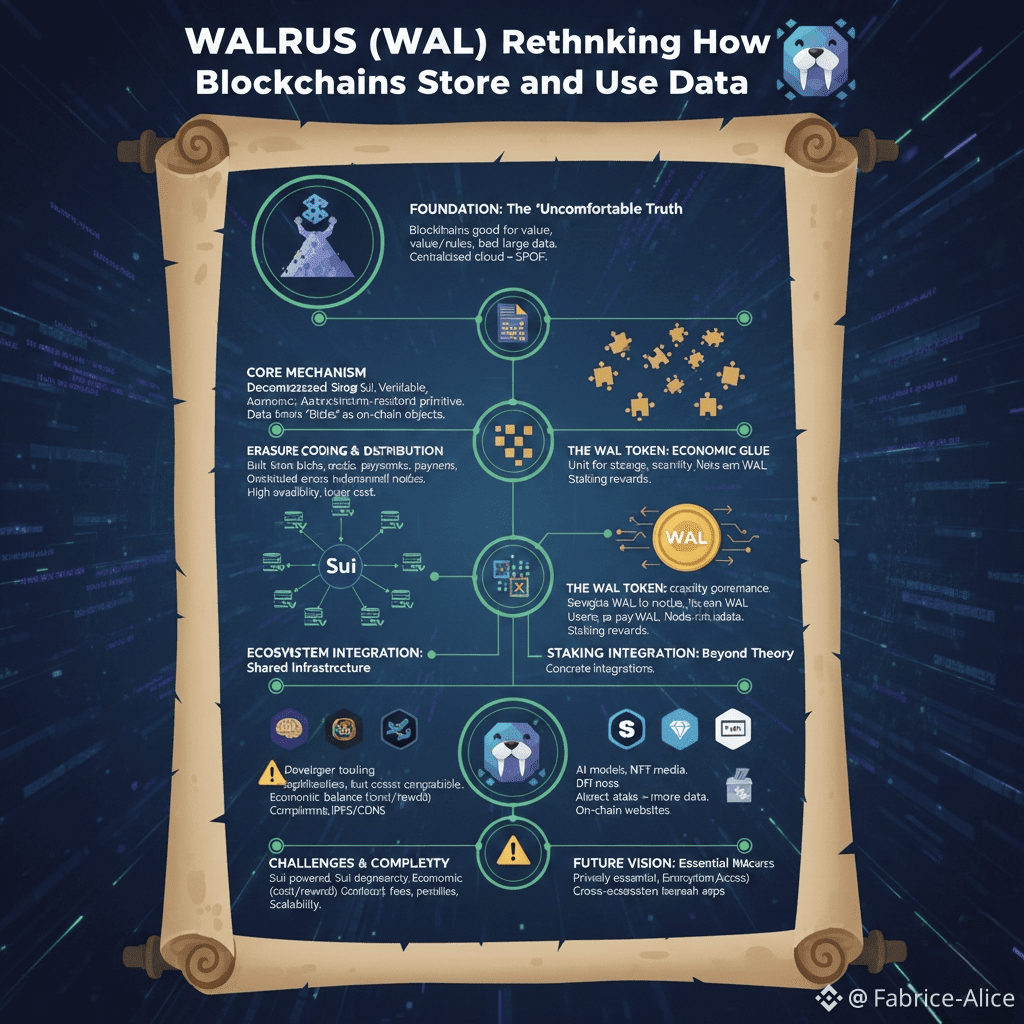
Walrus is tightly integrated with the broader blockchain ecosystem, particularly Sui. Developers building on Sui can rely on Walrus as a native storage layer for applications that generate far more data than blockchains can handle directly. This is especially relevant for sectors such as decentralized finance, gaming, artificial intelligence, and social platforms. Walrus effectively provides a data layer that blockchains can depend on without compromising decentralization. Although Sui is the initial focus, the protocol is designed with long-term flexibility in mind, allowing for future integration with other chains as demand grows.
Early real-world adoption is already visible. Certain DeFi applications use Walrus to store market data and front-end assets in a verifiable way, reducing the risk of manipulation. AI-oriented projects rely on Walrus for secure storage of training datasets and model outputs, enabling provable data provenance. Consumer applications are exploring Walrus as an alternative to traditional cloud storage, giving users control over their personal files. Enterprises are also testing the protocol for compliance-sensitive and edge computing scenarios, where auditability and resilience are critical.
Despite this progress, challenges remain. The decentralized storage sector is competitive, with established networks that already benefit from scale and user familiarity. Encouraging developers and organizations to migrate infrastructure is inherently difficult. Economic sustainability is another concern, as incentives must remain attractive for node operators without driving storage costs too high. Regulatory uncertainty around decentralized data hosting also persists, particularly regarding liability and data protection requirements.
Walrus’s close alignment with Sui introduces additional strategic considerations. While the partnership provides strong technical advantages, it also means that Walrus’s growth is partly dependent on Sui’s broader adoption. If Sui’s momentum slows, Walrus may need to accelerate expansion to other ecosystems. As with any complex system, there is also the ongoing risk of software vulnerabilities or unforeseen edge cases. Storage protocols are especially sensitive, and trust can erode quickly if availability or integrity is compromised.
Looking ahead, Walrus appears focused on normalization rather than disruption. The roadmap emphasizes better tooling, smoother user experiences, stronger privacy features, and deeper integration with production-grade applications. If Walrus succeeds, it is unlikely to be because of bold promises or flashy narratives. Instead, its success would come from quietly becoming dependable infrastructure that developers rely on without much thought. In an industry filled with grand ambitions, Walrus distinguishes itself by aiming for something more restrained yet arguably more impactful: making decentralized storage work reliably at scale.
