

@Walrus 🦭/acc I didn’t come to Walrus looking for something new. I came to it with a kind of accumulated skepticism that only comes from watching Web3 infrastructure mature in theory and fail in practice. Storage has always been one of those problems everyone acknowledges but rarely solves cleanly. The moment real data enters the system sensitive data, regulated data, data someone will be held accountable for decentralization often takes a back seat to convenience. What made Walrus stand out wasn’t a promise to fix this contradiction. It was the sense that it had been built with that contradiction fully in mind.
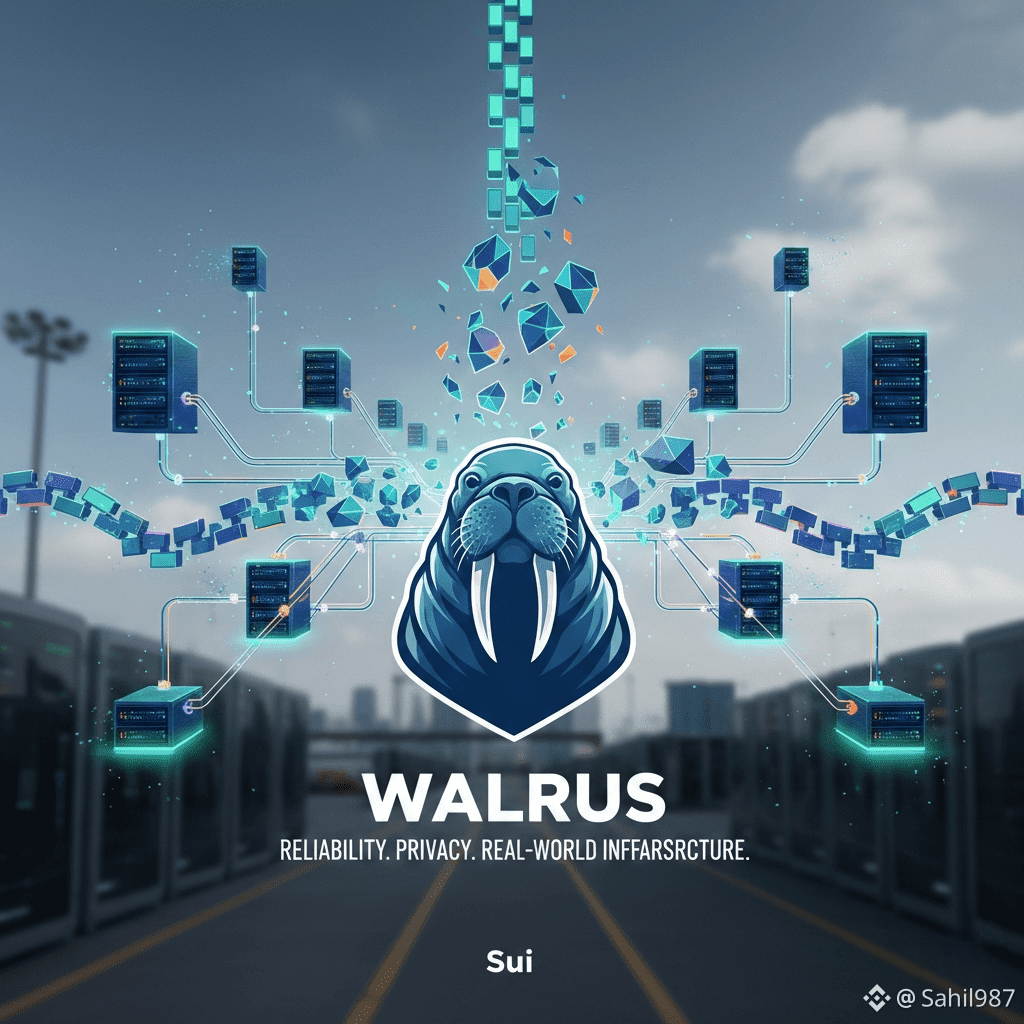
At the heart of Walrus is a design philosophy that feels refreshingly unambitious, and that’s meant as a compliment. Blockchains are powerful coordination layers, but they are inefficient and expensive places to store large amounts of data. Walrus doesn’t try to argue otherwise. Instead, it builds a decentralized storage layer that operates alongside the blockchain rather than inside it. Large files are stored as blobs, split using erasure coding, and distributed across a decentralized network so that no single node holds the entire dataset. Only a subset of fragments is required to reconstruct the data, which keeps redundancy manageable while preserving availability and censorship resistance. This approach isn’t revolutionary. It’s disciplined and discipline is often what infrastructure lacks.
What’s striking is how intentionally narrow Walrus keeps its scope. It doesn’t try to become a universal data layer or a wholesale replacement for traditional cloud providers. Its focus is precise: privacy-preserving, decentralized storage and transactions that behave predictably under real conditions. The protocol supports private interactions, decentralized applications, staking, and governance, but none of these are inflated beyond their practical role. The WAL token exists to coordinate participation and secure the network, not to serve as the centerpiece of the story. Privacy isn’t treated as ideology; it’s structural, emerging from how data is fragmented and distributed rather than from optimistic assumptions.
From a practical perspective, Walrus feels designed for people who care about failure modes more than narratives. Storage costs are treated as constraints, not footnotes. Efficiency is measured in predictability, not peak benchmarks. By operating on the Sui blockchain, Walrus benefits from an execution environment designed for high throughput and object-based data handling, which aligns naturally with blob storage. The result is a system that feels legible. When builders can understand how something behaves under stress, they’re far more likely to trust it with real workloads.
I’ve seen enough decentralized storage experiments to recognize why this matters. Many failed not because they lacked innovation, but because they overestimated patience. Incentives attracted operators until rewards declined. Complexity piled up until only a handful of specialists could keep systems running, quietly re-centralizing what was meant to be decentralized. Governance promised adaptability and delivered hesitation. Walrus feels informed by those failures. It doesn’t chase maximal decentralization if it undermines reliability. It doesn’t assume participants will behave ideally forever. Instead, it aims for balance enough decentralization to matter, enough efficiency to be usable, and enough simplicity to evolve without constant redesign.
Looking ahead, the questions around Walrus are the right ones. Can decentralized participation remain healthy as storage demand grows steadily rather than explosively? Will governance through WAL remain thoughtful as the network matures and incentives diverge? How does the system behave after years of ordinary usage, when novelty fades and only reliability remains? These aren’t abstract concerns. They’re the tests that decide whether infrastructure becomes foundational or forgotten. Walrus doesn’t claim to have permanent answers yet, but its architecture feels capable of adapting without reinventing itself every cycle.
The broader industry context makes this approach feel timely. Web3 is slowly moving past maximalism. The idea that everything must live on-chain is losing credibility. Modular architectures are becoming normal. Builders and enterprises alike are prioritizing predictable costs, privacy, and operational clarity over ideological purity. Early signs around Walrus quiet experimentation, integrations driven by necessity rather than incentives, interest rooted in risk reduction suggest this positioning resonates.
If Walrus succeeds, it likely won’t be because it dominates headlines or fuels speculation around WAL. It will be because it becomes boring in the right way. Data stays available. Privacy holds without constant vigilance. Costs behave as expected. The system simply works. In an ecosystem that has often confused ambition with durability, Walrus’s quiet focus on practicality may turn out to be its most valuable contribution.