
When people first encounter Dusk, they often focus on privacy, compliance, or its role in regulated finance. Governance tends to come later in the conversation. Quietly, though, it’s one of the protocol’s most deliberate design choices. Not because governance looks good in a whitepaper, but because Dusk is built for environments where decisions carry real consequences—financial, legal, and institutional.
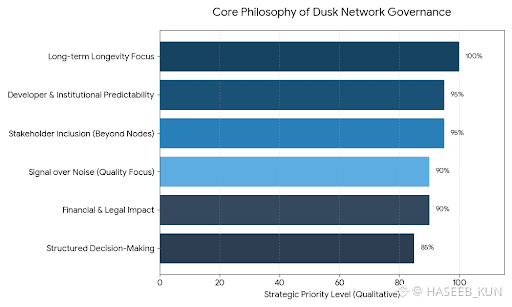
Dusk was never meant to be a chain where upgrades are decided in small validator circles while everyone else watches from the sidelines. From the beginning, the network was shaped around a broader question: Who should influence a financial protocol designed for the real world? The answer wasn’t “only nodes,” and it wasn’t “everyone shouting at once.” It was something more balanced, and more intentional.
At the technical level, nodes remain essential. They secure the network, validate transactions, and uphold consensus. But Dusk makes a clear distinction between securing the protocol and steering its evolution. Governance is where that distinction matters. The protocol recognizes that long-term direction should reflect not only infrastructure operators, but also builders, institutions, and community members who interact with Dusk as a financial layer.
This is especially important given Dusk’s focus on regulated assets, privacy-preserving finance, and compliant DeFi. Governance here isn’t theoretical. Decisions can affect how tokenized securities are issued, how disclosures are handled, or how regulatory logic evolves over time. Limiting those decisions to a narrow technical group would create blind spots. Dusk’s governance model is designed to avoid exactly that.
Instead, Dusk opens structured pathways for the wider community to participate meaningfully. Proposal mechanisms allow ideas to surface from beyond the validator layer. Community discussions give context before decisions are finalized. Voting frameworks transform participation into measurable outcomes rather than symbolic gestures. The system encourages contribution without turning governance into chaos.
What makes this work is restraint. Dusk doesn’t frame governance as endless democracy. It treats it as a process—one that values signal over noise. Proposals are expected to be reasoned, aligned with the protocol’s mission, and technically grounded. This filters participation naturally. Those who engage thoughtfully shape outcomes; those who don’t are simply observers.
For developers building on Dusk, this creates confidence. Changes to the VM, privacy mechanisms, or developer tooling don’t arrive unexpectedly. They emerge through governance cycles that are visible and paced. Builders can anticipate direction rather than react to surprises. Over time, this predictability becomes a competitive advantage.
Institutions see something equally important: stability with accountability. Governance on Dusk is transparent enough to audit and structured enough to trust. Institutions can participate without fearing that short-term sentiment will override long-term protocol health. At the same time, they are not positioned above the community. Their influence exists alongside it, not instead of it.
This shared governance structure mirrors the kind of financial systems Dusk is designed to support. In traditional markets, rules evolve through consultation, oversight, and gradual change—not abrupt rewrites. Dusk brings that same philosophy on-chain, without sacrificing decentralization. The protocol doesn’t freeze itself in place, but it also doesn’t lurch forward recklessly.
There’s a subtle cultural effect that emerges from this design. Community members don’t feel like passengers. They feel like stakeholders. When governance is accessible but serious, participation becomes thoughtful rather than performative. Discussions move from speculation to stewardship. Over time, this shapes how the ecosystem behaves.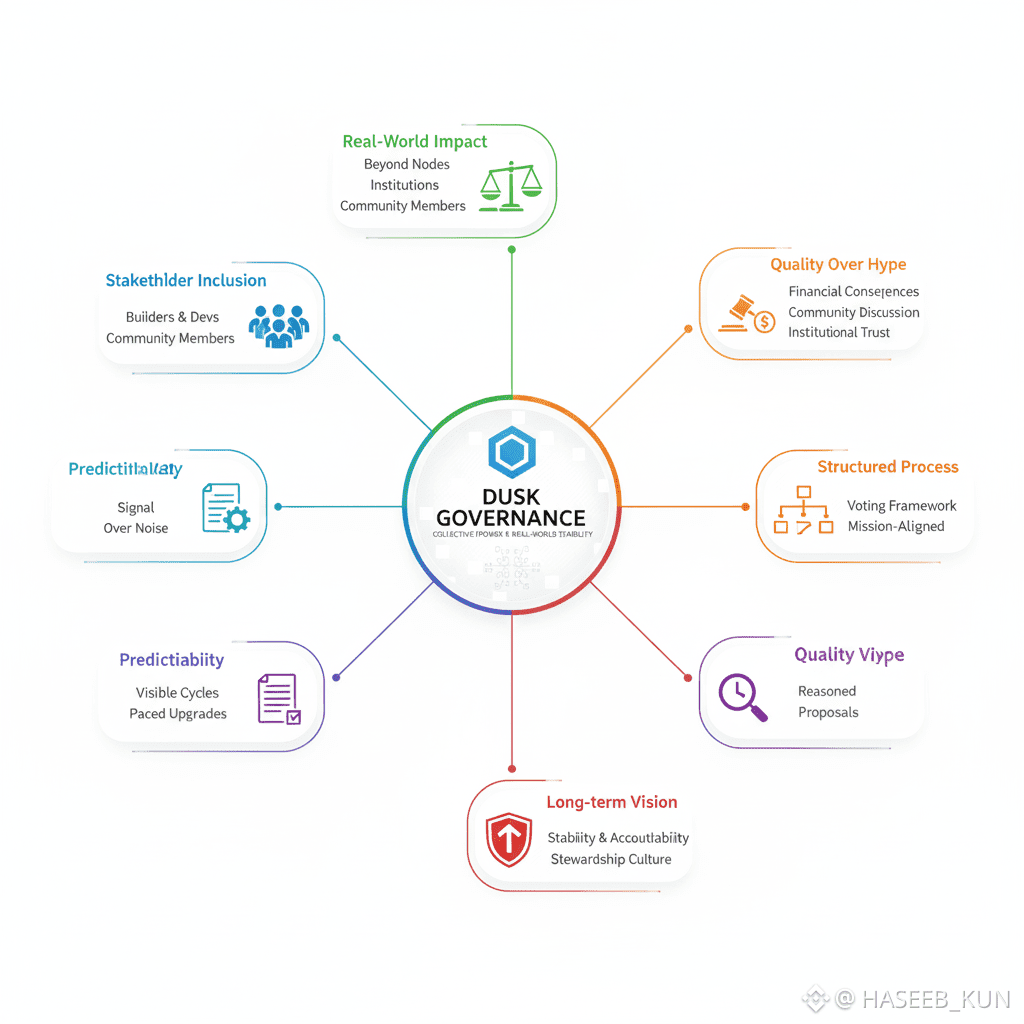
Consider how protocol upgrades are handled. On Dusk, upgrades are framed as collective decisions, not technical announcements dropped from above. Governance discussions explain why a change matters, who it affects, and how it aligns with the network’s long-term vision. This turns upgrades into moments of shared alignment rather than points of friction.
From an educational perspective, this matters because governance is often where decentralization quietly fails. Dusk treats it as infrastructure, not decoration. The same care given to cryptography and protocol design is applied to decision-making itself. That consistency is rare, and it’s intentional.
For readers trying to understand what separates Dusk from generic Layer 1s, governance beyond nodes is a clear signal. It shows that the protocol is not optimized for hype cycles, but for longevity. It’s built for a future where blockchains operate alongside regulators, institutions, and global markets—without losing community agency.
In the end, Dusk’s governance model reflects its broader philosophy: privacy with accountability, decentralization with structure, innovation with responsibility. By extending governance beyond nodes, Dusk doesn’t dilute power. It distributes it carefully, so the protocol can grow without losing coherence.
That’s not just governance design. It’s how Dusk prepares itself for the real world.
