


When I think about the long-term value of a blockchain’s native token, I don’t start with price charts or short-term market cycles. I start with utility. Specifically, I look at how deeply the token is woven into the daily functioning of the network, and whether that usage naturally scales as more people build and transact on it. In Plasma’s case, this is where XPL becomes interesting—not as a speculative asset, but as an operational one.
As more developers and users join Plasma, the value of holding XPL increases in a quiet, structural way. Not because of artificial scarcity or marketing narratives, but because XPL sits at the center of network activity, security, and coordination. This article is about unpacking that relationship carefully—how ecosystem growth translates into token relevance, and why that matters for anyone evaluating Plasma as infrastructure rather than hype.
Understanding XPL Beyond Price
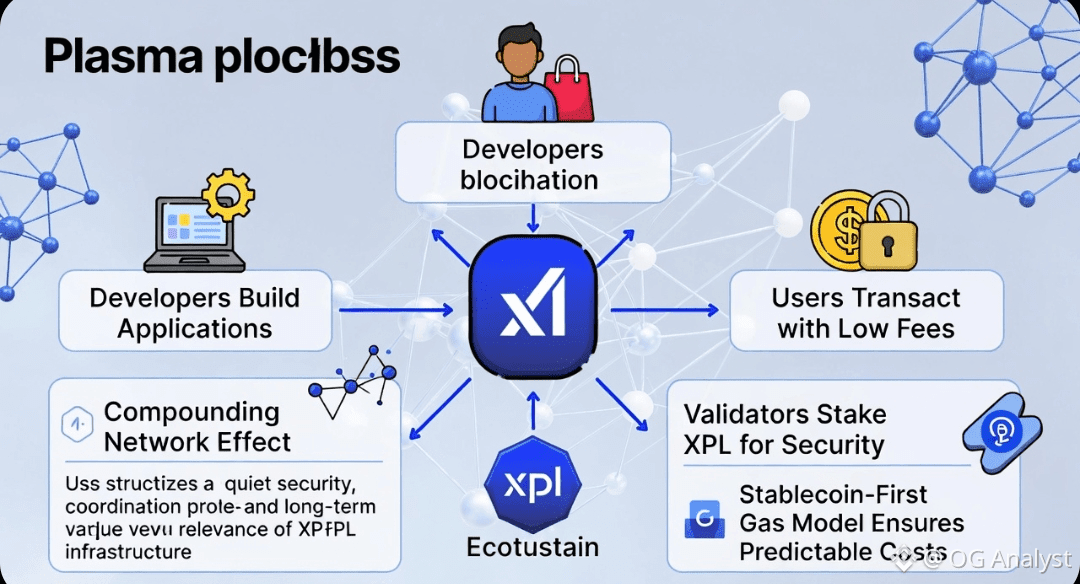
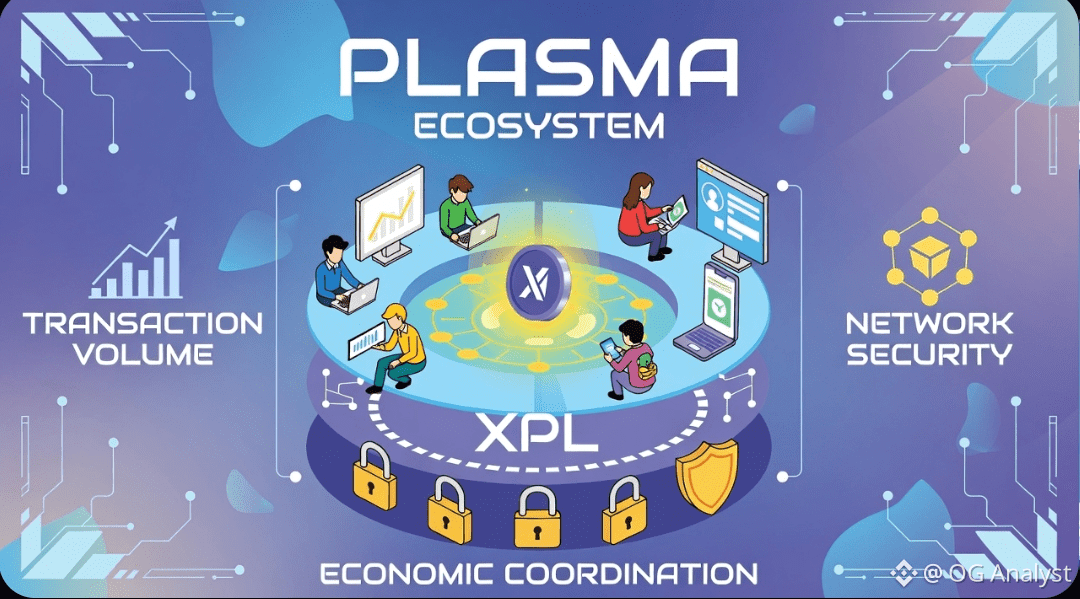
It’s easy to talk about tokens purely in terms of market value. But that perspective misses the more important question: what role does the token actually play? In Plasma, XPL functions as the economic glue that holds the network together.
Validators stake XPL to participate in consensus and secure the chain. Transaction activity—whether paid directly in XPL or abstracted through stablecoin-first gas—ultimately relies on XPL for settlement and incentive alignment. Governance mechanisms and protocol-level decisions also anchor back to XPL ownership and participation.
What this means in practice is that XPL is not optional. It’s not a token that exists on the side of the protocol. It is integral to how Plasma operates. And when a token is integral, growth in the ecosystem naturally increases its relevance.
Ecosystem Growth Is Not Just More Users
When we talk about “more developers and users joining Plasma,” it’s important to clarify what that actually means. Ecosystem growth is not just an increase in wallet addresses or transaction counts. It’s a layered process:
More developers building applications
More users interacting with those applications
More transactions flowing through the network
More validators required to secure and process that activity
More economic coordination happening on-chain
Each of these layers touches XPL in a different way. Together, they create a compounding effect that strengthens the token’s role.
Developers: The First Layer of Demand
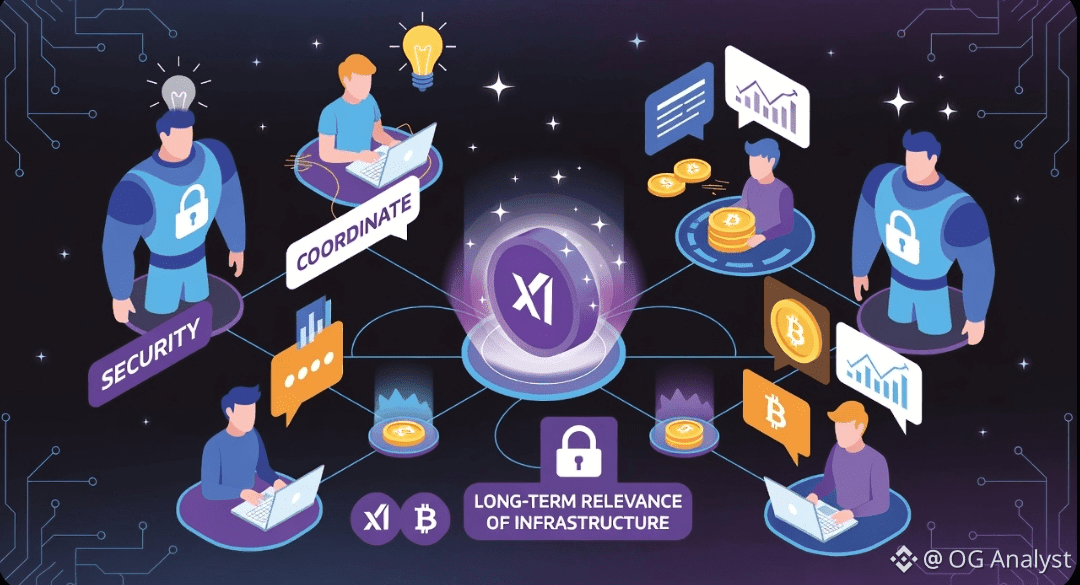
Developers are often the earliest signal of whether a blockchain has long-term potential. When developers choose Plasma, they are not just deploying code—they are committing to its execution environment, consensus model, and economic design.
Plasma’s full EVM compatibility lowers the barrier to entry. Existing Ethereum-based applications can migrate without rewriting their logic. That convenience matters, but what matters more is what happens after deployment.
As applications go live, they generate transaction volume. They rely on validators. They may integrate advanced features like stablecoin-first gas or optional confidential payments. All of this activity increases the operational load on the network—and that load is secured and coordinated through XPL.
From a developer’s perspective, XPL becomes part of the cost structure of running an application, whether directly or indirectly. From a network perspective, each new application deepens the token’s utility.
Users: Daily Activity Creates Structural Demand
Users don’t think in terms of tokenomics. They think in terms of whether something works. Can they send stablecoins quickly? Are fees predictable? Does the transaction settle instantly?
Plasma is designed to answer yes to those questions. Sub-second finality, high throughput, and stablecoin-first gas make it practical for everyday use. As more users adopt applications built on Plasma, transaction volume increases naturally.
Even when users pay fees in stablecoins, XPL remains involved behind the scenes. Validators still earn rewards. Consensus still depends on staked XPL. The network still requires economic security.
This is an important distinction. XPL does not rely on users consciously choosing to buy or spend it for demand to grow. Demand grows because the network is being used.
Validators: Security Scales With Activity
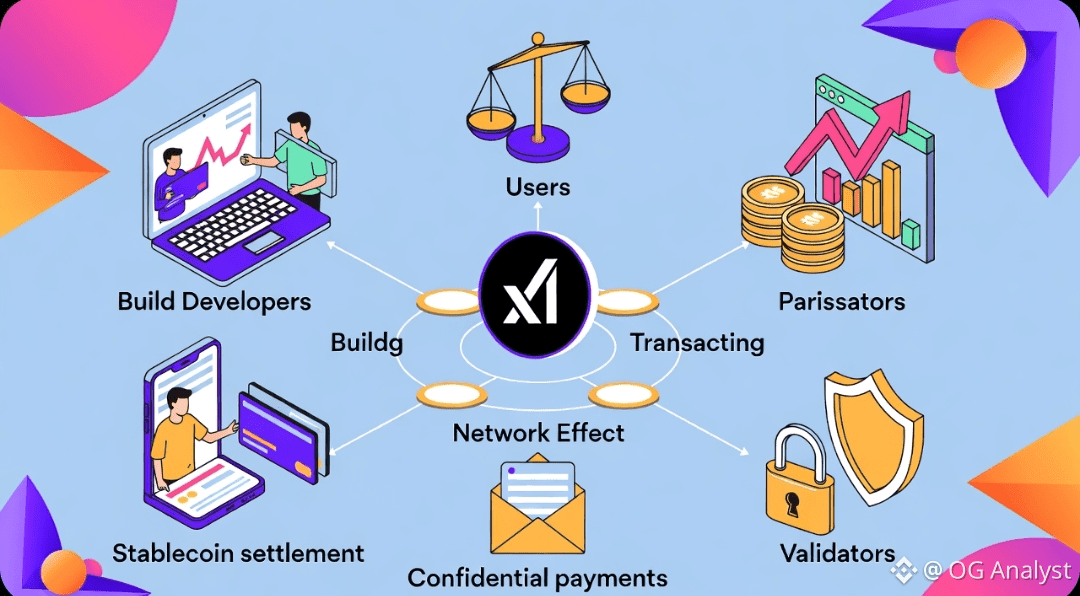
As transaction volume increases, so does the importance of network security. Plasma uses a Byzantine Fault Tolerant consensus mechanism—PlasmaBFT—that requires validators to stake XPL.
More applications and users mean:
Higher transaction throughput
Greater economic value flowing through the network
Increased need for robust, decentralized validation
This naturally increases the importance of staking. Validators must lock up XPL to participate, and as the network grows, validator participation becomes more competitive and more critical.
From a holding perspective, this matters. Staked tokens are not freely circulating. They are committed to securing the network. As ecosystem activity grows, so does the proportion of XPL that is economically active rather than idle.
XPL as a Coordination Token
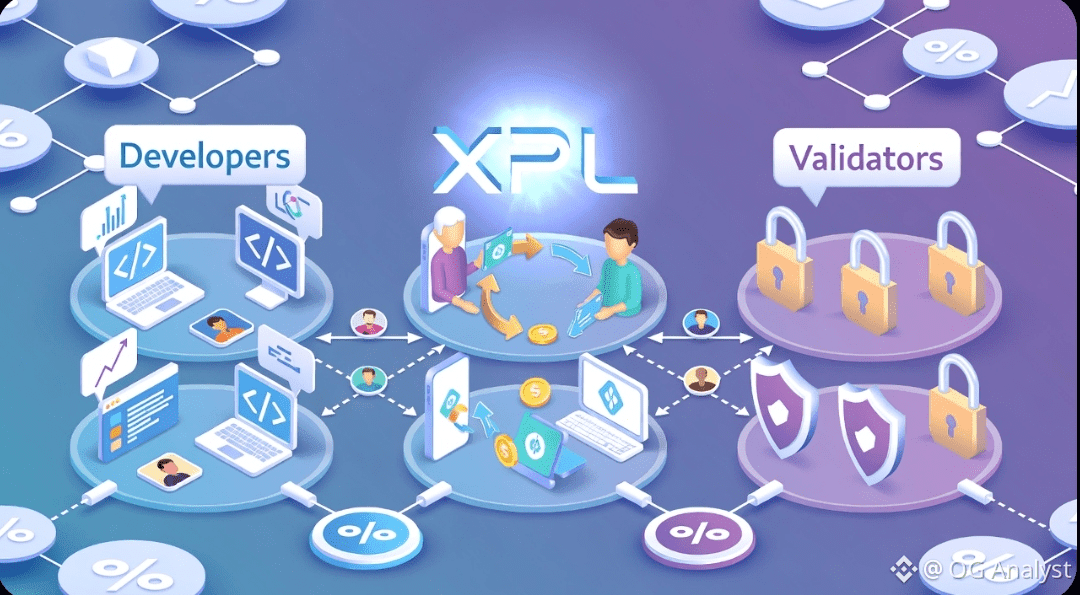
One of the most overlooked roles of a native token is coordination. XPL coordinates incentives between:
Developers, who want reliable infrastructure
Users, who want fast and predictable transactions
Validators, who want fair rewards for securing the network
The protocol itself, which must balance performance, security, and sustainability
As the ecosystem grows, coordination becomes more complex. More stakeholders are involved. More value is at stake. Tokens that play a central coordination role become more important—not because of speculation, but because there is no substitute for them.
In Plasma, XPL is that coordination layer.
Confidential Payments and Advanced Usage
As Plasma evolves, optional features like confidential payments add another dimension to token utility. Private transactions typically require more computational effort and stronger security guarantees.
If confidential transaction volume grows:
Validators process more complex proofs
Network security becomes even more critical
Staking incentives must remain robust
All of this reinforces XPL’s role. Advanced features don’t dilute the token’s importance; they intensify it.
Why Ecosystem Growth Is Different From Short-Term Hype
It’s worth distinguishing between organic ecosystem growth and short-term attention. Hype can inflate prices temporarily, but it doesn’t create lasting value. Ecosystem growth does.
When developers choose Plasma because it solves real problems, they stay. When users transact because it’s cheaper and faster, they return. When validators stake because the network is active and secure, they commit long-term.
XPL benefits from this kind of growth because its utility is tied to participation, not promotion.
A Network Effect That Compounds Quietly
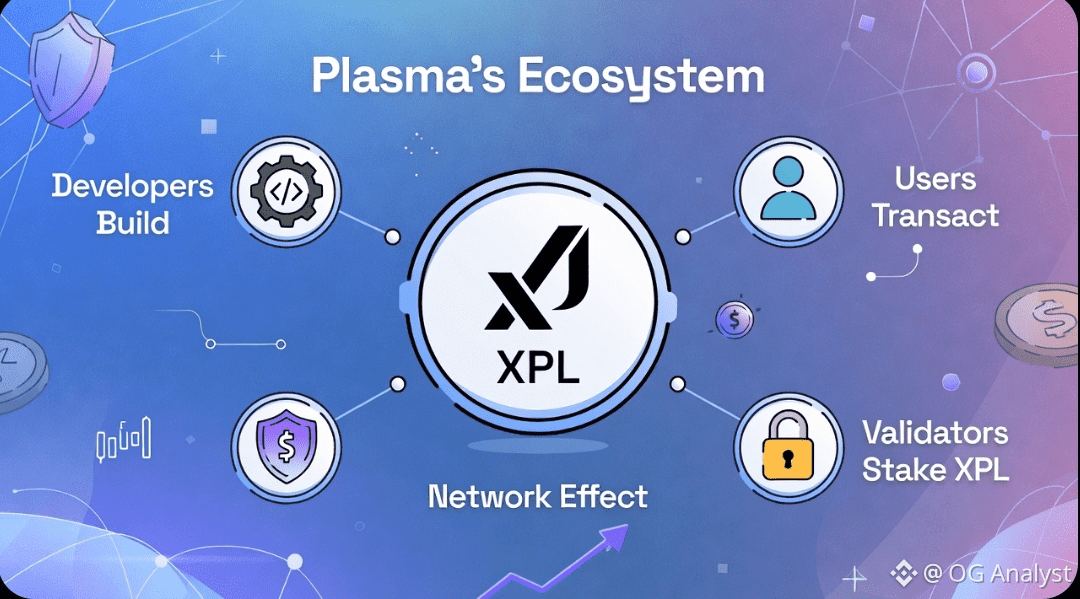
The relationship between Plasma’s ecosystem and XPL is not linear—it’s compounding.
More developers → more applications
More applications → more users
More users → more transactions
More transactions → more validator activity
More validator activity → more XPL staked and utilized
Each step reinforces the next. None of this requires aggressive marketing or speculative narratives. It emerges naturally from usage.
This is the kind of dynamic that tends to be underestimated early and appreciated later.
Holding XPL as Exposure to Network Growth
When I think about holding XPL, I don’t think of it as a bet on price appreciation alone. I think of it as exposure to the growth of Plasma as infrastructure.
If Plasma succeeds in becoming a meaningful settlement layer for stablecoins:
Transaction volume increases
Developer activity expands
Validator participation deepens
Economic coordination intensifies
In that scenario, holding XPL means holding a claim on the network’s operational backbone.
Risks and Realism
None of this is guaranteed. Ecosystem growth depends on execution, developer adoption, regulatory clarity, and competition. Plasma operates in a crowded landscape, and stablecoin infrastructure is not a trivial challenge.
But this is precisely why understanding token utility matters. Tokens with shallow utility are fragile. Tokens with deep, structural roles are resilient.
XPL’s value proposition is not based on promises—it’s based on usage.
Final Reflection
As more developers and users join Plasma, the value of holding XPL increases not because of speculation, but because the token becomes more necessary. It secures the network, coordinates incentives, and underpins every layer of activity.
This kind of value is quiet. It doesn’t announce itself loudly. But it compounds over time.
For anyone looking at Plasma through a long-term, infrastructure-focused lens, XPL represents more than a token. It represents participation in a growing settlement network—one where value accrues through use, not hype.
And in the long run, that distinction matters more than most people realize.
Plasma and the Practical Future of Stablecoin Payments
When people talk about stablecoins, the conversation often focuses on market size, issuance, or regulatory headlines. What gets less attention is the infrastructure underneath—how stablecoins actually move, settle, and integrate into everyday economic activity. Over time, I’ve come to believe that stablecoins don’t just need better applications; they need purpose-built settlement rails. This is where Plasma’s design philosophy becomes relevant.
Plasma is not trying to be everything for everyone. Instead, it narrows its focus to one core problem: making stablecoin payments simple, fast, and usable at scale. In this article, I want to walk through five aspects of Plasma’s approach that, taken together, explain why it positions itself as infrastructure for mass stablecoin adoption rather than just another Layer 1 blockchain.
1. Plasma’s USD₮ Gasless Transfers and the Path to Mass Adoption
One of the most underestimated barriers to blockchain adoption is the need to hold a native token just to make a basic transfer. For experienced users, buying ETH or SOL to pay gas might feel routine. For everyone else, it’s friction.
Plasma addresses this head-on with gasless USD₮ transfers. From a user’s perspective, this changes the entire experience. Sending USD₮ on Plasma doesn’t require planning around gas balances or fee spikes. The transaction feels closer to a traditional digital payment—initiate, confirm, settle.
This matters for adoption because stablecoins are already widely understood. People use them as digital dollars. But on most chains, the act of moving a stablecoin introduces complexity that feels disconnected from its purpose. Plasma removes that disconnect.
Behind the scenes, a protocol-level mechanism absorbs or abstracts gas costs for qualifying stablecoin transfers. What I find important here is not the technical cleverness, but the behavioral shift it enables. Users don’t have to learn blockchain mechanics to benefit from blockchain rails. They can focus on value transfer, not infrastructure management.
Mass adoption doesn’t happen because systems are powerful. It happens because they’re invisible. Gasless USD₮ transfers move Plasma closer to that invisibility.
2. Why Stablecoin Settlement Needs a Dedicated Layer 1 Blockchain
Stablecoins have outgrown the blockchains they run on. Ethereum, Tron, and Solana were not designed primarily for stablecoin settlement. They evolved into that role because demand emerged, not because the architecture was optimized for it.
This mismatch shows up in several ways:
Fee volatility that makes small payments impractical
Network congestion during peak demand
Design trade-offs favoring general-purpose computation over predictable settlement
Plasma starts from the opposite assumption. It treats stablecoin settlement as the primary use case, not a secondary one. That shift influences every design decision—from consensus to gas mechanics to finality guarantees.
A dedicated Layer 1 for stablecoins doesn’t need to optimize for NFTs, gaming, or experimental DeFi primitives. It needs to optimize for reliability, cost predictability, and throughput. Plasma’s architecture reflects this focus.
When stablecoins are treated as first-class citizens rather than guests, the network can make trade-offs that better match real-world payment behavior. That’s why a specialized Layer 1 isn’t fragmentation—it’s specialization.
3. Stablecoin-First Design and Reduced Transaction Friction
Transaction friction is rarely about speed alone. It’s about uncertainty. Users hesitate when fees fluctuate, confirmations are delayed, or requirements feel unintuitive.
Plasma’s stablecoin-first design tackles friction at multiple layers:
Fee abstraction: Users don’t need volatile assets to transact.
Predictable settlement: Transactions finalize in sub-seconds, not minutes.
Economic clarity: Costs are aligned with stablecoin values, not token speculation.
From a design perspective, this is subtle but powerful. Plasma doesn’t force users to adapt to blockchain economics. It adapts blockchain economics to user expectations.
For developers, this reduces onboarding friction dramatically. Applications can be built assuming users will interact using stablecoins only. There’s no need to explain gas tokens, fee markets, or balance management. That simplification has downstream effects on adoption, support, and retention.
In my view, reducing friction isn’t about removing features—it’s about removing cognitive load. Plasma’s stablecoin-first approach does exactly that.
4. Micropayments and Retail Adoption with Plasma
Micropayments are often cited as a use case for blockchain, but rarely delivered at scale. The reason is simple: fees and latency make small payments irrational.
If it costs a few cents—or even a few seconds—to send a payment, many everyday transactions stop making sense. Plasma’s architecture reopens this door.
With gasless or near-zero-fee stablecoin transfers and sub-second settlement, Plasma makes micropayments practical again. This has implications far beyond theory:
Retail purchases with instant confirmation
Digital services priced in cents rather than dollars
Cross-border payments where fees don’t exceed value transferred
Retail adoption depends on trust and predictability. Merchants need to know that payments won’t reverse or delay. Customers need to feel confident that transactions are simple and final. Plasma’s design aligns with both expectations.
What stands out to me is that Plasma doesn’t frame micropayments as a novelty. It treats them as a natural extension of stablecoin usability. When costs and latency disappear, new economic behaviors emerge organically.
5. Sub-Second Settlement as a Structural Advantage
Settlement speed is often marketed as a headline metric, but its real impact is operational. Sub-second settlement changes how systems are designed and how people behave.
On Plasma, deterministic finality means a transaction is not just fast—it’s done. There’s no waiting for confirmations, no probabilistic risk, and no ambiguity about state.
For stablecoins, this is especially important. Payments are expected to behave like cash or instant bank transfers. Delayed settlement undermines confidence, particularly for merchants and institutions.
Sub-second settlement enables:
Real-time accounting and reconciliation
Instant release of goods or services
Lower counterparty risk in financial operations
This isn’t about being faster than other chains for its own sake. It’s about matching the expectations of real-world money movement.
When settlement becomes immediate, systems can be built assuming certainty rather than delay. That changes everything from POS integration to cross-border clearing.
How These Pieces Fit Together
Individually, gasless transfers, stablecoin-first design, and fast settlement are useful features. Together, they form a coherent system.
Plasma’s architecture aligns incentives, usability, and performance around one goal: making stablecoin payments feel natural. Not novel. Not experimental. Just functional.
This alignment is what differentiates Plasma from general-purpose Layer 1s. Instead of layering stablecoin features on top of existing systems, Plasma embeds them at the protocol level.
From my perspective, this is the difference between adaptation and intention.
A Note on Adoption and Reality
None of this guarantees success. Adoption depends on integration, regulation, and competition. But the direction matters.
Stablecoins are already widely used. The bottleneck is not demand—it’s infrastructure. Plasma’s design suggests an understanding of that reality.
By focusing on friction reduction rather than feature expansion, Plasma positions itself as a settlement layer rather than a speculative platform.
Final Reflection
When I look at Plasma’s approach to stablecoins, I see a network designed around how people actually use money, not how blockchains traditionally operate.
Gasless USD₮ transfers remove entry barriers. A dedicated Layer 1 acknowledges stablecoins’ unique requirements. Stablecoin-first design simplifies interaction. Micropayment support expands use cases. Sub-second settlement restores trust in digital value transfer.
None of this is flashy. And that’s the point.
Infrastructure that works rarely draws attention to itself. It simply becomes part of how things are done. Plasma seems to be building toward that outcome—quietly, deliberately, and with a clear understanding of what stablecoin adoption truly requires.