


Web3 has changed many things in the world of technology and the internet It has reinvented how we transfer value how we prove ownership and how we run programs without a central authority But there is one major piece that has been quietly ignored and that piece is data Images videos game assets AI files and other forms of digital content are essential for modern software and applications Yet most Web3 projects still rely on centralized storage systems This makes them dependent on large companies and weakens the core idea of decentralization
The Walrus Protocol begins from this contradiction If applications are truly decentralized then their data should not remain stuck on centralized servers Most current Web3 apps treat storage as an afterthought as if it is just a backend service This goes against the philosophy of Web3 Walrus brings storage to the center of the infrastructure It makes sure data ownership availability and verification are defined by the rules of the network and not by a single company or server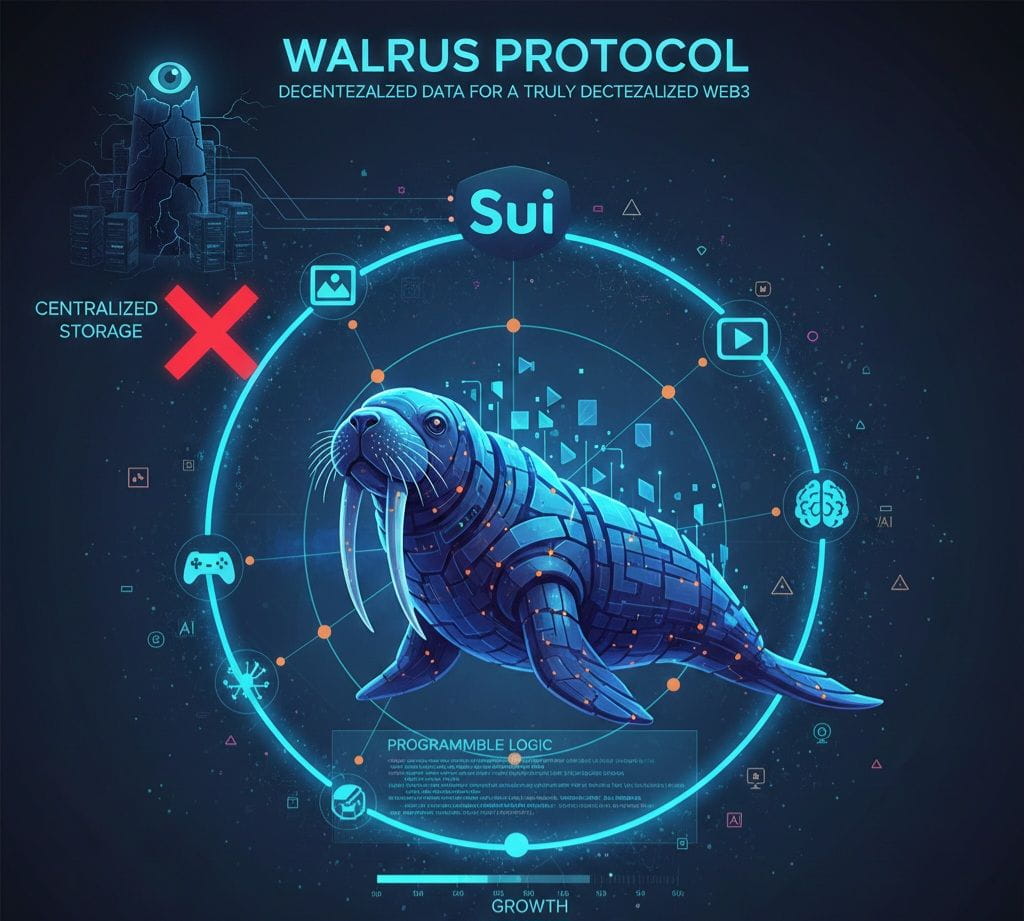
Walrus is built on the Sui blockchain and this choice is not random Sui uses an object centric model that allows Walrus to treat data as living objects instead of static files This means that storage is more than a simple save and forget operation The lifecycle of data can be programmed into logic You can decide when data expires who can access it and who must renew it All of these behaviors are controlled by programmable logic inside the network
Traditional cloud systems work on one assumption trust the provider But Walrus removes this assumption Files are divided into smaller parts and distributed across many independent nodes Even if some nodes go offline the data still remains accessible This means there is no single point of failure and the network stays reliable for everyone
Another advantage of this design is efficiency In old storage systems copying the entire file to every node is expensive and wasteful Walrus uses special encoding techniques so that redundancy is controlled without reducing reliability This allows the network to grow horizontally without making the architecture complex or costly
Walrus is focused not just on storing data but on proving that the data really exists and is available Metadata and availability proofs are stored on the blockchain and can be verified by anyone Users do not have to blindly trust a storage provider The system itself gives proof that the data is stored and can be accessed This difference is a real line between centralized clouds and decentralized storage
The economic layer of Walrus is not decoration It is a functional part of the WAL token ecosystem Users who use storage pay and those who provide storage earn The network is secured through staking Participants can influence key parameters through governance Without aligned incentives decentralized storage is not sustainable
One subtle effect of this design is that the community does not remain only spectators Those who stake WAL or operate nodes are directly involved in the network They have a voice in pricing penalties upgrades and future direction These decisions are not made behind closed doors but through transparent community governance
From a use case perspective Walrus has a wide scope Media and metadata for NFTs can remain stable and not depend on a single centralized server Games do not have to rely on one server for their assets AI projects can store large datasets in a permissionless and verifiable manner In the long term data itself can become a tradable and programmable asset
Another important point is interoperability Walrus is not designed only for a crypto native audience Developers can integrate with traditional web tools This reduces friction for adoption and makes decentralized storage feel practical and not only ideological It makes it easier for developers to build applications that use Walrus without learning a completely new stack
Looking to the future Walrus seems to be part of a larger shift Just as computation and consensus have become decentralized data should become decentralized too As long as storage remains centralized the Web3 stack will remain incomplete Walrus aims to fill this missing layer Its claims are measured and it takes an infrastructure first approach If the next generation of applications truly wants to be decentralized they will have to treat data with as much seriousness as they treat execution The Walrus Protocol is an expression of that seriousness
Walrus shows that Web3 can go beyond tokens and smart contracts and finally deal with real world data in a decentralized way This is the next step for the evolution of the internet and for building applications that are truly free from central control and truly owned by the people who use them