

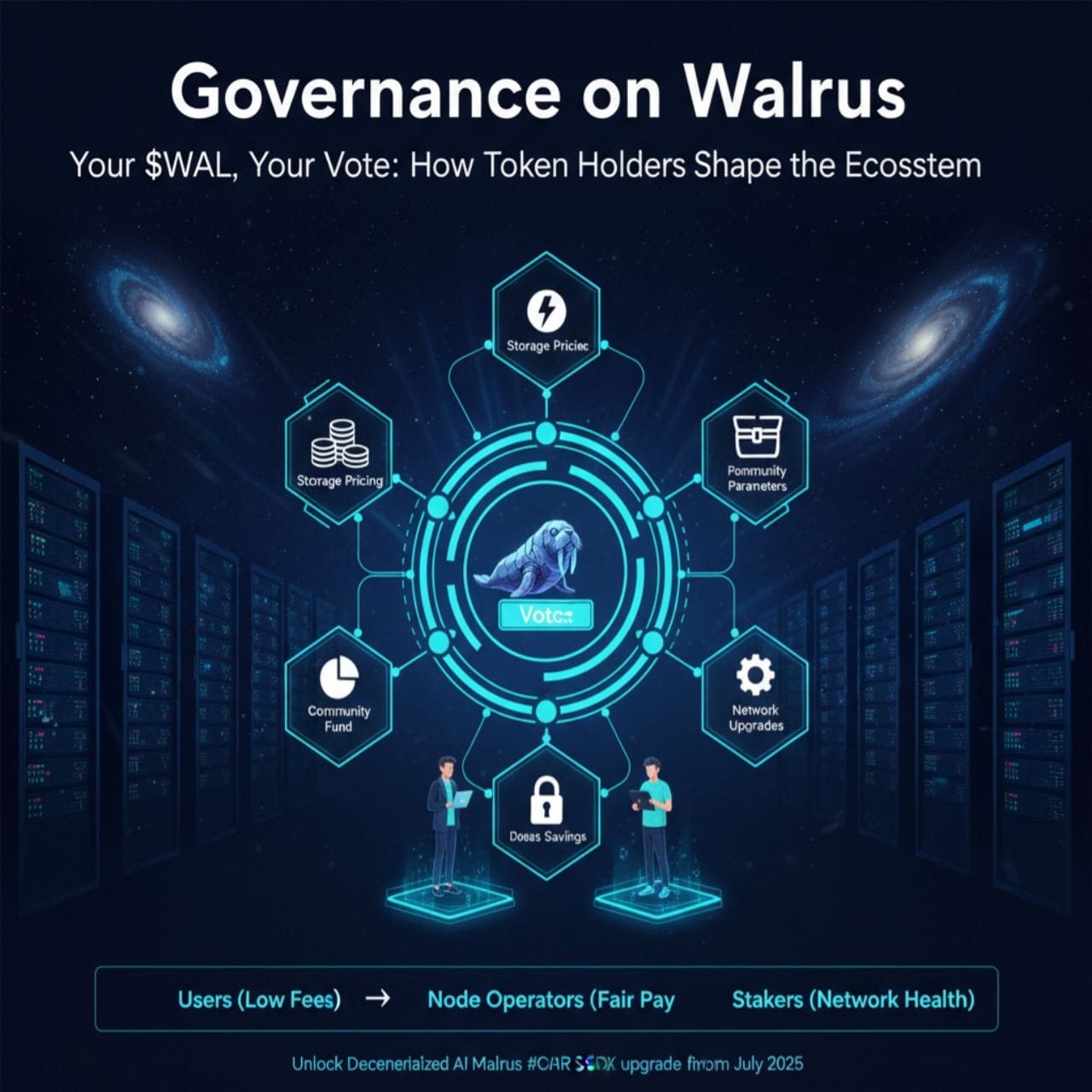
Let’s dig deeper into what “governance” truly means for Walrus. Beyond the surface-level buzzwords, governance here is about real people taking the reins and making decisions that have a direct impact on the network’s direction and health. When you hold $WAL and decide to stake it, you’re not just watching from the sidelines. You’re stepping into an active role—one that gives you the authority to help determine everything from how storage is priced, to what upgrades get rolled out, to how the underlying incentives work.
Here’s How It Works
Walrus operates on a Delegated Proof-of-Stake (DPoS) framework. In plain terms, the more $WAL you lock up as stake, the stronger your influence on the network’s direction. This isn’t just a passive holding. You have the option to either run a node yourself—becoming a direct participant in consensus—or you can delegate your tokens to a trusted node operator, effectively lending them your voting power. Either way, your tokens are your voice, and they count when it matters most.
Governance isn’t random or chaotic. Decisions are made at set points in time, known as epochs. This structured approach means that no one can arbitrarily change things overnight. When it comes time to debate and vote on protocol settings—like adjusting storage prices, tweaking network fees, or changing incentives—your influence is proportional to your staked $WAL. It’s a straightforward, fair system: stake more, have a bigger say.
What Do You Actually Vote On?
Your influence isn’t limited to obscure technical tweaks. As a participant, you’re helping to guide the entire economic landscape of Walrus. Here are some of the major issues that regularly come up for a vote:
- Storage Pricing: Ensuring Walrus remains competitive with giants like AWS, balancing affordability for users with sustainability for node operators.
- Protocol Fees: Deciding how transaction fees are split—between the treasury for future development, node operators for their service, and stakers for their commitment.
- Penalties: Calibrating the system to keep node operators honest, but also making sure that occasional small mistakes don’t result in undue punishment.
- Community Fund: Allocating resources to where they’ll have the most impact—developing new tools, funding grants for developers, launching community projects, or supporting marketing initiatives to spur growth.
Why It Matters
This system isn’t just theory—it’s an ongoing, real-world feedback loop. The needs of users, node operators, and stakers naturally intersect and sometimes conflict. Users want storage to be cheap and reliable. Node operators want fair compensation for their work. Stakers want the network to be robust and their rewards to be meaningful. If storage becomes too costly, the community can band together and vote to lower it. If rewards start to lag, that can be addressed collectively. The protocol can adapt quickly, responding to real-world conditions and feedback, without waiting for a centralized authority to intervene.
Your Stake Isn’t Just a Number
The promise of decentralization only becomes reality when people get involved. Simply holding $WAL isn’t enough to make a difference. By staking—and by either voting directly or choosing a node operator who reflects your priorities—you’re taking part in shaping the future of the network. This is a hands-on role, not a passive one. Every vote, every delegation, is a real act of participation that ripples out across the entire ecosystem.
Quick Answers
Do you lose tokens if your vote doesn’t win? No—your staked tokens remain yours, regardless of outcome. Just remember, if the node operator you back breaks the rules, penalties can apply, so it’s important to choose wisely.
Can you change your vote? Not in the middle of an epoch. Once your vote is submitted for that round, it’s locked until the epoch concludes. This ensures stability and prevents last-minute manipulation.
Is there a minimum to vote? Typically, yes. Minimums are set to prevent spam and ensure the process remains efficient. The current requirements can always be found in the Walrus Governance Portal, so it’s easy to stay informed.
Governance is the invisible but essential engine that fuels Walrus. By casting your vote with $WAL, you’re not just holding a digital asset—you’re actively contributing to the operation and evolution of a global, decentralized storage platform. That’s a level of impact and responsibility that goes far beyond passive investment.
Want to see what’s being debated right now? Visit the Walrus Foundation dashboard to review the latest proposals and see where your voice can make a difference. Always remember: your stake is your voice. Use it to shape the future you want to see.
Disclaimer: This is not financial advice. It’s intended to help you understand how the protocol works. Make sure you do your own research before getting involved.