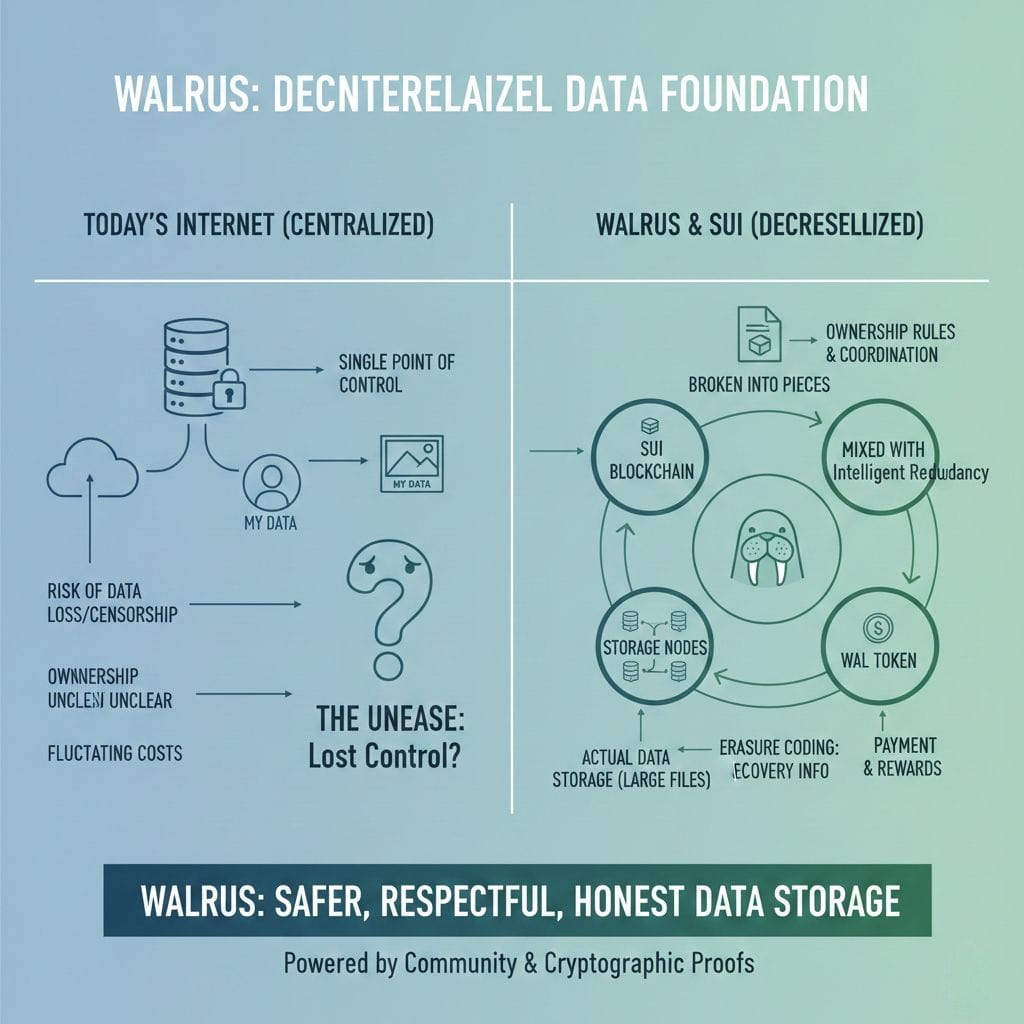
When I try to explain Walrus to a friend I never start with technology I start with a feeling most of us already recognize That quiet unease when you upload something important to the internet.
A photo a project a memory something you worked hard on It lives somewhere far away owned by someone else under rules you did not write Walrus begins right there with that feeling and asks a gentle question What if storing data felt safer more respectful and more honest
The internet today depends on centralized storage and most of the time it works fine until one day it doesn’t Prices change Access disappears.
Platforms shut down Sometimes there is a reason sometimes there isn’t Either way the control is not yours We’re seeing data become more valuable more sensitive and more powerful with time It is no longer just files It is identity creativity history and leverage Walrus exists because a group of builders believed data deserved a stronger foundation
Walrus is built alongside the Sui blockchain but not in a way that overwhelms you with complexity Instead it makes a very human choice It separates responsibility.
Sui is used to manage ownership rules and coordination while Walrus focuses on storing the actual data.
This matters because blockchains are good at keeping truth and structure but terrible at holding large files Walrus respects that reality Instead of forcing data into the wrong place it builds a system where each part does what it does best
When someone stores a file on Walrus the process feels thoughtful First the file is linked to an onchain object that represents ownership.
This is important because it makes ownership clear not implied Then the file is prepared for decentralized storage It is broken into many pieces and mixed with extra recovery information Those pieces are spread across independent storage nodes No single node holds everything No single failure can erase the data Even if many parts disappear the original file can still be rebuilt
This process uses a technique called erasure coding but the name is less important than the intention Instead of making endless copies Walrus designs redundancy intelligently.
It creates strength without waste It is like spreading parts of a story across many places with enough backup that the story survives even if chapters are lost This approach keeps storage costs lower while still protecting against failure censorship and disruption It is quiet resilience not flashy strength
Walrus focuses on large unstructured data things like videos game assets datasets and application files This focus is deliberate Rather than trying to do everything Walrus chooses to do one thing well They’re betting that as applications become richer and more immersive reliable storage for large data will matter more than ever Not exciting storage just dependable storage
WAL is the token that keeps this system alive but it is not meant to be just a speculative object It is how storage is paid for and how contributors are rewarded When someone pays to store data that value flows over time to the nodes that actually hold the file and to those who help secure the network through staking.
The logic is simple and human If you want something protected you pay for that protection If you help protect it you earn from doing so
One detail that makes Walrus feel grounded is how it thinks about cost Real people think in real money not charts Walrus designs its system so storage pricing aims to remain stable in real terms even when the token price moves.
That does not remove all risk but it shows care for real users not just traders It suggests a desire for long term use rather than short term attention
Of course Walrus is not perfect It depends on Sui for coordination which means issues at the base layer can affect it.
The technology behind erasure coding is powerful but complex and complexity always carries risk Adoption is also a challenge because centralized storage is familiar and easy Walrus has to earn trust through reliability not promises Acknowledging these weaknesses does not weaken the project It makes it more honest
If you want to understand whether Walrus is healthy over time look beyond excitement Look at whether files are consistently available Look at how the network responds when nodes fail Look at whether storage capacity grows with real usage.
Look at whether incentives keep operators engaged without concentrating power These signals matter more than short term activity on Binance or anywhere else
The most realistic future for Walrus is not domination of the cloud It is quiet integration into places where decentralization truly adds value.
Projects where ownership matters where availability must be provable where trust should not depend on a single company staying friendly forever.
If It becomes a trusted layer people rely on without thinking too much about it then Walrus has succeeded
In the end Walrus is about patience It is about building infrastructure that respects time ownership and resilience When people feel confident that their data will last they create more freely.
That confidence does not arrive loudly It arrives quietly and it stays.