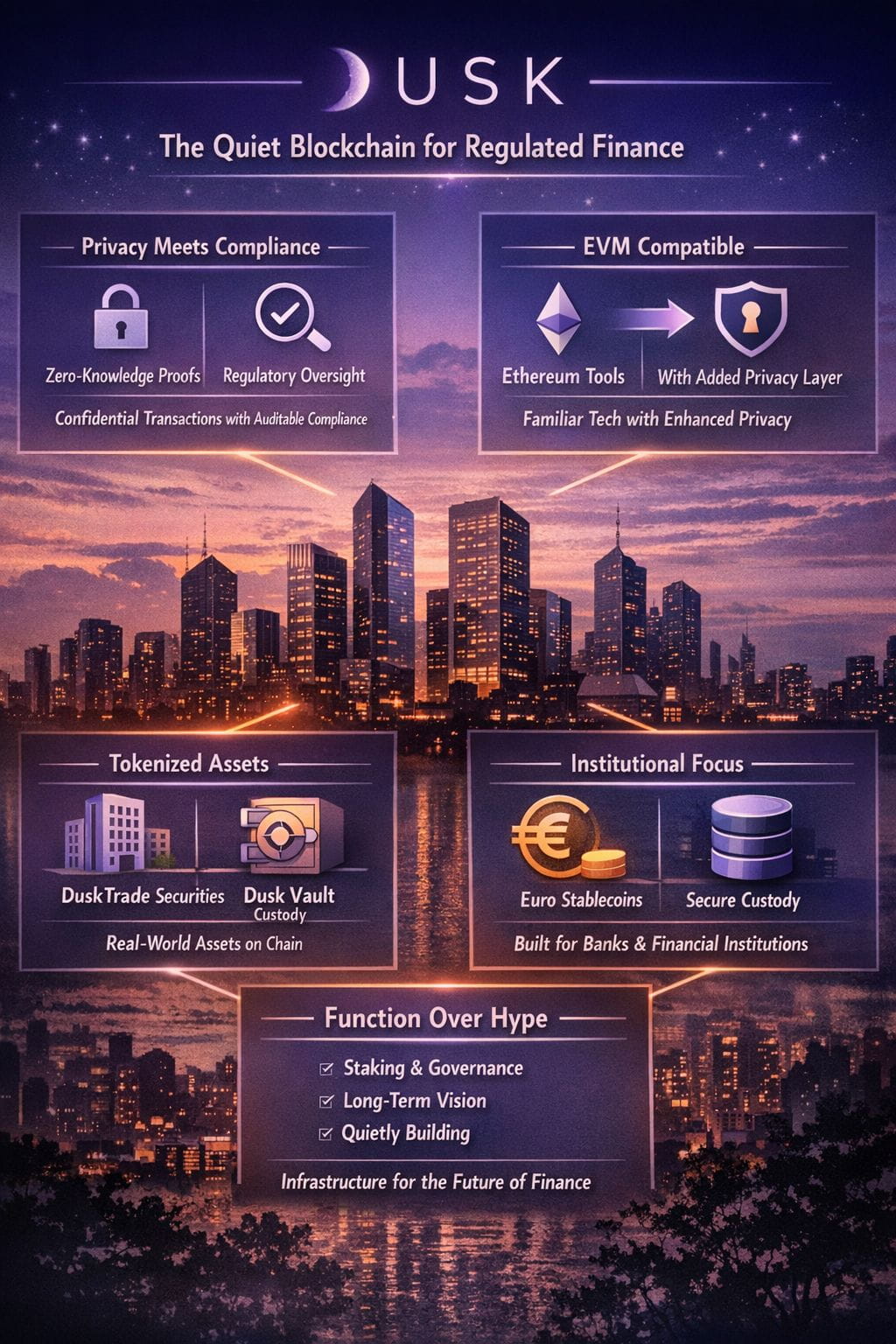
Dusk is not trying to be loud,viral, or trendy. It is not chasing meme culture or fast hype cycles. Instead, Dusk is building something far more ambitious and far more difficult: a blockchain that regulated financial institutions can actually use without breaking the rules. At its core, Dusk is a privacy-focused Layer-1 network designed for real money, real companies, and real laws. The kind of blockchain banks, exchanges, and asset issuers don’t laugh off—but slowly start to take seriously.
The vision behind Dusk is simple to explain, yet extremely hard to execute. Financial markets need privacy. Traders, investors, and institutions cannot expose positions, balances, or strategies on a fully transparent public ledger. At the same time, regulators demand oversight, audits, and compliance. Most blockchains choose one side: either full transparency or total privacy. Dusk chooses both. It is built on the idea that privacy and compliance are not enemies—they can coexist if cryptography is used correctly.
This is where Dusk’s technology stands apart. The network uses advanced zero-knowledge cryptography, allowing transactions to remain confidential while still being provably valid. In plain words, Dusk lets you prove something happened correctly without showing sensitive details. Institutions can keep data private, but regulators can still verify that rules were followed. This approach is not about hiding from the law; it is about respecting privacy while honoring it.
Behind this vision is a focused leadership team. Emanuele Francioni, the founder and CEO, has consistently positioned Dusk as infrastructure rather than speculation. Alongside him, Fulvio Venturelli has shaped the network’s technical and cryptographic direction. The project has never marketed itself as a “quick profit” chain. Instead, it has spent years quietly building, testing, and aligning with regulated financial frameworks, particularly in Europe.
By 2026, that long preparation phase turned into action. This year is widely considered Dusk’s real launch era. The rollout of the DuskEVM marked a critical milestone. By becoming EVM-compatible, Dusk opened its ecosystem to developers already familiar with Ethereum tooling, while adding a privacy layer that Ethereum itself cannot natively provide. This is important because institutions do not want to rebuild everything from scratch—they want familiar systems enhanced with better guarantees.
Alongside the EVM launch, Dusk introduced platforms designed specifically for real-world assets. DuskTrade is built to support the issuance and trading of tokenized securities, not experimental tokens. Think equities, bonds, and regulated financial instruments moving on-chain in a compliant way. Complementing this is Dusk Vault, which focuses on institutional-grade custody—another critical requirement for serious players who cannot rely on retail wallet standards.
The ecosystem is structured, intentional, and conservative by crypto standards. Stable settlement matters. That’s why euro-based stable assets are being integrated, enabling institutions to transact in familiar denominations rather than volatile currencies. Oracle infrastructure has also been prioritized so that off-chain data, pricing, and verification can flow securely into the network.
The DUSK token itself is not just a trading asset. It secures the network through staking, governs protocol decisions, and incentivizes validators and builders. Its role is functional before speculative. On Binance, where DUSK has maintained strong liquidity and visibility, the token reflects growing market interest tied closely to product delivery rather than empty promises. Volume spikes have tended to follow real announcements mainnet progress, infrastructure launches, and ecosystem expansion rather than vague hype.
What makes Dusk particularly interesting is its tone. It does not promise to replace the global financial system overnight. It doesn’t claim banks are obsolete. Instead, it accepts a hard truth many crypto projects ignore: finance moves slowly, regulation matters, and trust is earned over time. Dusk is building rails, not revolutions. And those rails are designed to carry real value.
There are, of course, challenges ahead. Regulatory clarity is never guaranteed. Institutional adoption takes patience. Technology must prove itself under real stress, not just test environments. But Dusk’s strength lies in its alignment with reality. It is not fighting the system it is quietly integrating with it.
In a market full of noise, Dusk feels different. It feels like infrastructure you don’t notice until it’s everywhere. If blockchain is ever to truly merge with traditional finance, it won’t happen through memes or maximalism. It will happen through projects like Dusk calm, deliberate, and built for the long game.