

Efficiently storing large volumes of data remains a major challenge in the blockchain and decentralized application space. While traditional blockchains handle token balances and simple transactions effectively, they struggle with large files such as videos, datasets, or high-resolution images. Uploading such content directly to a blockchain is slow, expensive, and often impractical. Early decentralized storage solutions addressed centralization concerns but often relied on full-file replication across multiple nodes, which drives up costs and wastes storage capacity. Walrus, built on the Sui blockchain, addresses these limitations by combining scalable, cost-efficient storage with blockchain programmability, offering a solution that is practical, secure, and flexible for developers, enterprises, and individuals.
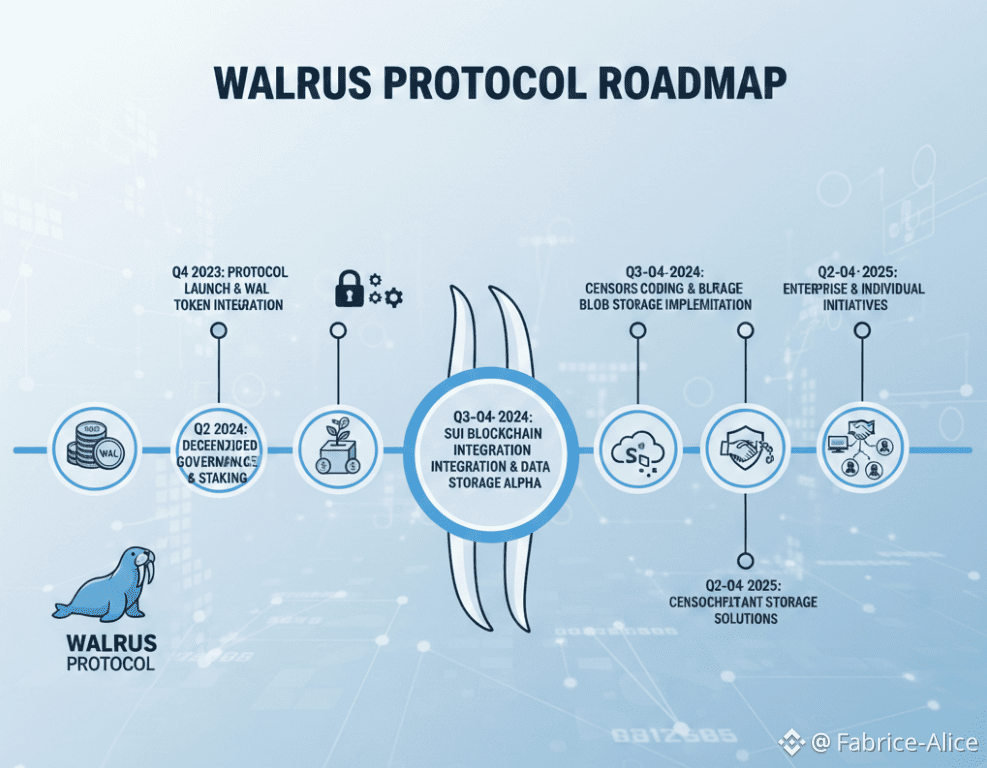
Walrus separates data storage from blockchain management. When a user uploads a file, only its metadata and cryptographic proofs are stored on-chain, while the actual data is split and distributed among a network of storage nodes. This design allows Sui smart contracts to reference, verify, and manage stored files programmatically. Permissions, expiration rules, and other access controls are enforced directly through the blockchain without requiring the network to host the full file. To maximize resilience and efficiency, Walrus employs erasure coding: files are divided into many fragments and encoded so that even if multiple nodes go offline, the original file can still be reconstructed from a subset of pieces. This method mirrors the redundancy strategies of traditional data centers but is adapted for a decentralized, peer-to-peer network. The result is a storage solution that reduces costs compared to simple replication while maintaining high reliability.
Central to the ecosystem is the WAL token, which underpins the network’s economic model. Users pay WAL to store data, and tokens are gradually distributed to storage nodes as compensation. Token holders can stake WAL to support nodes, participate in delegated proof-of-stake mechanisms, and earn rewards for maintaining uptime and reliability. WAL also enables governance: holders can vote on proposals related to storage pricing, rewards, and protocol upgrades. In this way, WAL aligns the incentives of users, node operators, and the broader community, reinforcing network security and encouraging dependable performance.
Walrus is not a standalone blockchain but a layer integrated within the Sui ecosystem. By leveraging Sui for metadata storage, transaction validation, and smart contract execution, Walrus benefits from a high-performance blockchain while avoiding its limitations in handling large files. The platform also offers APIs and developer tools that allow data stored on Walrus to be used by applications beyond Sui, bridging traditional Web3 infrastructure and decentralized storage needs.
Practical applications are already emerging. Developers can host decentralized media—such as NFT content, video streams, and game assets—without relying on centralized servers. Large datasets for AI research or enterprise analytics can be stored securely and efficiently, bypassing the cost and limitations of on-chain storage. Decentralized applications gain a reliable backend for user-generated content, configuration files, and other critical data. Since its mainnet launch, Walrus has been integrated into multiple Sui projects and has drawn attention from both developers and investors for its tangible utility.
Nonetheless, challenges remain. Creating sustainable incentives for nodes to remain online and honest over the long term is complex. Walrus competes with established decentralized storage networks like Filecoin, Arweave, and Storj, and its adoption will hinge on performance, cost-effectiveness, and ecosystem integration. Early-stage decentralized networks also risk concentration of stake among a few nodes, raising potential centralization concerns. Additionally, while erasure coding and recovery mechanisms enhance reliability, they introduce technical complexity that must be carefully managed as the network scales.
Looking ahead, Walrus aims to establish itself as a foundational layer for decentralized storage. By combining blockchain programmability with efficient large-file storage, it offers developers and enterprises a practical alternative to centralized cloud solutions while preserving security and censorship resistance. Its future success will depend on growing adoption within Sui, expanding integrations across other ecosystems, refining incentives for node operators, and consistently demonstrating reliable performance at scale. If these objectives are achieved, Walrus could become a critical infrastructure layer for Web3, supporting NFT platforms, decentralized media, enterprise data, and scientific datasets alike.
Ultimately, Walrus represents more than just a token or storage network; it embodies a strategic solution to one of the most persistent bottlenecks in decentralized technology. By bridging the gap between on-chain programmability and off-chain efficiency, it enables blockchain applications to manage large-scale data securely, sustainably, and in a decentralized manner. While still in its early stages, Walrus’s design and vision position it as one of the most compelling projects in the evolving decentralized storage landscape.