


Dusk stabilizes before anyone can say what failed.
Traffic keeps flowing. Outputs still line up. On the liveness view it is boring, Dusk validators answering, attestations forming though... blocks sealing like nothing touched them.
The graph stays green. The Dusk's attestation certificate hash still is not a sentence you're allowed to circulate.
A path got heavier. Something rerouted. No "stop" moment. No incident language you're allowed to use yet.
A fallback engaged, but only the way you notice later... timing shifts, a different route doing more work, capacity holding a little too clean. Nothing crosses the lines your role can escalate on. Nobody files. The queue keeps moving because the alternative is pausing on a hunch you can't defend inside scope.
On Dusk, "add eyes" isn't a reflex.
It is actually an entitlement change. Names added to a viewer list. Someone's signature on the scope note. Someone else owning the why.
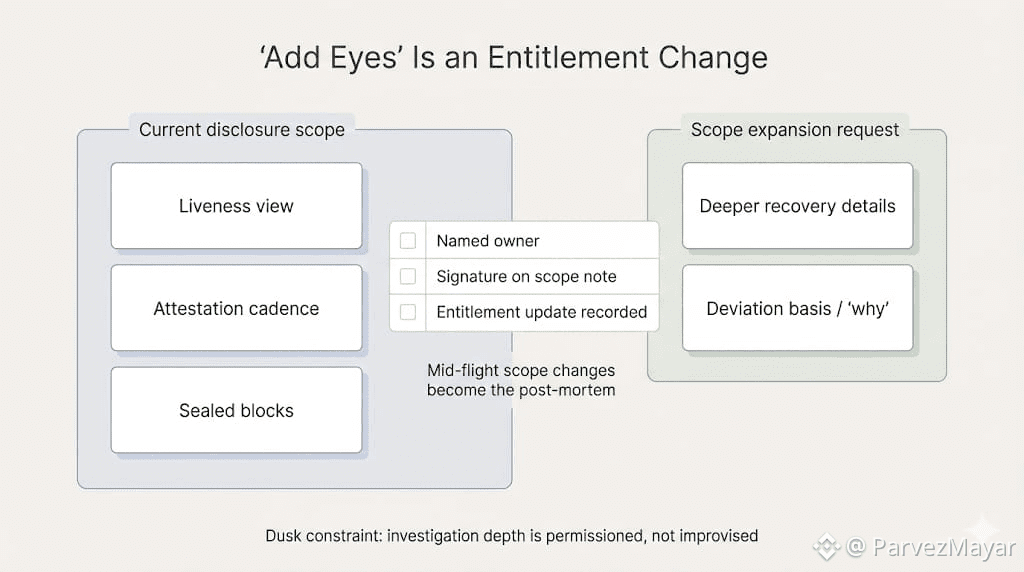
So the recovery engineer does the only safe thing... keep correctness intact, write the deviation down, dont widen anything mid-flight. You do not want the post-mortem to become "why did you expand disclosure', when the committee never stopped ratifying.
Nobody says "this is fine". They just keep routing like it is.
Silence turns into a convenience. If the network kept producing valid states, what exactly are you stopping? If nothing tripped, what exactly are you escalating?
Days later the trail gets opened for a different reason. Close out memo. "Return to baseline" box. Someone pings, "can we close this today?" Someone wants the day to read normal.
Outputs match. Ledger is clean. Yet one segment never returned. Not broken. Just… different. More overhead than before. Less slack. A recovery path that stayed 'temporary' by never being named temporary.
No artifact that says "failure here." Not in the shareable slice. Not in the version that survives internal review without reopening Dusk disclosure. Just a gap you can point at and a boundary you can't cross fast enough to explain it... because the certificate is the only thing you are allowed to stand behind.
The memo gets three words and a date.
Recovered. Contained. Stable.
Meanwhile, the behavior change is already live. Teams start treating "stayed live" as "resolved." They stop expecting the missing failure story to arrive later, because later is still scoped and the scope owner is still never on the call when the fallback flips.
Next time, people route like the fallback is normal. Because last time nothing bad happened.
Nothing they could see.
Validity holds. Paperwork closes. The extra cost just sits there, unnamed, in the path everyone now treats as standard. #Dusk $DUSK @Dusk