

I want to talk to you today the same way I would talk to people who have been around long enough to feel patterns instead of chasing signals. This is not about convincing anyone of anything. It is about sharing an observation that has been forming slowly but clearly. Dusk has reached a stage where it no longer feels like a project explaining why it exists. It feels like infrastructure that quietly fits the direction the world is moving, whether people are ready to admit it or not.
If you rewind a few years, Dusk was often misunderstood. People grouped it with privacy chains without really understanding the distinction. Others dismissed it as too institutional, too cautious, too serious for a space driven by experimentation and speed. At the time, that criticism made sense in a market that rewarded noise. But markets evolve. And when they do, the qualities that once looked boring start looking responsible.
Over the most recent cycles, Dusk has made real progress that changes how it should be evaluated. The network has matured in ways that are visible if you look past surface level chatter. Core infrastructure has been reinforced. Consensus behavior has become more predictable. Validator performance has stabilized. Network uptime and reliability have improved. These are not marketing points. They are the minimum requirements for hosting financial activity that involves real consequences.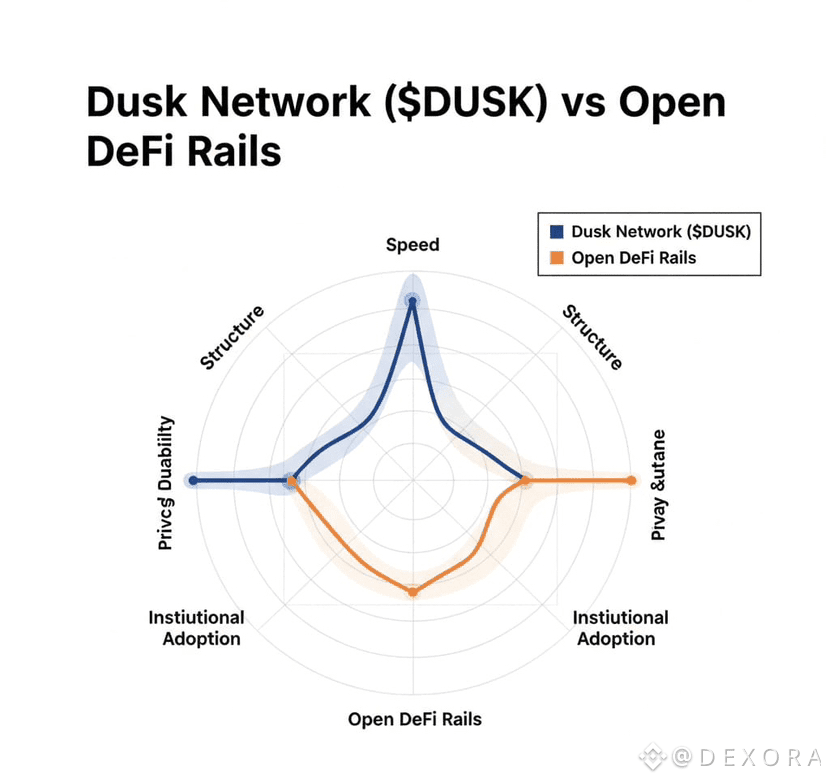
One of the most important developments has been how Dusk has refined its approach to privacy. This was always the foundation, but now it feels operational rather than conceptual. The zero knowledge systems underpinning the network have been optimized so confidential transactions and smart contracts can execute efficiently. Privacy no longer feels like a heavy feature that slows everything down. It feels native. More importantly, privacy on Dusk is not absolute secrecy. It is selective. Information is protected by default but can be proven or disclosed when rules demand it.
That distinction matters more than ever. The world is not moving toward a fully anonymous financial system, and pretending otherwise has only delayed adoption. Institutions and regulated entities need assurance that actions are valid without exposing everything publicly. Dusk provides that balance. It allows truth to be proven without forcing data into the open. Recent upgrades have made this mechanism more robust and easier to integrate into real applications.
Confidential smart contracts are where this balance becomes tangible. Over the latest releases, these contracts have become more usable and more efficient. Developers can now deploy logic that operates on private data while remaining verifiable by the network. That opens doors that transparent blockchains simply cannot open. Financial agreements, private market instruments, and regulated asset flows require confidentiality to function. Dusk is not experimenting with these ideas anymore. It is enabling them.
Settlement is another area where Dusk has quietly strengthened its position. In financial systems, settlement is trust. Once something settles, both sides move on with certainty. Recent improvements to block finality and execution consistency make the network feel more dependable in this regard. This might sound subtle, but it is critical. Privacy without reliable settlement is fragile. Speed without certainty is dangerous. Dusk prioritizes certainty.
Validator infrastructure has also seen meaningful improvement. Running a validator is more predictable than it used to be. Resource requirements are clearer. Performance is more consistent. Delegation mechanisms are easier to understand, which lowers the barrier for participation. This matters because decentralization is not just about ideology. It is about whether people can realistically participate without constant friction. A healthier validator ecosystem leads to a healthier network.
The role of the DUSK token has become more grounded as well. It has always been part of staking and governance, but its connection to actual network activity is stronger now. Fees, staking rewards, and participation incentives are increasingly tied to real usage. This aligns value with function. Instead of relying on attention cycles, the token derives relevance from necessity. As the network is used, the token is used.
Governance has matured alongside this. Decision making is becoming more structured and more informed by stakeholders who are actually involved in the ecosystem. There is a noticeable emphasis on stability and long term planning. Changes are not rushed. They are discussed with awareness of downstream impact. This kind of governance culture is essential for systems that want to host regulated assets and serious financial flows.
Developer experience is another area where progress is evident. Building on Dusk used to require deep familiarity with protocol internals. That barrier has been steadily lowered. Tooling has improved. Documentation has become more practical. Testing environments are more robust. These improvements matter because adoption does not happen on vision alone. Builders choose platforms that respect their time and reduce friction.
Security remains a constant theme across all these updates. Dusk does not rush features into production. Upgrades are tested carefully. Monitoring and diagnostics have improved, allowing issues to be identified early. Safeguards around execution and consensus continue to be refined. This approach sacrifices speed in exchange for reliability, which aligns with the type of users Dusk is targeting.
What I find most interesting is how the conversation around Dusk has changed. It used to revolve around explaining why privacy with compliance was even desirable. Now the discussion is more practical. People talk about deployments, pilots, and real use cases. That shift in tone usually means a project has moved from defending its existence to demonstrating its value.
The broader environment also plays into this. Regulation is no longer optional. Tokenization of real world assets is accelerating. Institutions are actively exploring blockchain settlement. At the same time, privacy expectations are increasing. People want control over their information. Businesses want to protect strategies. Regulators want proof without chaos. These pressures converge rather than conflict. Dusk sits at that intersection.
One thing Dusk does particularly well is respecting the lifecycle of real assets. Assets are not just created and traded. They have rules. They have restrictions. They change over time. Some expire. Some require permissioned access. Dusk designs for this reality. It does not force real world complexity into simplistic models. It provides tools that reflect how finance actually works.
This is why Dusk often feels calmer than other projects. There is no urgency to chase trends. No sudden pivots to attract attention. Development feels deliberate. Each release builds on the last. Each improvement serves a clear purpose. That discipline is rare in this space and usually signals a long term mindset.
It is important to be honest. Dusk is not finished. Privacy systems are complex. Adoption takes time. Education remains a challenge. Integrations need to expand. Competition will not disappear. But what matters is the order in which problems are being solved. Infrastructure first. Reliability first. Compliance first. These priorities may not generate hype, but they build systems that last.
If you are here expecting fireworks, Dusk might disappoint you. If you are here because you believe blockchain needs to grow up, Dusk makes a lot of sense. It feels like infrastructure built for responsibility rather than excitement. For durability rather than speed alone.
Looking ahead, the path feels clear even if it is not flashy. More advanced confidential contracts. Deeper support for tokenized real assets. Continued refinement of consensus and settlement. Stronger governance participation. Gradual but meaningful institutional engagement. These are not speculative hopes. They are logical next steps given what has already been built.
As a community, this is the phase where patience matters. These are the moments when foundations are set and mistakes are avoided. When systems are shaped quietly rather than loudly. Dusk feels like it is in that phase now.
If blockchain is going to be more than an experiment, it needs places where privacy and certainty coexist. Where rules are respected without sacrificing individual dignity. Where trust is engineered, not assumed. Dusk is not trying to convince the world of that vision anymore. It is implementing it.
And if the next chapter of this space is about real finance, real rules, and real people, then projects like Dusk stop being niche. They start becoming necessary.