In order to guarantee availability and durability, early decentralized storage systems mostly depended on full replication. Even though replication is straightforward, it is incredibly wasteful because each extra copy increases storage expenses without correspondingly boosting durability. Reed-Solomon (RS) erasure coding, a method that drastically lowers replication requirements by encoding data into pieces and parity shards, was used by a second generation of decentralized storage services to overcome this inefficiency.
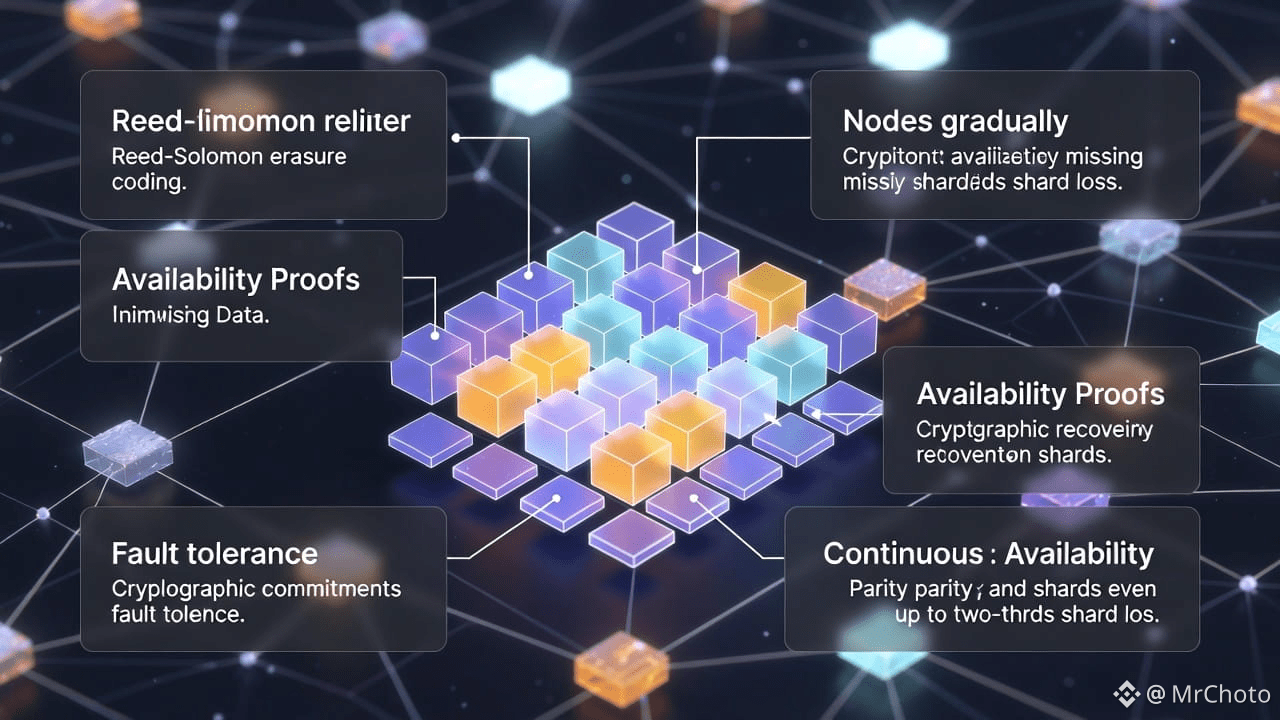
A file can be divided into k data shards and m parity shards using Reed-Solomon encoding so that any k of the total k + m shards can be used to reconstruct the original contents. When compared to complete replication, this method significantly reduces storage costs and enhances fault tolerance in controlled failure circumstances. Despite the logical elegance of RS encoding, there are practical difficulties when implementing it in completely decentralized, adversarial, and asynchronous systems.
Walrus develops the fundamental concept of erasure coding into a system intended for decentralized functioning in the real world. Walrus incorporates erasure coding directly into the protocol's execution, recovery, and incentive mechanisms rather than treating it as a stand-alone optimization. Walrus uses a two-dimensional encoding scheme and sophisticated erasure coding to reassemble data across both rows and columns of encoded shards. Completeness is made possible by this design, which guarantees that even if honest storage nodes miss shards during the initial writing, they will eventually be able to recover and retain their allocated data.
Walrus continues to function in challenging circumstances, in contrast to conventional RS-based systems that frequently stall with partial failures. The network can continue to accept new writes even when up to one-third of shards are unresponsive, and it can withstand the loss of up to two-thirds of shards while still ensuring data recoverability. For decentralized systems, when network partitions, sluggish nodes, and brief outages are frequent rather than unusual, this feature is crucial.
In order to prevent storage nodes from pretending to own data fragments, Walrus also incorporates erasure coding with cryptographic commitments and availability proofs. Inconsistencies can be found and verified on-chain, and every encoded shard is verifiable. This avoids silent data loss, which is a significant flaw in many RS-based systems that depend on synchronous challenges or recurring audits.
The Walrus asynchronous recovery approach is another important difference. Conventional RS deployments frequently presuppose prompt communication and well-coordinated recovery. By allowing recovery to occur gradually without preventing reads or writes, Walrus dispels this presumption. Quorum-based guarantees allow storage nodes to gradually repair missing shards, preserving liveness even during reconfiguration events.
Walrus shows that although Reed-Solomon encoding is an effective technique, it is insufficient for large-scale decentralized storage. Erasure coding is transformed by Walrus from a storage optimization into a fundamental protocol primitive that is closely linked to fault tolerance, verification, and incentives. As a result, the system delivers continuous availability, robust resilience, and low overhead without relying on inefficient replication.
Walrus sets a new standard for effective, safe, and always-on decentralized storage infrastructure by going beyond conventional RS encoding. @Walrus 🦭/acc $WAL