

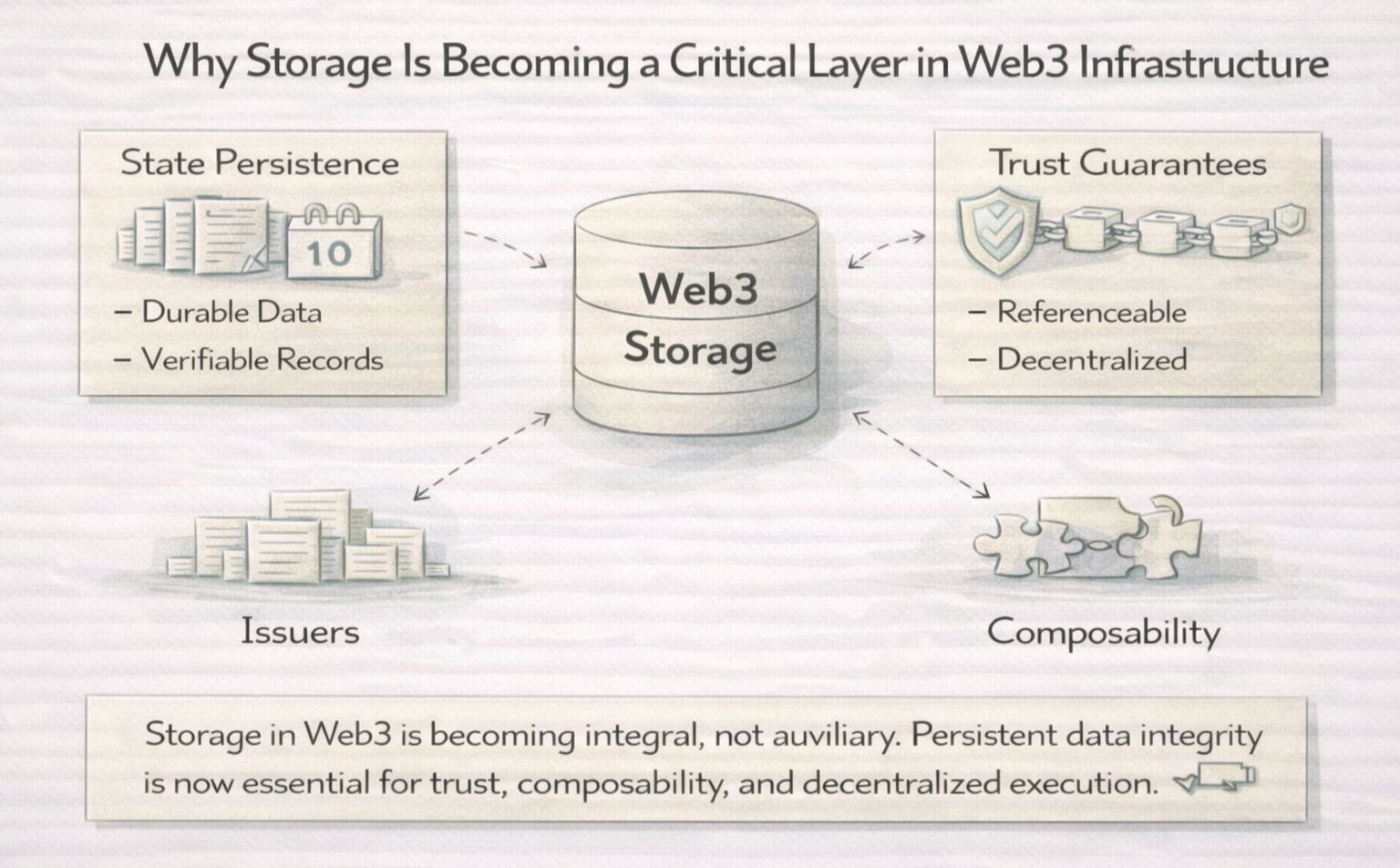
 Why Storage Is Becoming a Critical Layer in Web3 Infrastructure
For a long time, storage sat quietly in the background of Web3. Blockchains executed transactions, smart contracts handled the logic, and storage was treated as an external utility to be plugged in when needed. That separation made a lot of sense when on-chain activity was sparse and episodic. It breaks down as Web3 systems become continuous, stateful, and economically consequential.
The shift is subtle but decisive: data is no longer an artifact of execution. It is part of execution.
Early blockchains minimized storage because it was expensive and hard to coordinate. State was kept small, logic was simple, and anything heavy lived off-chain. As a result, storage evolved as an accessory layer rather than a foundational one. This created a fragile stack where applications depended on data systems that were not governed by the same trust assumptions as the chains they ran on.
Today, that mismatch is no longer tolerable.
Modern Web3 applications generate persistent state: game worlds, identity records, proofs, governance artifacts, financial histories, and agent memory. This data is referenced repeatedly, verified continuously, and relied upon by other systems. When storage is external and weakly coupled, trust leaks out of the protocol and into assumptions.
This is why storage is becoming a critical layer rather than a supporting service.
As execution environments mature, they demand data that is durable, verifiable, and referenceable without ambiguity. Applications can no longer afford to ask users to “trust” that data will remain available or unchanged. Storage must offer guarantees similar to settlement: what was written must remain accessible and correct, or the system’s integrity collapses.
Another pressure comes from composability. Web3 systems are no longer isolated apps. They are networks of contracts and services that build on each other’s outputs. Storage becomes the connective tissue between them. If data cannot be reliably referenced across time and context, composability degrades into coordination risk.
This is also where decentralization stops being ideological and becomes practical. Centralized storage can be fast and cheap, but it introduces single points of failure that ripple through dependent systems. When storage fails, execution may continue but on false premises. Decentralized storage distributes that risk structurally instead of masking it operationally.
Protocols like Walrus exist because storage now has to operate under the same design discipline as execution layers. Data must have identity, lifecycle, access rules, and economic accountability. It cannot be an opaque blob managed by assumptions and hope.
Building on execution-first chains like Sui amplifies this need. When computation is fast and expressive, data usage multiplies. Storage must keep pace not in throughput alone, but in correctness and reliability. Otherwise, performance simply accelerates failure.
There is also a human dimension to this shift. As Web3 moves beyond speculation into coordination, users stop interacting occasionally and start relying continuously. Systems that forget, lose, or mutate data unexpectedly erode trust faster than slow systems ever did. Storage becomes a user experience layer, even if users never see it directly.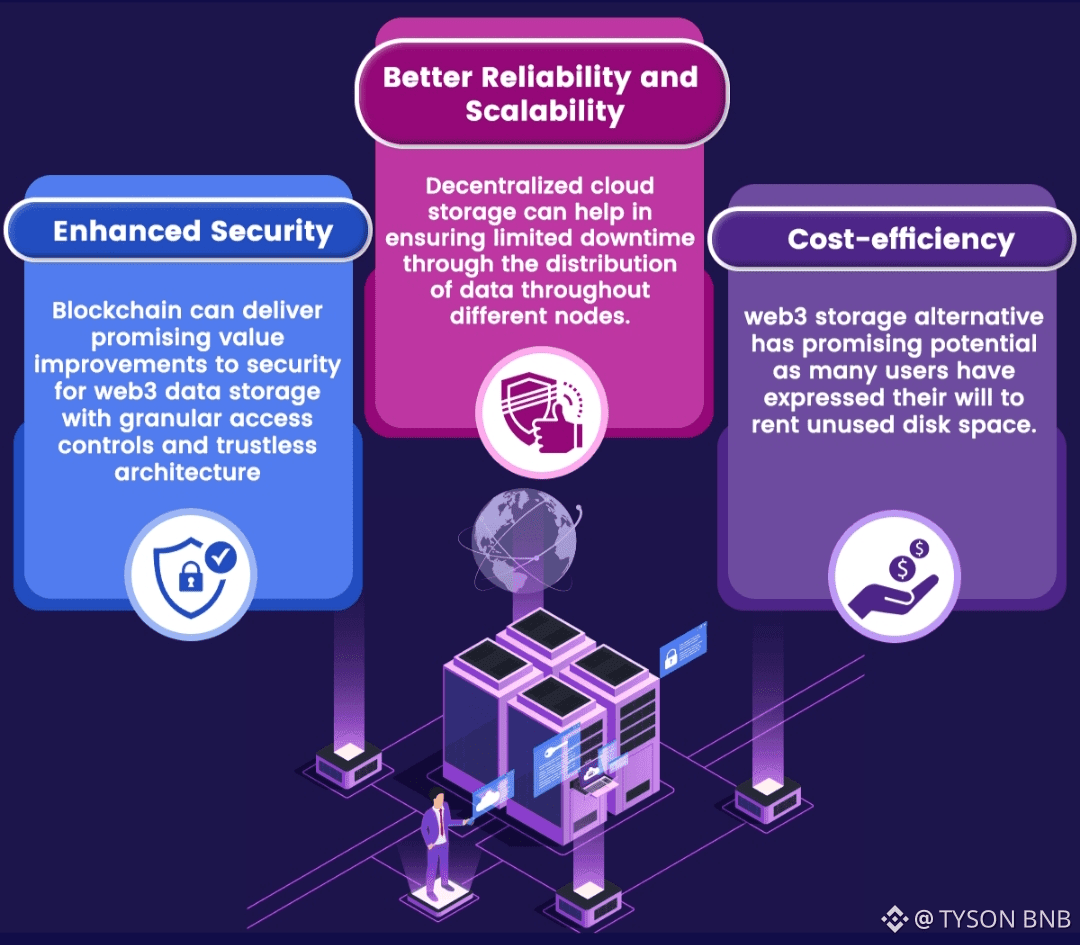
What ultimately makes storage critical is responsibility. Execution decides what happens. Storage decides what persists. In systems meant to outlast individual participants, persistence is power. Whoever controls storage controls memory, history, and reference points for truth.
Web3 infrastructure is maturing. As it does, the stack is reorganizing itself around reality rather than convenience. Execution without durable, verifiable storage is incomplete. Composability without shared data guarantees is illusion. Decentralization without decentralized persistence is temporary.
Storage is no longer the place where data rests. It is the place where systems remember and that makes it foundational.