

There are projects that have waited for demand generation. Other projects have been building silently and well before demand generation. vanar.co falls into the latter. The past two years or so, and specially so for 2024 and 2025, vanar.co has been moving at a speed that can appear slow. However, if one were to look beneath the surface, vanar.co has been building intrinsic foundation and has been willing to feel the pinch of being ahead of times.
Vanar began its life as a Layer 1 blockchain network, albeit one with a very different direction by the latter part of 2024. The project began positioning itself not merely as a blockchain that incorporated artificial intelligence applications, but as a blockchain system itself that is native to artificial intelligence. Again, there are subtle differences. While one approach merely attempts to integrate artificial intelligence into a blockchain system, the other builds upon a fundamentally different inner approach with regard to how data can be contextualized and advice rendered. The latter is far harder to implement, far slower, but far richer in potential.
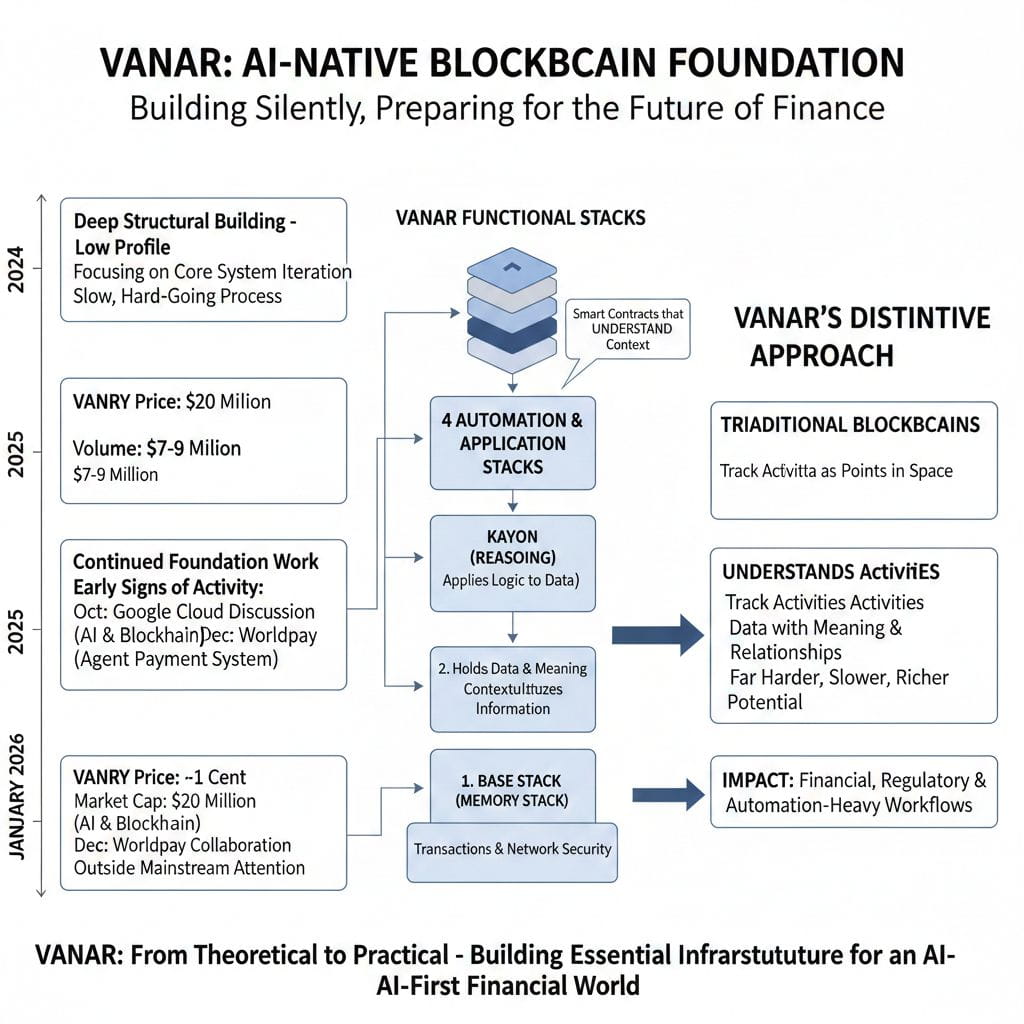
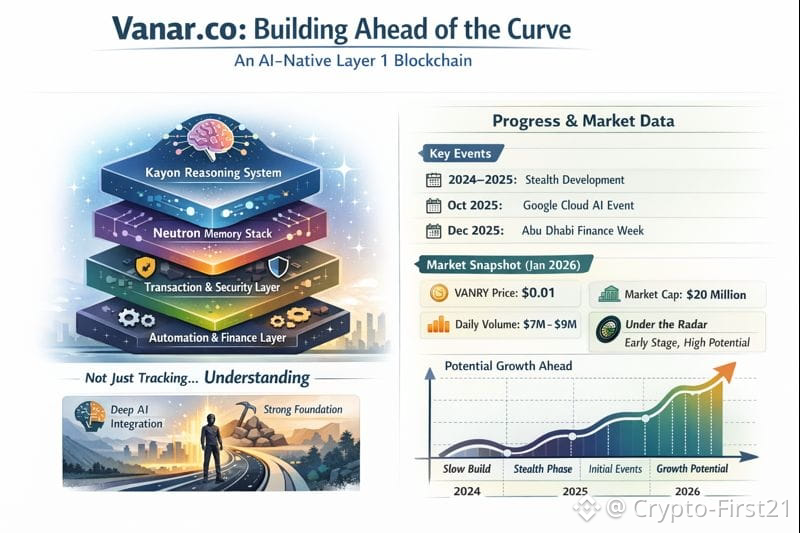
At its core, Vanar possesses a number of functional stacks. First, it possesses a base stack for transactions, as well as network security. The next stack is called Neutron, built as a memory stack to hold not just data, but its meaning. This is important as it contrasts with data being represented by points in space, while relationships are maintained as is. This is important as it is functional for intelligent systems involved in understanding data, not just retrieving it. Next comes the stack called Kayon, essentially a reasoning system applied to the data being held. This essentially allows for decision making at an automated level. Following this, stacks exist for automation as well as practical application in relation to finance and payments.
So, in simple terms, most blockchains track activities. Vanar seeks to understand it. The distinction, while perhaps not so applicable in most minds today, can be extremely powerful with financial, regulatory, and other workflows, especially when they are systemized and automation heavy. A smart contract that can understand its own context can accomplish far more than one that can only execute its code in a way that again mirrors human cognition.
The deeper, structural nature of all this also accounts for Vanar's relative low profile during most of 2024. The work was a slow, hard going process that wasn't easy to talk about with clear metrics. There were no glamourized launches, and the ecosystem gains were perhaps not as impressive as some of the quicker moving projects around the space. However, towards the end of 2025, there were some indications of activity beginning to emerge. Vanar attended a discussion with Google Cloud and its enterprise peers in October with a focus on its work with both AI and blockchain technology, and then also participated with its agent payment system with Worldpay at Abu Dhabi Finance Week in December. While not grabbing the headlines, this marked a move from theoretical into practical space.
In terms of the market, Vanar is still relatively small in size. In fact, as of January 2026, VANRY is still trading at close to a cent. In addition, the market capitalization is at twenty million and volume trades at between seven and nine million. Its relative insignificance in the market puts it far outside the realm of public view.
The deeper, structural nature of all this also accounts for Vanar's relative low profile during most of 2024. The work was a slow, hard going process that wasn't easy to talk about with clear metrics. There were no glamourized launches, and the ecosystem gains were perhaps not as impressive as some of the quicker moving projects around the space. However, towards the end of 2025, there were some indications of activity beginning to emerge. Vanar attended a discussion with Google Cloud and its enterprise peers in October with a focus on its work with both AI and blockchain technology, and then also participated with its agent payment system with Worldpay at Abu Dhabi Finance Week in December. While not grabbing the headlines, this marked a move from theoretical into practical space.
In terms of the market, Vanar is still relatively small in size. In fact, as of January 2026, VANRY is still trading at close to a cent. In addition, the market capitalization is at twenty million and volume trades at between seven and nine million. Its relative insignificance in the market puts it far outside the realm of public view. Those numbers place it far outside of mainstream attention. Still, history would suggest that infrastructure networks often look inconspicuous before their moment arrives. Certainly, Ethereum in its early years, Solana before 2021, and Chainlink before DeFi all are long periods of construction while prices remained subdued.
Being early also has significant, unseen costs. Development drags out more than expected. The community grows much more slowly. Investors become restless. Builders work in a great unknown. For much of 2024 and into early 2025, Vanar endured this phase. Instead of pivoting to quick incentives or hard sell marketing, the team continued to iterate on the core system. That decision probably delayed visibility, but also gave it a far more robust foundation.
But there's a broader trend playing out here, too. Global investment in artificial intelligence infrastructure surpassed two hundred billion dollars in 2025 and grew at a clip of more than thirty percent annually. In the same period, investment in blockchain infrastructure was a fraction of that. The intersection between these two worlds is tiny. What strikes me is how Vanar focuses on regulated environments. Many projects talk about decentralization in the abstract; this one designs directly for financial compliance. Its architecture supports audit trails, identity logic, and regulatory checks baked into the system itself. It's not exciting to speculators, but that's what matters most to institutions. When blockchain is ever to handle large scale payments, settlements, or asset issuance, it can't afford to have compliance as an afterthought.
Of course, technical ambition is no guarantee of success. Complex systems are harder to build and explain, much harder to adopt. Developer tooling, onboarding, and ecosystem growth remain pain points for Vanar. Real world integrations move glacially when finance and regulation are in play. But whereas many networks were competing just on speed or fees, Vanar tried to define a new layer for blockchain functionality.
Projects like this are a test of patience. For long stretches, price action can remain flat, progress comes in milestones, not headlines. But when adoption finally picks up speed, often these foundational networks are the first to move and the fastest to climb. The market tends to reward infrastructure once it becomes essential.
Being early means living with uncertainty. You put in the time, the capital, the energy, yet uncertain about whether the broader market would ever turn up. But when it does, preparation becomes an advantage that cannot be rushed. For one, the architecture of Vanar is premised on a world wherein blockchains aren't merely anticipated to think, adapt, and even interface with the real financial world with ease.
Thus, it’s crucial to ask: how will Vanar’s AI-native stack scale under practical usage? How will apps be built on top of this stack that are actually useful? How will businesses implement systems that are practical for solving business related challenges? It’s under this premise that one can evaluate if Vanar is more than a great experiment.
For now, though, it serves as a reminder that some of the most important work is done quietly, well before the crowds arrive.
