Most people think blockchains are only about money. Prices go up, prices go down, and tokens change hands at lightning speed. But beneath all of that noise is a quieter problem that has never really gone away: where does all the data go? As decentralized applications grow more complex, they generate images, videos, documents, AI models, and entire datasets that simply don’t fit neatly inside a traditional blockchain. Walrus was created to face that problem head-on, and its native token, WAL, sits at the center of this idea.
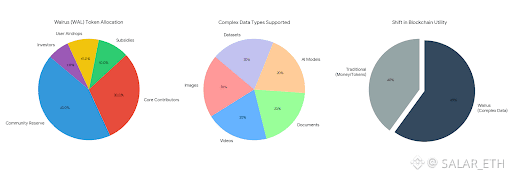
Walrus is not trying to replace blockchains or compete with payment networks. Instead, it focuses on something far more practical: storing large amounts of data in a way that feels natural to Web3. Built on the Sui blockchain, Walrus is designed for what developers often call “blob storage,” meaning large files that are too heavy to live directly on-chain. These blobs might be high-resolution media, machine learning datasets, or application data that needs to be available but not constantly executed. Walrus treats this data as first-class infrastructure rather than an afterthought.
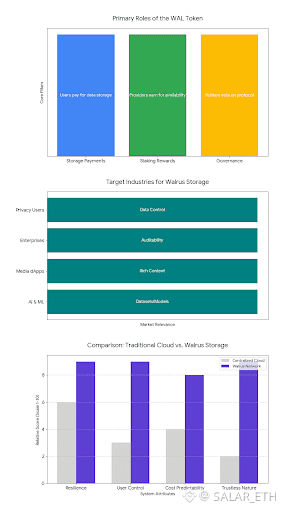
The motivation behind Walrus becomes clearer when you think about how centralized storage works today. Most apps, even Web3 ones, still rely on traditional cloud providers. That means trusting a small number of companies with critical data, accepting censorship risks, and dealing with unpredictable pricing models. Walrus takes a different path. Instead of storing full files in one place, it breaks them into pieces and spreads those pieces across a decentralized network. No single operator holds the whole file, and yet the file can still be recovered reliably when needed.
This approach is made possible through erasure coding, a technique that allows data to be reconstructed even if some pieces are missing. In practice, this means Walrus doesn’t need to duplicate entire files again and again, which would be expensive and inefficient. Instead, it stores fragments in a way that balances resilience and cost. If a few storage nodes go offline, the data is still safe. If demand grows, the system scales without dramatically increasing overhead. It’s a design choice that feels grounded in real-world constraints rather than theory.
What makes Walrus especially interesting is how it uses the Sui blockchain. Sui acts as the coordination layer, managing metadata, access rules, and economic logic. The actual data lives off-chain, but its lifecycle is controlled on-chain. This separation allows Walrus to stay fast and flexible without overloading the blockchain itself. Developers can reference large files on-chain, verify availability, and build applications that feel seamless to users, even when massive amounts of data are involved.
At the center of this ecosystem is the WAL token. WAL is not just a speculative asset; it has a clear role in how the network operates. Users pay in WAL to store data for a specific period of time. Storage providers stake WAL to participate in the network and earn rewards for keeping data available. Governance decisions are also tied to WAL, giving token holders a say in how the protocol evolves over time. This creates a loop where the token supports the infrastructure, and the infrastructure gives the token its purpose.
From a user’s perspective, WAL helps make costs more predictable. Instead of paying ongoing subscription fees that can change without warning, storage is paid upfront for a defined duration. Behind the scenes, those payments are distributed over time to storage providers and stakers. This structure encourages long-term participation and discourages short-term behavior that could harm the network. It’s a subtle design choice, but one that reflects careful thinking about incentives.
The real strength of Walrus becomes obvious when you look at potential use cases. AI developers need to store large datasets and model files that must remain accessible and tamper-resistant. Media-heavy dApps need a way to host content without relying on centralized servers. Enterprises exploring blockchain technology want storage that is auditable, resilient, and not tied to a single jurisdiction. Even individual users who care about privacy can benefit from a system where no single party controls their data. Walrus speaks to all of these needs without trying to be everything at once.
Of course, no protocol exists without trade-offs. Walrus is still relatively young, and adoption takes time. Competing decentralized storage networks already exist, each with their own strengths and weaknesses. Token price volatility can also affect how users think about long-term storage costs, even if the underlying system is designed to smooth those effects. These are real considerations, and they shouldn’t be ignored. Still, the direction Walrus is moving in feels aligned with where Web3 is headed.
What stands out most about Walrus is that it doesn’t chase hype. It focuses on infrastructure, on solving a problem that developers quietly struggle with every day. As blockchains move beyond simple transactions and into data-heavy applications, storage will matter more than ever. Walrus positions itself as a bridge between decentralized logic and real-world data needs, and WAL acts as the fuel that keeps that bridge standing.
For anyone watching the evolution of blockchain technology, Walrus represents a shift in priorities. It suggests that the future of Web3 won’t just be about faster transactions or cheaper fees, but about building systems that can actually support complex, data-rich applications at scale. Whether Walrus becomes a dominant player or simply influences how others design storage solutions, its approach already feels like a meaningful step forward. In a space often driven by noise, Walrus is quietly building something practical, and sometimes that’s exactly how lasting technology begins.