

Walrus Protocol: Turning Data Retention Into an Economically Enforced Continuity Mechanism for Stateful Applications on Sui
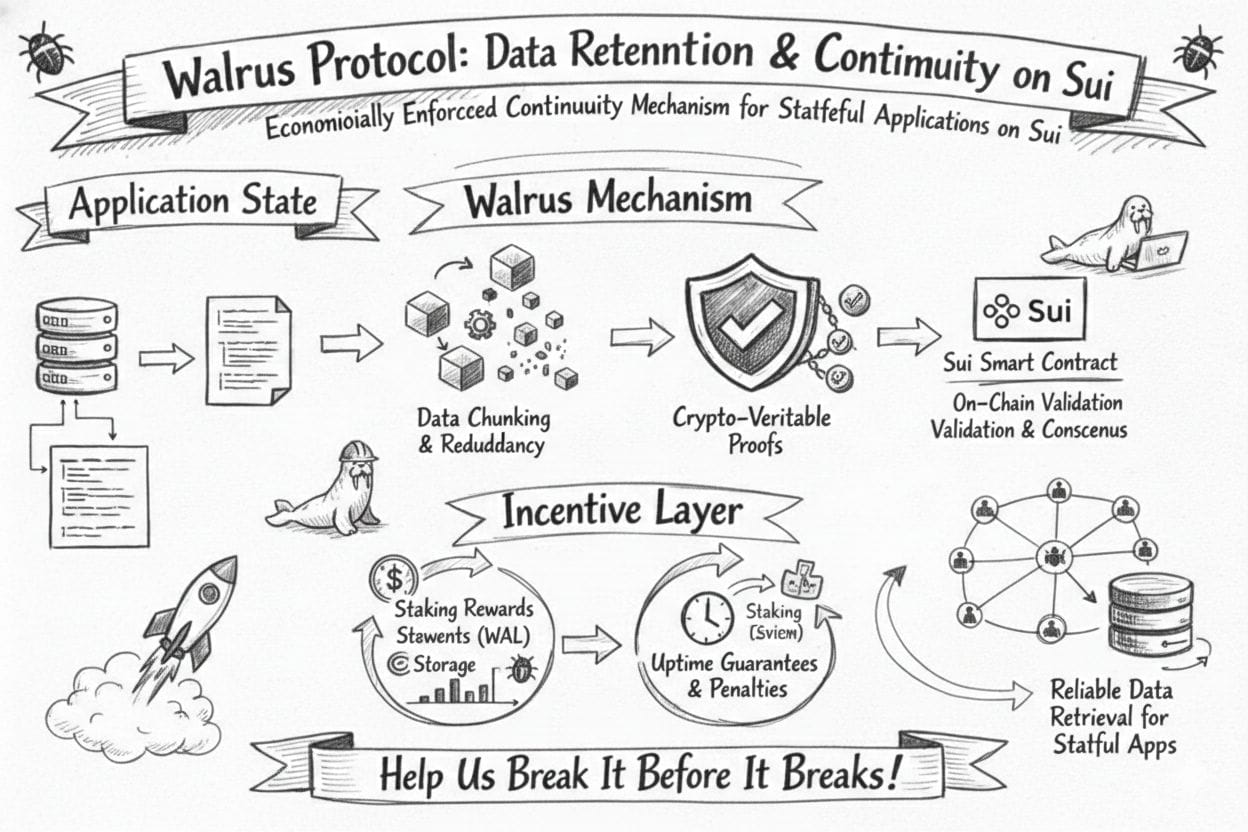 One of the unspoken realities of modern decentralized applications is that state lives longer than execution. Financial protocols need historical state to reconcile. AI systems need checkpoints to resume training. Social applications need content history to maintain context. Enterprise systems need audit trails to satisfy compliance. Yet in almost every blockchain today, the continuity of that state is treated as an external assumption rather than a protocol-level guarantee. Walrus enters this exact gap and converts data retention from a “best-effort storage problem” into an economically enforced continuity mechanism for applications running on Sui.
Usually, in older systems, developers just park important data somewhere off-chain and cross their fingers that it’ll be there later when they need it. Not exactly rock solid. If that off-chain bit goes down, the on-chain stuff is stuck nothing moves forward. Walrus flips this idea on its head. It doesn’t treat data retention as some afterthought; it makes it a must-have for everything to work right. By connecting data availability to proofs you can check and lease cycles backed by real economic value, Walrus turns continuity into something you can actually measure, program, and enforce.
The mechanism works because Walrus introduces a separation that most protocols ignore: execution is instantaneous; continuity is temporal. Execution happens in microseconds and does not care about tomorrow. Stateful systems especially AI, enterprise, and consumer platforms only exist because tomorrow continues to work. Walrus is the component that makes tomorrow guaranteed rather than assumed. Sui’s object-centric execution model makes this abstraction natural: retention periods, renewals, proofs, and ownership metadata become objects that applications can manipulate just like any other state.
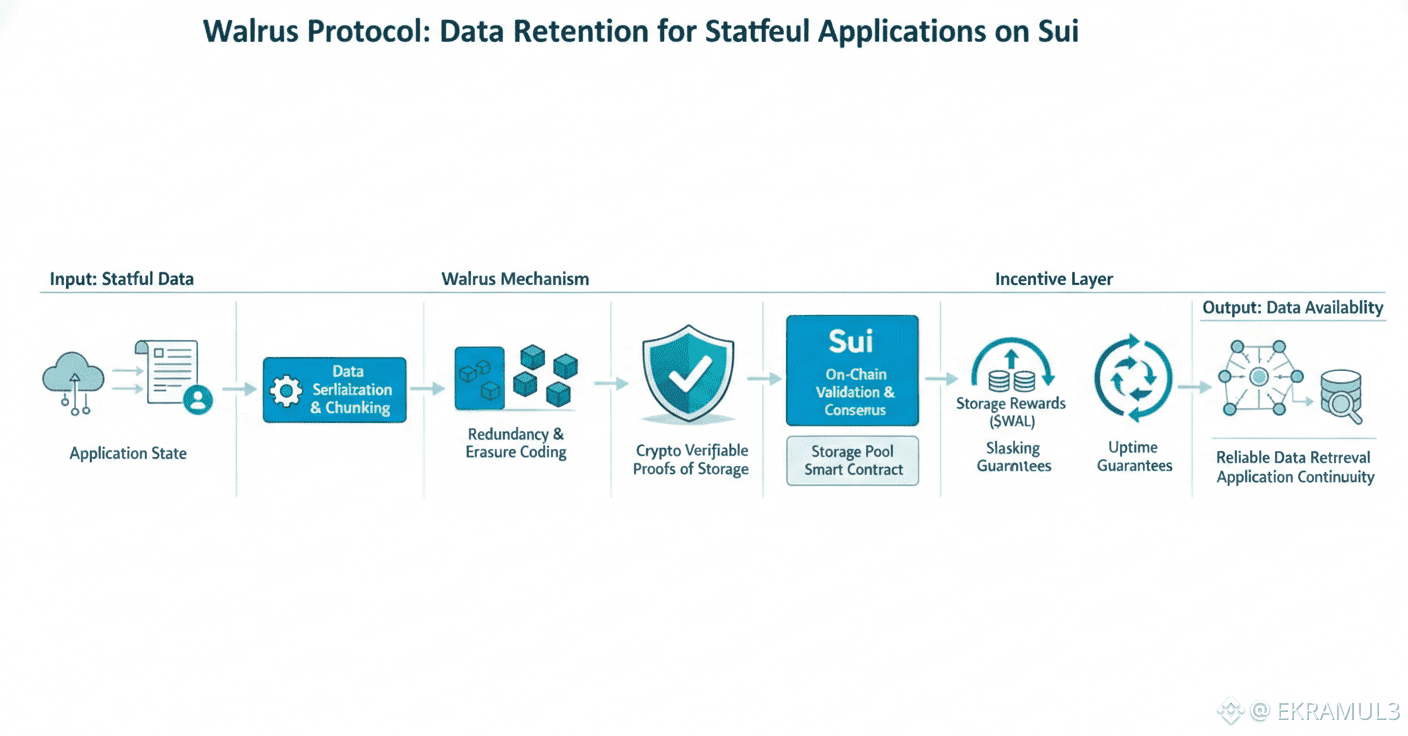 Where continuity becomes interesting is in enforcement. Walrus is not trusting operators to behave; it is contracting them. Storage providers stake WAL, commit to a retention period, submit periodic proofs of availability, and receive continuous compensation over the term. Failure is not philosophical it destroys stake and interrupts revenue. This turns retention into an economically sustainable resource class rather than a one-time purchase. The longer data must survive, the longer the payment stream must flow aligning duration with cost rather than flattening it into a one-time fee.
This has a second-order effect that most people miss: continuity becomes predictable. Developers can budget for retention the same way they budget for compute or bandwidth. AI systems can checkpoint deterministically. Compliance workloads can guarantee multi-year retention without centralized custody. Consumer apps can keep user-generated content available without sacrificing control to cloud intermediaries. The key innovation isn’t storage it’s that storage becomes a contract.
WAL is the accounting unit that makes continuity enforceable. WAL is used to pay for leases, to stake for obligations, and to slash for failure. Instead of rewarding storage operators up-front and hoping they continue, Walrus rewards them in time with real economic friction for noncompliance. In infrastructure markets, continuity without enforcement is charity; continuity with enforcement is a service.
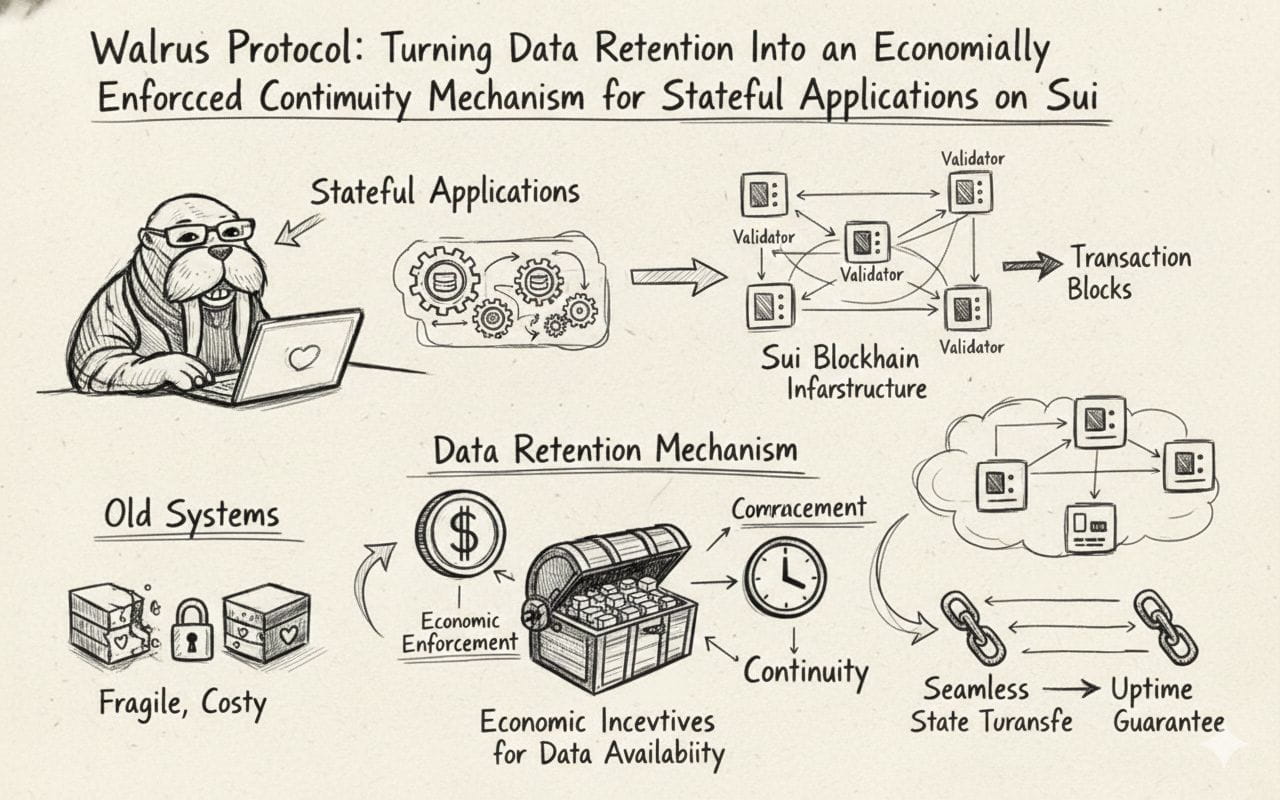 This unlocks Sui in a direction most L1s are not prepared for. High-throughput execution is not enough for AI-driven or stateful applications; what they need is resumability. A model that trains for twelve epochs cannot restart at epoch zero every time the system resets; it needs to resume from a checkpoint. A compliance audit cannot ignore historical logs because a storage bucket expired. A game cannot reconstruct a world state if asset histories vanish. Continuity becomes existential rather than optional.
By converting retention into a measurable and billable unit, Walrus allows Sui applications to extend their lifecycle beyond execution windows without pretending that data lives forever. Permanence becomes a configurable variable instead of a universal obligation. This is fundamentally more realistic for the real world, where data has value curves: some data deserves to die; some deserves to persist; some deserves to persist longer than its originator. Walrus turns those decisions into protocol-level controls rather than backend improvisations.
In a space obsessed with throughput, Latency, TPS, and validators, Walrus introduces a primitive that rewires how state survives time. The protocol does not assume continuity it enforces it. And the applications that need time more than computation are the ones most likely to shape the next wave of adoption.