

Have you ever lost an important file or worried about someone snooping through your personal data online? Most of us rely on cloud storage for convenience, but central servers can fail, get hacked, or even lose your files forever. That’s where Walrus comes in, using advanced coding techniques to make sure your data stays private, reliable, and always available.At its core, Walrus is a decentralized storage network built on the Sui blockchain. Unlike traditional systems that store data in one place, Walrus spreads your files across multiple nodes in the network. But simply splitting data isn’t enough—what if one node fails or goes offline? That’s why Walrus uses erasure coding and other advanced methods to protect your files. Erasure coding breaks a file into pieces and adds extra “parity” data, so even if some pieces are missing, the file can still be reconstructed perfectly. In simple terms, it’s like cutting a puzzle into many pieces and having backup pieces ready—your file will always come together no matter what happens.This approach also keeps your data private. Instead of storing your file in full on any single node, only fragments are kept, and they’re encrypted. That means no node operator—or hacker—can access your complete file. Even if someone gets hold of a fragment, it’s useless on its own. The coding and encryption work hand-in-hand to make sure your information stays confidential while still being accessible to you when you need it.Redundancy is another key benefit.
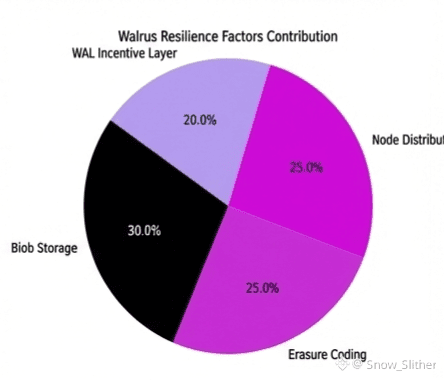 Centralized storage can fail for many reasons: power outages, server crashes, or even natural disasters. In Walrus, your data exists in multiple places at once. If a few nodes go down, your file remains safe and accessible from other nodes. This makes the network far more reliable than traditional storage and gives users peace of mind that their important documents, videos, or datasets won’t suddenly vanish.The network’s coding techniques also optimize efficiency. By carefully distributing data fragments and parity across nodes, Walrus reduces the overall storage space needed while increasing reliability. This means it can handle large files without excessive costs or waste. Whether it’s high-resolution videos, business databases, or app assets, Walrus provides practical, scalable storage that adapts to real-world needs.But coding alone isn’t enough to run a strong network. Walrus pairs these techniques with incentives and governance powered by WAL tokens. Nodes that store data correctly are rewarded, encouraging them to maintain uptime and reliability. Token holders can also vote on network upgrades, including improvements to coding techniques, creating a system that grows stronger over time. The combination of smart coding and active participation ensures that the network remains robust, secure, and sustainable.What makes Walrus especially interesting is that it teaches a simple lesson about technology: security and reliability don’t have to be complicated. By applying clever coding methods and spreading responsibility across the network, it solves real-world problems without asking users to understand every technical detail. You don’t need to be a blockchain expert to benefit—your files are simply safer, private, and always retrievable.Another advantage of these coding techniques is censorship resistance. In centralized systems, access to data can be blocked by governments, corporations, or even malicious actors.
 In Walrus, the distributed and fragmented nature of storage means no single party can restrict access to your files. As long as part of the network is running, your data remains accessible. This makes the network not just secure, but resilient and fair.The system also scales well. As more users join and more data is stored, the network can handle growth without compromising safety or efficiency. Advanced coding ensures that even as files increase in size and number, redundancy and privacy remain intact. This scalability is crucial for businesses, developers, and individuals who rely on large-scale storage for real-world applications.Walrus’s approach also highlights an important principle in technology: trust through design. Instead of asking users to trust a single company or server, the network’s coding, encryption, and redundancy enforce security automatically. Users can feel confident that their data is protected, without having to monitor or manage every detail. In this sense, the technology itself carries the responsibility, giving people freedom and peace of mind.Ultimately, Walrus shows that advanced coding isn’t just for tech experts—it’s a practical solution that makes decentralized storage usable, secure, and reliable. It balances privacy, redundancy, and accessibility, creating a network that people and businesses can trust for critical data. By turning complex technical concepts into a simple, functioning system, it proves that protecting digital information can be straightforward and effective.In a world where data is growing exponentially and security breaches are common, Walrus offers a clear lesson: smart technology, thoughtful design, and distributed responsibility can make storage not only safer but also more resilient. With coding that protects, distributes, and recovers your files, Walrus ensures that your digital life stays private, reliable, and always within reach. #Walrus #walrus $WAL @Walrus 🦭/acc