

@Dusk On DuskEVM, the hardest part of “bringing markets on-chain” isn’t writing smart contracts. It’s earning the right to be believed when the world is noisy. A regulated market doesn’t collapse because code can’t run. It collapses because people can’t agree on what is true fast enough to settle a decision without regret. That’s why Chainlink matters here—not as decoration, but as a discipline layer that forces DuskEVM to treat reality as a first-class dependency, with all the discomfort that implies.
The recent shift is not subtle. In November 2025, Dusk and NPEX publicly committed to using Chainlink’s interoperability and data standards as part of a unified framework for compliant issuance, cross-network settlement, and market data publication. The language is institutional on purpose: it’s not “connect anything to anything,” it’s “move regulated instruments without losing control.” NPEX is not an abstract partner either. It’s a supervised Dutch venue with a real history of financing—over €200 million raised and 17,500+ active investors referenced by Dusk in that announcement—meaning the inputs and the consequences are already shaped by regulators, auditors, and reputational risk
In calm markets, people underestimate what an oracle really is. They picture a price number arriving, clean and punctual, like the world is a spreadsheet. In regulated markets, the feed is never just a number. It’s an argument that has already happened off-chain: which venue counts, which timestamp counts, which corporate action counts, whether a halted market is “no price” or “last price,” whether an outlier is truth or manipulation. When that argument is smuggled on-chain without guardrails, the chain becomes the place where disputes go to multiply. DuskEVM’s choice to anchor itself to a widely used oracle standard is a choice to make those arguments explicit, measurable, and costly to fake, instead of letting them leak into every application as silent assumptions. 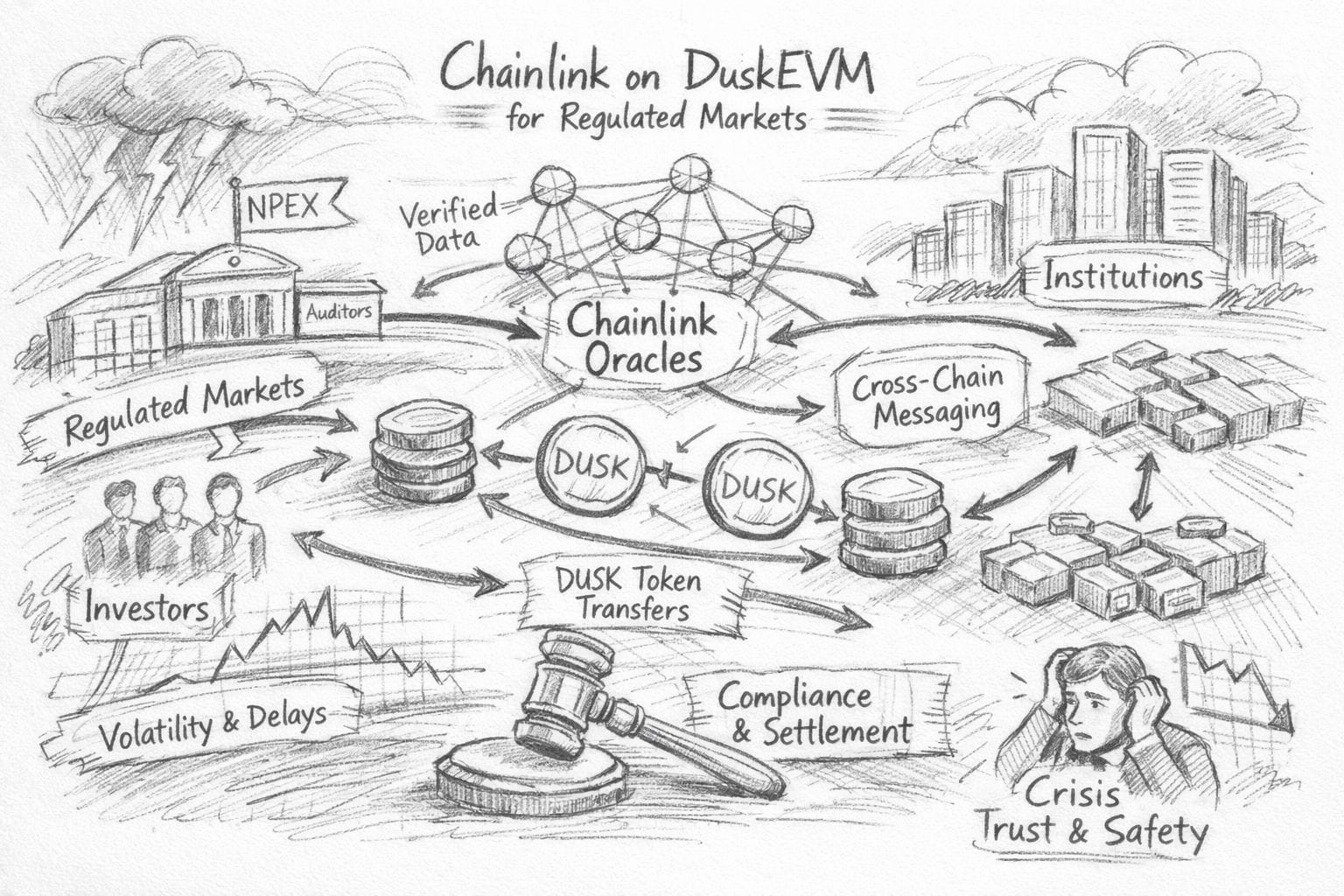
Cross-chain messaging makes that discomfort sharper, not easier. Once an asset can move across environments, you’re no longer protecting a single ledger. You’re protecting meaning. The same tokenized instrument must remain the same promise even as it travels, and that promise includes restrictions, lifecycle rules, and the right kind of reversibility. The Dusk–NPEX–Chainlink announcement frames the goal as composable access to compliant securities across multiple networks, but the deeper point is psychological: institutions don’t fear the existence of other chains; they fear losing the ability to explain, in court or to a regulator, why a transfer was allowed and why it happened the way it did. The “message” can’t just arrive—it has to arrive with accountability.
This is where incentives stop being theory. An oracle network is a labor market for truth-telling under adversarial conditions. People like to talk about decentralization as if it’s a moral property, but for regulated settlement it’s more like a practical insurance policy: multiple parties are paid to disagree with each other until the disagreement becomes too expensive to sustain. The economics behind that are not glamorous. Operators need to earn enough to stay awake during chaos, and penalties need to be real enough to make “close enough” unacceptable. If the system underpays honesty, it subsidizes negligence. If it overpays without structure, it subsidizes rent-seeking. Dusk’s bet is that adopting an industry-standard oracle and interoperability stack aligns that economic pressure with the kind of uptime and auditability regulated markets demand, rather than inventing a bespoke trust story that only works until the first incident.
What most users feel is not the architecture. What they feel is the moment the architecture fails. A trader doesn’t experience “cross-chain interoperability.” They experience a transfer that completes when volatility is ripping, without the sickening pause where you wonder if you’ve just sent value into a void. A compliance officer doesn’t experience “data standards.” They experience the ability to trace why a contract made a decision, using data that can be defended as official rather than merely convenient. Dusk’s own framing leans into “high-integrity, real-time market data” and “secure cross-chain settlement” because those are the words people reach for when the cost of being wrong becomes personal.
The DUSK token sits inside this story as more than fuel or symbolism.
The update links interoperability to cross-network transfers of DUSK too, not only assets issued on DuskEVM. That’s a big signal. If DUSK is central to security and participation, it shouldn’t be boxed in. Letting it move with proper controls supports healthier liquidity and easier access—and frames reliability as something users can actually feel day to day.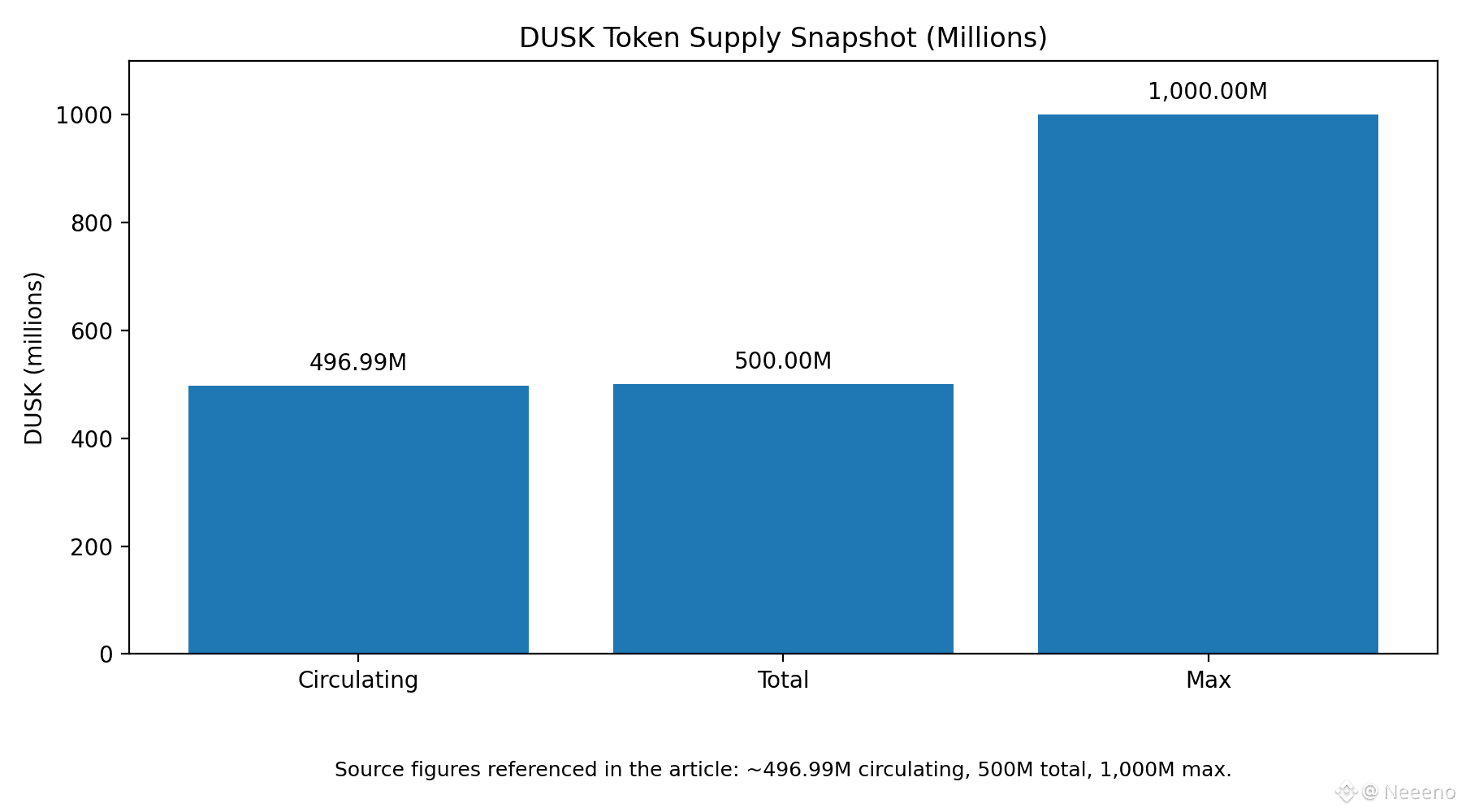
The numbers around DUSK make the stakes feel real, not mythic. CoinMarketCap currently lists a circulating supply of about 496.99 million DUSK, a total supply of 500 million, and a maximum supply of 1 billion, alongside a live market cap figure around the high tens of millions of USD at the time of access. Those figures are not the point by themselves. The point is that a token with that distribution footprint becomes a coordination object: people hold it, stake it, trade it, and interpret its movement as a proxy for whether the ecosystem is trustworthy. When the system extends its connectivity and data guarantees, it’s also extending the surface area of that coordination—and raising the bar for how carefully it must behave.
There is also a quieter institutional reality embedded in the NPEX details. Dusk’s own post references NPEX’s track record—100+ SMEs financed and more than €200 million facilitated—and the press release repeats the scale and supervision context. This anchors the integration in something less forgiving than crypto-native experimentation. If on-chain data publication is wrong, it’s not just an “oracle exploit” thread; it can become a disclosure problem. If cross-network settlement behaves unexpectedly, it can become a client-protection problem. Regulated markets don’t give you the luxury of learning in public by hurting people. They demand you learn before the public arrives.
The deepest value of Chainlink on DuskEVM is that it encourages a specific kind of humility. It forces builders to admit that reality arrives late, sometimes contradictory, and occasionally weaponized. It forces the ecosystem to think about what happens when inputs diverge, when a venue pauses, when an update is delayed, when a bad actor tries to shape the feed through thin liquidity or manufactured prints. And it forces a practical answer: not “trust us,” but “here is the path data took, here is how it was validated, here is how messaging was constrained, and here is how damage is limited when the world refuses to be clean.”
Dusk’s documentation now lists Chainlink plainly as an oracle and cross-chain messaging partner for DuskEVM, alongside the institutional names that signal where this is headed. That kind of quiet listing is sometimes more meaningful than a headline. It suggests the integration is being treated as part of the environment—something developers and operators can plan around, not something they have to re-litigate every time they ship. It’s the difference between a partnership and plumbing. 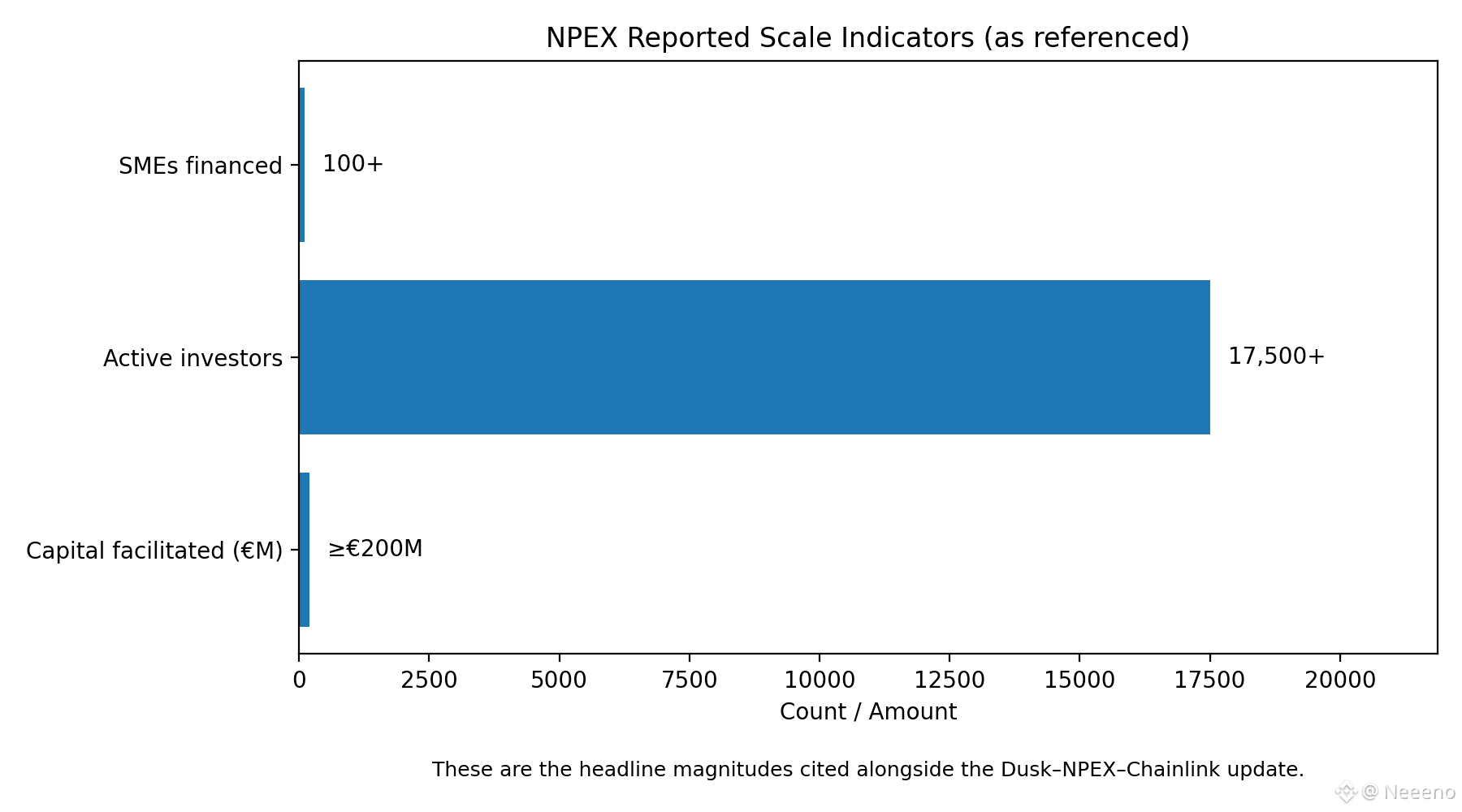
In the end, reliability in regulated markets is not a vibe. It’s a promise you keep while people are scared. It’s a transfer that settles when the room is loud. It’s a price that arrives with enough integrity that someone can stake their job on it. The recent Dusk–NPEX–Chainlink work is meaningful because it points toward an ecosystem willing to be judged by boring criteria: continuity, traceability, controlled movement, defensible inputs, and the ability to keep operating when the incentives to cheat are highest. The DUSK token’s supply reality—roughly 497 million circulating against a 1 billion max, with market cap and volume shifting daily—only adds weight to that responsibility, because coordination at that scale magnifies every flaw and every safeguard.
Quiet responsibility looks like choosing infrastructure that will not flatter you, because it will keep asking for proof. Invisible infrastructure looks like messages that arrive correctly so nobody writes a post about them. And in regulated markets, that invisibility is not a lack of ambition—it’s the most honest sign that the system is learning to value reliability more than attention.
