As blockchain ecosystems mature, one truth becomes increasingly unavoidable: data, not just transactions, is becoming the dominant resource of Web3.
AI systems require enormous training corpora, rollups publish massive execution traces, games generate persistent worlds, and creators mint media that must remain accessible forever. Yet most blockchains were never designed to hold or coordinate data at this scale, forcing developers back toward centralized cloud providers and undermining decentralization at the infrastructure layer. Walrus Protocol enters precisely at this pressure point, positioning itself as a decentralized blob-storage network engineered for the modular future of Web3.
Walrus is built around the idea that data should be treated as a first-class on-chain asset rather than an external dependency. Instead of storing files in monolithic replicas across a few large operators, the protocol relies on erasure-coding techniques that split large objects into fragments and distribute them across many independent nodes. Only a subset of those fragments is required to reconstruct the original file, which dramatically reduces storage overhead while maintaining fault tolerance and censorship resistance. This architectural choice allows Walrus to scale capacity without drifting toward centralization, preserving one of crypto’s most fragile properties as networks grow larger.
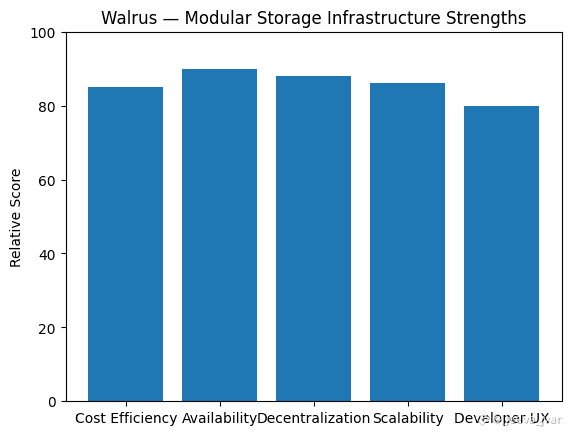
Coordination of this storage market is anchored on-chain through integration with the Sui blockchain, where objects are registered, proofs of availability are tracked, payments flow, and governance decisions are executed. Nodes continuously demonstrate that they are still storing assigned fragments, and rewards are distributed gradually over time rather than in a single upfront payment, aligning compensation with long-term reliability. These mechanics transform storage from a trusted service into a competitive cryptoeconomic marketplace, where uptime, responsiveness, and honest behavior determine profitability.
In practical terms, Walrus becomes useful anywhere large datasets intersect with decentralized logic. AI agents can retrieve verified training corpora without relying on cloud providers, NFT platforms can host rich media permanently, rollups can offload heavy data requirements to a neutral layer, and data marketplaces can trade access rights to datasets as programmable assets. If Web3 truly evolves into a stack of specialized layers for execution, settlement, and availability, Walrus is positioning itself as the layer responsible for making information persistent, verifiable, and economically viable across them all.