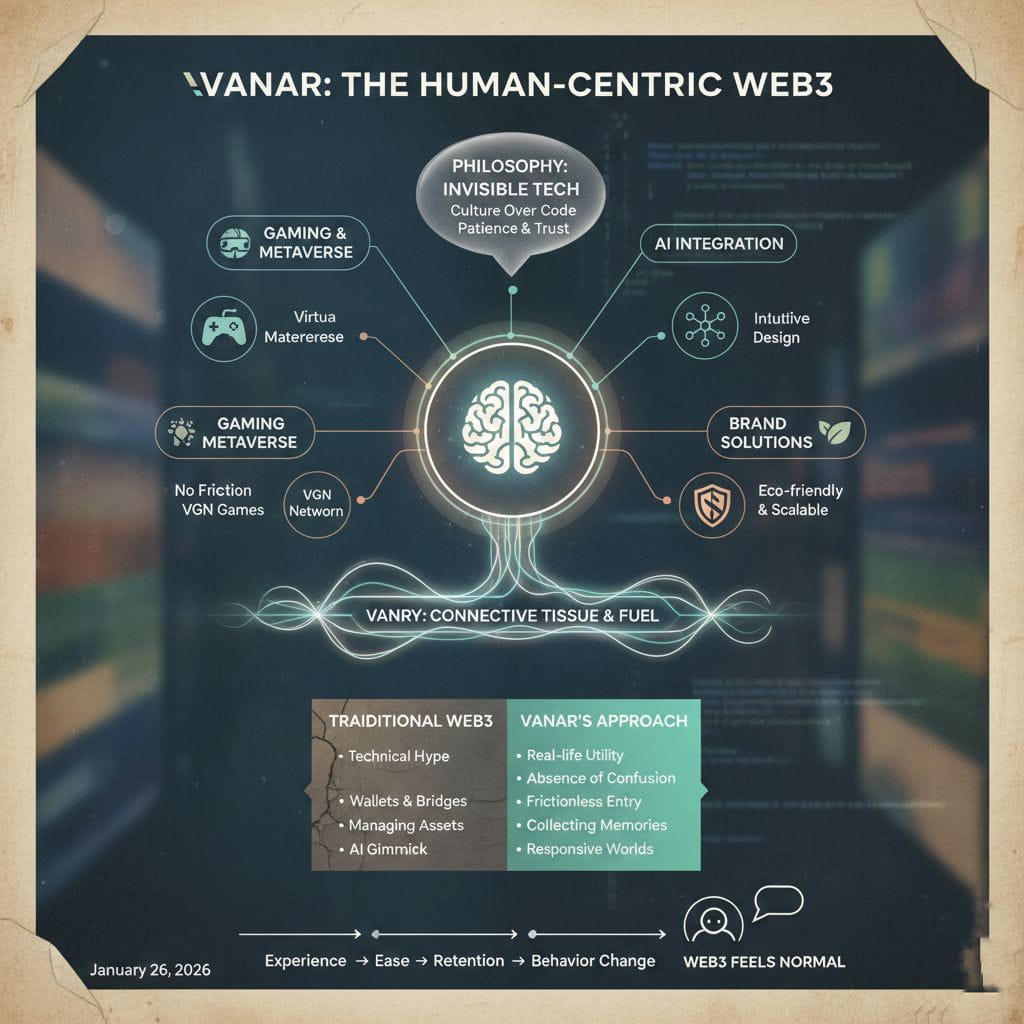
There’s a certain moment that sticks with me whenever I think about new technology. It’s not a launch event or a price chart shooting upward. It’s usually much smaller. Like the time a friend who couldn’t care less about crypto picked up a controller, played a blockchain-based game, and didn’t once ask me what a wallet was. That pause that absence of confusion — felt important. That’s the space where Vanar seems to be building.
Vanar doesn’t come across like it’s trying to impress you with technical fireworks. Instead, it feels like someone finally asked a very basic question: how does this fit into real life? Built as a Layer 1 blockchain, Vanar is clearly shaped by a team that has spent time in gaming studios, entertainment rooms, brand meetings — places where attention is fragile and users don’t wait around patiently while technology explains itself. That background quietly seeps into everything they’re building.
When people talk about “the next three billion users,” it usually sounds like a slogan. With Vanar, it feels more like a design constraint. If your audience includes gamers, music fans, movie lovers, and everyday consumers, you can’t afford friction. You can’t expect people to study documentation just to have fun. Vanar’s approach reflects that reality. It’s not obsessed with proving how decentralized or clever it is. It’s focused on being usable, invisible when it needs to be, and expressive when it matters.
I keep thinking about how gaming has always been the gateway. Long before NFTs, people were buying skins, trading items, and building identities inside digital worlds. Vanar leans into that instinct instead of fighting it. Products like the Virtua Metaverse and the VGN games network don’t feel bolted on; they feel like natural extensions of how people already interact online. Worlds you can step into. Games you can lose time in. Digital ownership that feels more like collecting memories than managing assets.
There’s also something quietly ambitious happening under the surface. Vanar weaves AI into its core infrastructure, not as a gimmick, but as a way to make digital experiences smarter and more responsive. Think about how strange it feels when virtual worlds forget you the moment you log out. Now imagine environments that remember how you play, what you prefer, how you interact — not in a creepy way, but in the same way a good game designer anticipates your next move. That’s where Vanar’s AI-native design starts to feel less like technology and more like intuition.
The VANRY token plays its role here without demanding the spotlight. It’s the fuel, the connective tissue, the thing that allows these worlds, games, and brand experiences to function without constant friction. The best infrastructure is often the kind you barely notice, and VANRY feels positioned that way — practical, embedded, quietly necessary rather than loudly speculative.
I’ve seen too many projects chase trends and forget people. They launch with grand promises and leave users juggling wallets, bridges, and half-finished interfaces. Vanar feels different because it seems patient. Almost restrained. It’s less concerned with shouting and more focused on building places people might actually want to return to. That matters. Loyalty isn’t created by hype; it’s earned through comfort, familiarity, and trust.
What really pulls me in is the sense that Vanar understands culture, not just code. Brands don’t want complexity. Gamers don’t want lectures. Everyday users don’t want to feel like outsiders. Vanar’s ecosystem crosses gaming, metaverse spaces, AI-driven tools, and even eco and brand solutions, but it does so with a single unspoken goal: make Web3 feel less like a barrier and more like an invitation.
I don’t think adoption happens with a bang. It happens quietly, one enjoyable experience at a time. One game that doesn’t feel broken. One virtual world that feels alive. One brand interaction that feels personal instead of forced. Vanar seems to be building for those small moments, the ones that don’t trend on social media but slowly change behavior.
If Web3 is ever going to feel normal not exciting in a speculative way, but comforting in a daily-life way it will look a lot like this. Less noise. More intention. Fewer explanations. More experiences. Vanar isn’t trying to reinvent how humans behave online. It’s simply meeting them where they already are and gently showing what’s possible when the technology finally gets out of the way.