

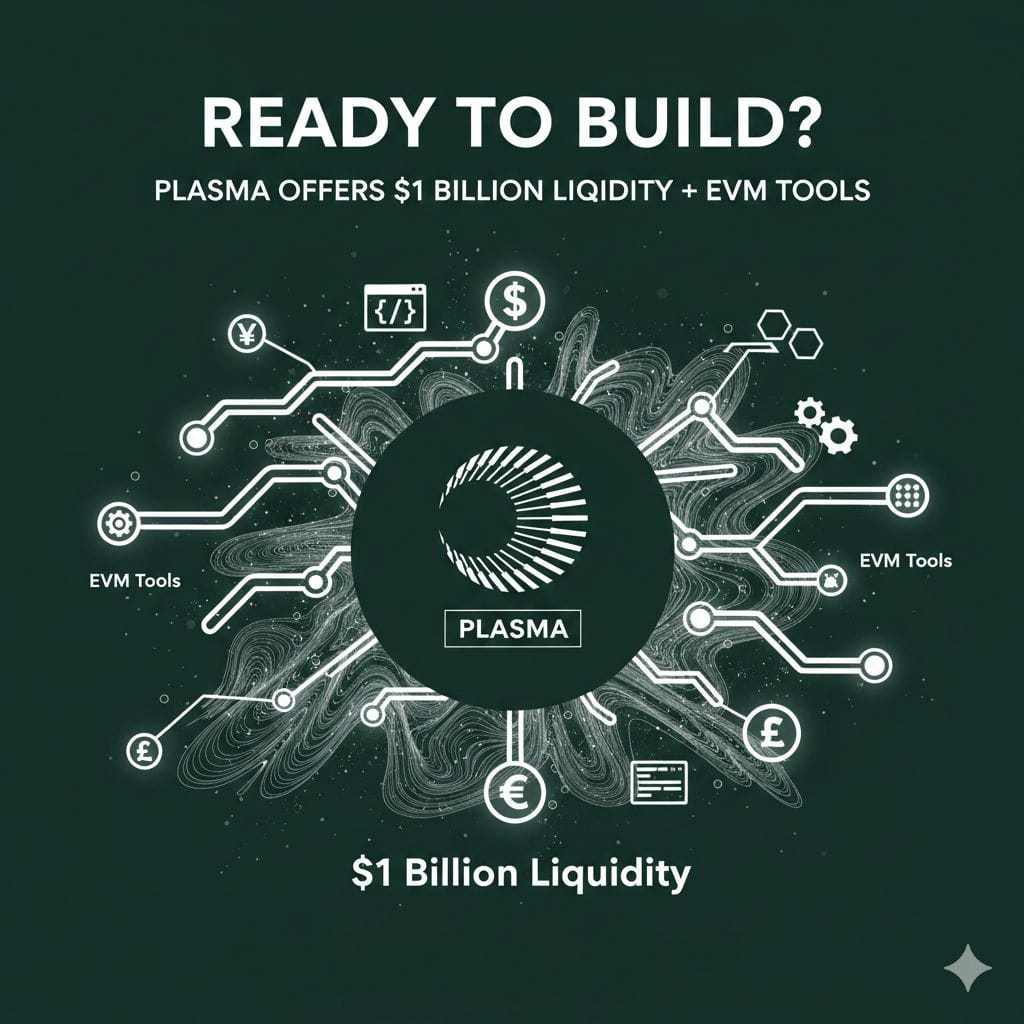
This is exploding right now and developers are moving fast. While other Layer 2s are still trying to convince liquidity providers to show up, Plasma just dropped $1 billion in available liquidity plus the entire Ethereum tooling ecosystem, fully compatible and ready to use. No learning curve. No waiting for infrastructure. No wondering if there'll be enough liquidity when your app launches. Everything you need to ship production applications is live right now.
Let's get real about what this means for builders.
The Builder's Dilemma Just Got Solved
Here's the impossible choice developers usually face: build on Ethereum mainnet with amazing tooling and liquidity but prohibitive gas costs, or build on a new Layer 2 with cheap transactions but shallow liquidity and immature infrastructure. You sacrifice something either way—user experience, development velocity, or economic viability.
Plasma eliminates this tradeoff completely. You get Ethereum's full development stack, $1 billion in ready liquidity, and transaction costs that make microtransactions viable. This isn't choosing the least-bad option—it's actually having everything you need.
The question isn't whether you can build what you want. It's how fast you can ship it.
What $1 Billion in Liquidity Actually Means
Bottom line: one billion dollars in available liquidity isn't marketing hype. It's real stablecoin capital deployed across DEX pools, lending markets, and liquidity protocols ready for your application to tap into.
Your DEX doesn't need to bootstrap liquidity—USDT/USDC pools with millions in depth already exist. Your lending protocol doesn't wait for deposits—borrowable capital is available from day one. Your payment app doesn't worry about settlement capacity—the liquidity exists to handle serious volume.
This changes the entire trajectory of how applications develop. You're not spending six months trying to attract liquidity. You're spending that time improving your product because liquidity is already there.
Full EVM Compatibility Without Asterisks
Let's talk about what "full EVM compatibility" really means when it's not marketing speak. Your Solidity contracts deploy without modification. Your OpenZeppelin libraries work identically. Your Hardhat scripts run unchanged. Your Foundry tests pass without adjustments. Your Remix experiments behave exactly like mainnet.
This isn't "mostly compatible except for these edge cases." This is actual EVM—same bytecode, same gas mechanics, same everything. If you know how to build on Ethereum, you know how to build on Plasma. The learning curve is literally zero.
For experienced Ethereum developers, this means shipping fast. For teams new to Web3, this means the massive knowledge base around Ethereum development applies directly to Plasma.
The Complete Tooling Ecosystem
Everyone keeps asking what tools work on Plasma. The answer is: all of them. Every development framework, every debugging tool, every security scanner, every indexing service—if it works for Ethereum, it works for Plasma.
Hardhat for smart contract development and testing. Foundry for Solidity-native workflows. Tenderly for transaction debugging and monitoring. The Graph for indexing blockchain data. Chainlink for oracle services. OpenZeppelin Defender for operations and security. Etherscan-compatible block explorers for transparency.
You're not waiting for Plasma-specific tooling to mature. You're using battle-tested infrastructure that millions of developers already rely on.
Real-World Performance Numbers
Here's what actually matters: Plasma handles thousands of transactions per second with sub-second finality and costs measured in fractions of a cent. Not theoretical capacity—actual tested throughput under production load.
Your high-frequency trading bot can execute without gas price anxiety. Your gaming application can handle constant player interactions without worrying about network congestion. Your social platform can process likes, comments, and interactions at internet-scale costs.
The performance headroom exists for applications that would be completely unviable on mainnet or even most Layer 2s.
Gas Costs That Change What's Possible
Bottom line: when transaction costs approach zero, entire categories of applications become viable. Prediction markets with penny-sized positions. Content micropayments for individual articles. Gaming with frequent small transactions. Social applications where every interaction hits the chain.
Plasma's gas costs—literally fractions of a cent—mean you design applications for user experience rather than constantly optimizing to minimize transactions. This freedom fundamentally changes product design.
Stablecoin-Native Infrastructure Advantage
Let's get specific about the $1 billion liquidity. It's concentrated in USDT and USDC—the assets that actually matter for real applications. Not speculative governance tokens. Not wrapped derivatives. The stablecoins that process more transaction volume than everything else in crypto combined.
Your payment application, remittance service, neobank, or DeFi protocol builds on top of deep liquidity in the exact assets your users want to transact with. You're not fighting against the infrastructure—you're building on infrastructure designed for your use case.
Developer Grant Programs and Support
Everyone building on Plasma gets access to grant programs, technical support, and ecosystem resources. This isn't just throwing money at projects—it's structured support to help applications succeed.
Technical integration support from Plasma engineers. Marketing and user acquisition assistance. Liquidity mining programs to bootstrap your protocol. Security audit funding for smart contracts. The ecosystem is actively helping builders ship quality products fast.
Security Model You Can Trust
Here's what matters for applications handling real value: Plasma's security inherits from Ethereum mainnet with exit mechanisms that protect users even in worst-case scenarios. This isn't sidechain security with validator set trust assumptions—it's cryptographic security backed by Ethereum consensus.
Your users can trust your application because the underlying infrastructure has robust security guarantees. You can build confidently knowing exit mechanisms exist if anything goes wrong at the infrastructure level.
Live Applications Prove It Works
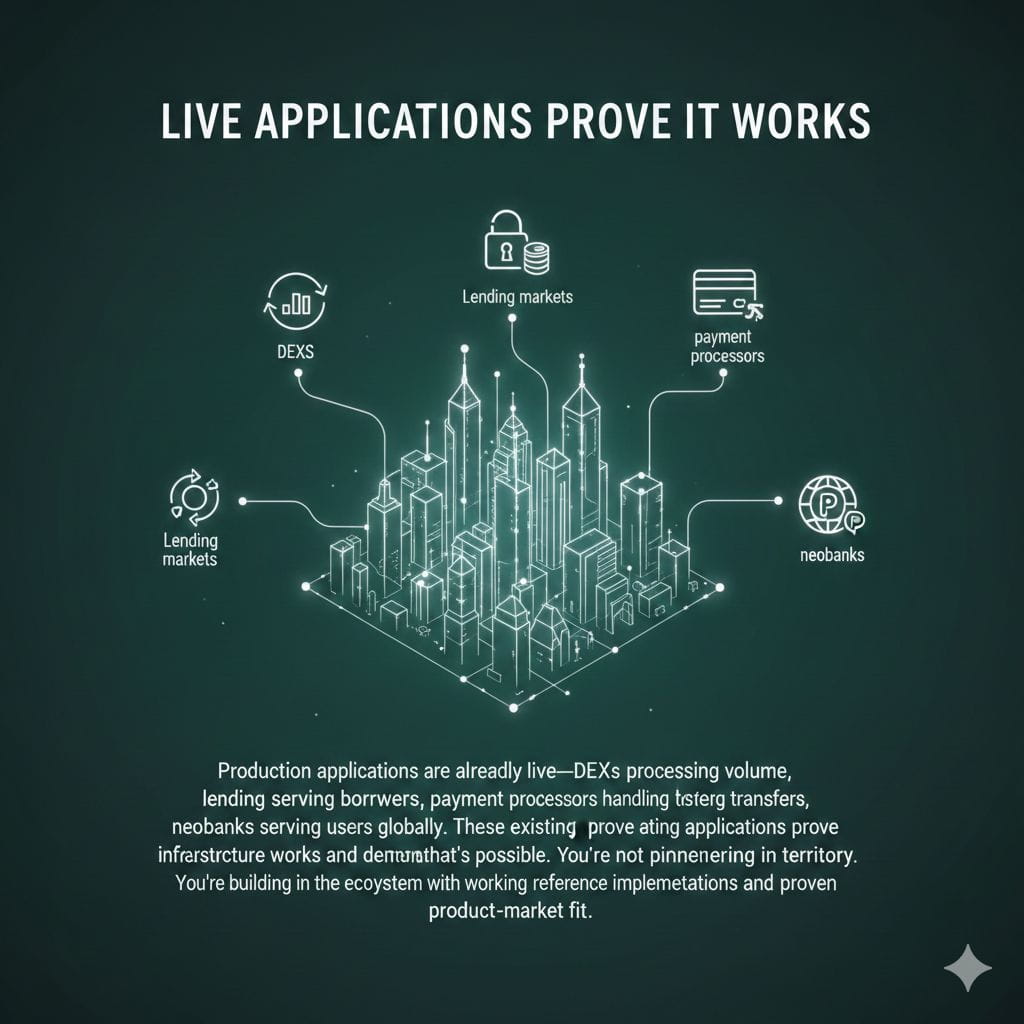
Plasma isn't theoretical infrastructure waiting for first movers. Production applications are already live—DEXs processing volume, lending markets serving borrowers, payment processors handling transfers, neobanks serving users globally.
These existing applications prove the infrastructure works and demonstrate what's possible. You're not pioneering in unknown territory. You're building in an ecosystem with working reference implementations and proven product-market fit.
Composability Across the Ecosystem
Let's talk about what becomes possible when multiple applications build on shared infrastructure. Your lending protocol can integrate with existing DEXs for liquidations. Your derivatives platform can tap into established price oracles. Your payment app can leverage liquidity from multiple sources.
The composability that made Ethereum DeFi powerful works identically on Plasma. Applications build on top of each other, creating network effects where each new protocol adds value to existing ones.
Migration Path for Existing Projects
Here's the practical question: how hard is it to move an existing Ethereum application to Plasma? The answer is surprisingly easy. Deploy the same contracts to Plasma. Update frontend RPC endpoints. Adjust gas price expectations downward. Maybe add Plasma-specific features to leverage the cheaper execution.
Many projects run multi-chain deployments—same contracts on mainnet and Plasma, letting users choose based on their needs. The full EVM compatibility makes this trivial rather than requiring separate codebases.
What You Can Build Right Now
Everyone keeps asking what's possible on Plasma. Here are concrete examples with current viability:
Decentralized exchanges that compete with CEX execution quality because liquidity depth supports tight spreads. Lending markets with competitive rates because capital is available. Payment processors handling cross-border transfers because throughput and costs support the use case. Gaming with on-chain assets and frequent interactions because transaction costs don't prohibit it. Social platforms where engagement happens on-chain because cheap transactions enable it. Prediction markets with granular positions because the economics work. Content micropayments that make sense for individual articles. Remittance services that outcompete Western Union on price and speed.
These aren't future possibilities—they're buildable today with available tools and liquidity.
The Time-to-Market Advantage
The combination of full EVM tooling, deep liquidity, and proven infrastructure means dramatically faster time-to-market. You're not building tooling. You're not waiting for liquidity. You're not pioneering untested technology. You're shipping products.
In crypto, shipping fast matters enormously. Market windows open and close. User attention is fickle. First-mover advantages compound. Plasma's infrastructure lets you focus on product differentiation rather than fighting infrastructure limitations.
Network Effects Already Spinning
Let's be honest about ecosystem momentum. Plasma launched with serious liquidity, attracted quality builders, those builders shipped good applications, users had positive experiences, more builders noticed, and the flywheel is already spinning.
You're not betting on whether the ecosystem will achieve critical mass—it already has. You're joining an ecosystem with momentum where each additional application makes the whole ecosystem more valuable.
The Support Ecosystem
Everyone building on Plasma has access to a growing support ecosystem. Developer communities sharing knowledge. Security firms experienced with Plasma deployments. Design partners for user testing. Marketing channels for user acquisition. Liquidity partners for protocol bootstrapping.
You're not building in isolation. You're joining a builder community that compounds knowledge and helps each other succeed.
What This Opportunity Represents
Here's the reality: windows to build on infrastructure that's production-ready but not yet saturated don't stay open long. Ethereum's window closed years ago—competition is intense and costs are prohibitive. Early Layer 2s filled up fast with first movers who captured markets.
Plasma represents that rare moment where infrastructure is mature, liquidity is deep, tooling is complete, but builder competition is still reasonable. You can still be early to an ecosystem that's going to be massive.
Why Act Now
$1 billion in liquidity, full EVM compatibility, complete tooling ecosystem, proven infrastructure, active ecosystem support—everything you need to build production applications exists today. The question isn't whether you can build successfully on Plasma. It's whether you'll ship before someone else captures your market opportunity.
The infrastructure is ready. The liquidity is deployed. The tools are waiting. The only variable is whether you're ready to build. And if you are, Plasma just removed every excuse for not shipping immediately.
Stop waiting for perfect conditions. They're already here. Start building.
