
Financial history doesn’t repeat itself it upgrades.
Every few decades, capital finds a more efficient rail.
Every time it does, the old systems don’t disappear overnight they slowly become irrelevant.
We are standing at that inflection point now.
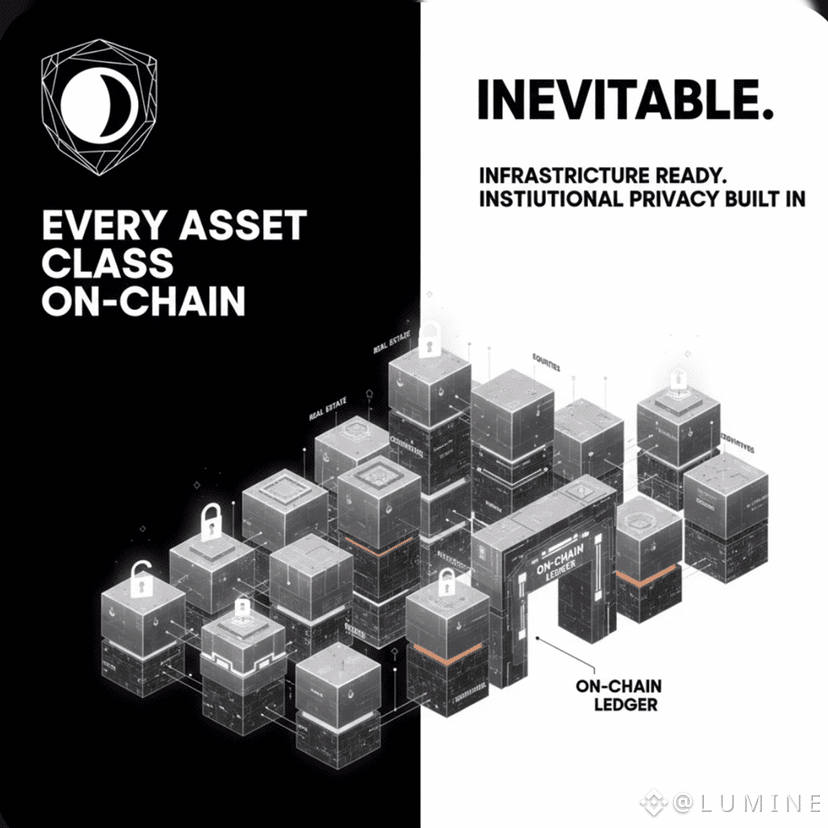
Every asset class is moving on-chain.
Not because it’s fashionable.
Not because it’s experimental.
But because the infrastructure is finally ready.
And this time, institutional privacy is built in.
The Quiet Shift No One Can Stop
At first, on-chain assets were dismissed as niche.
Then speculative.
Then dangerous.
Then interesting.
Now they’re becoming unavoidable.
Real estate.
Equities.
Bonds.
Derivatives.
Commodities.
Carbon credits.
Private funds.
Intellectual property.
Everything that can be represented digitally will be.
Because on chain rails are simply better.
Capital Always Moves Toward Efficiency
Markets don’t care about ideology.
They care about speed, cost, transparency, and control.
On-chain infrastructure offers:
Instant settlement
Programmable ownership
Global accessibility
Reduced intermediaries
Atomic execution
Traditional systems can’t compete with that long-term.
But there was one missing piece.
The Privacy Problem That Slowed Everything Down
Institutions don’t operate in public.
They can’t.
Portfolio strategies are sensitive.
Positions are competitive intelligence.
Counterparty relationships are confidential.
Compliance is non-negotiable.
Early blockchains were transparent by design — and that transparency was a deal-breaker.
You can’t run trillion-dollar markets on systems where:
Every balance is visible
Every transaction is traceable
Every strategy is exposed
So institutions waited.
Not because they didn’t believe in on-chain assets —
but because the infrastructure wasn’t mature enough.
That Era Is Over
The narrative has shifted.
Privacy is no longer an afterthought.
It’s part of the architecture.
Modern on-chain systems are designed with:
Confidential transactions
Selective disclosure
Regulatory compliance
Institutional-grade security
This is what unlocks the next phase.
Dusk: Built for the Real World of Finance
Dusk doesn’t try to “disrupt” finance by ignoring reality.
It integrates with it.
From day one, the design assumption is simple:
Institutions require privacy.
Regulators require clarity.
Markets require trust.
Dusk sits at that intersection.
Not loud.
Not speculative.
Not hype-driven.
Just engineered for where capital is actually going.
Tokenization Is Just the First Step
Tokenization gets the headlines.
Infrastructure gets the results.
Putting assets on-chain isn’t about novelty — it’s about:
Lifecycle automation
Corporate actions executed by code
Compliance embedded at protocol level
Settlement without friction
On-chain assets don’t just exist digitally — they behave digitally.
That’s the difference.
Institutions Don’t Need Permission — They Need Assurance
Institutions don’t ask:
“Is this decentralized enough?”
They ask:
Can this scale?
Can this integrate?
Can this comply?
Can this protect sensitive data?
Can this operate globally?
Dusk answers those questions without compromising on the core promise of on-chain systems.
That’s why this shift isn’t loud yet.
But it is permanent.
Privacy Is the Feature That Enables Everything Else
Transparency is powerful.
But selective transparency is what real markets require.
On Dusk:
Participants control what is disclosed
Regulators can verify without exposing strategies
Counterparties can transact without leakage
This is how:
Equities trade
Bonds settle
Funds operate
Institutions compete
Privacy doesn’t weaken trust — it enables it.
Every Asset Class Follows the Same Path
First comes skepticism.
Then experimentation.
Then parallel systems.
Then migration.
We’re already past experimentation.
Pilots are running.
Frameworks are forming.
Standards are emerging.
The question is no longer if assets move on-chain.
It’s how fast.
Why This Time Is Different
Previous attempts failed because they were early.
Not wrong — just premature.
Now:
Cryptography is mature
Institutions are educated
Regulation is clearer
Infrastructure is production-ready
The rails exist.
The tools exist.
The demand exists.
And capital always follows readiness.
On-Chain Doesn’t Replace Markets — It Upgrades Them
This isn’t about tearing down finance.
It’s about removing friction:
Days-long settlement becomes seconds
Manual reconciliation becomes automated
Middle-office complexity collapses
Cross-border barriers dissolve
Markets don’t lose structure.
They gain efficiency.
The Compounding Effect No One Talks About
Once assets are on-chain, something interesting happens.
They become:
Composable
Programmable
Interoperable
An equity can interact with a bond.
A fund can automate compliance.
A settlement can trigger instantly.
This isn’t just faster finance.
It’s smarter finance.
Dusk Is Infrastructure, Not a Narrative
The strongest systems don’t shout.
They operate quietly while others debate.
Dusk isn’t chasing attention cycles.
It’s building for:
Financial institutions
Issuers
Regulators
Market infrastructure providers
The kinds of players who don’t move fast — but move decisively.
Adoption Won’t Be Explosive — It Will Be Relentless
There won’t be a single moment where everything flips.
Instead:
One asset class moves
Then another
Then another
Until suddenly, on-chain is just how it’s done.
Just like:
Electronic trading
Digital settlement
Online banking
No announcements.
No drama.
Just inevitability.
The Infrastructure Is Ready
That’s the difference now.
Privacy is built in.
Compliance is native.
Institutions are aligned.
The excuses are gone.
What remains is execution.
Final Thought
Markets evolve quietly — then all at once.
When every asset lives on-chain, it won’t feel revolutionary.
It will feel obvious.
And the systems that were built early —
with privacy, trust, and institutions in mind —
will form the backbone of global finance.
Every asset class moving on-chain isn’t a prediction.
