

A common narrative suggests that Bitcoin sell-offs are financing the rally in precious metals, particularly gold. On-chain data does not support this view.
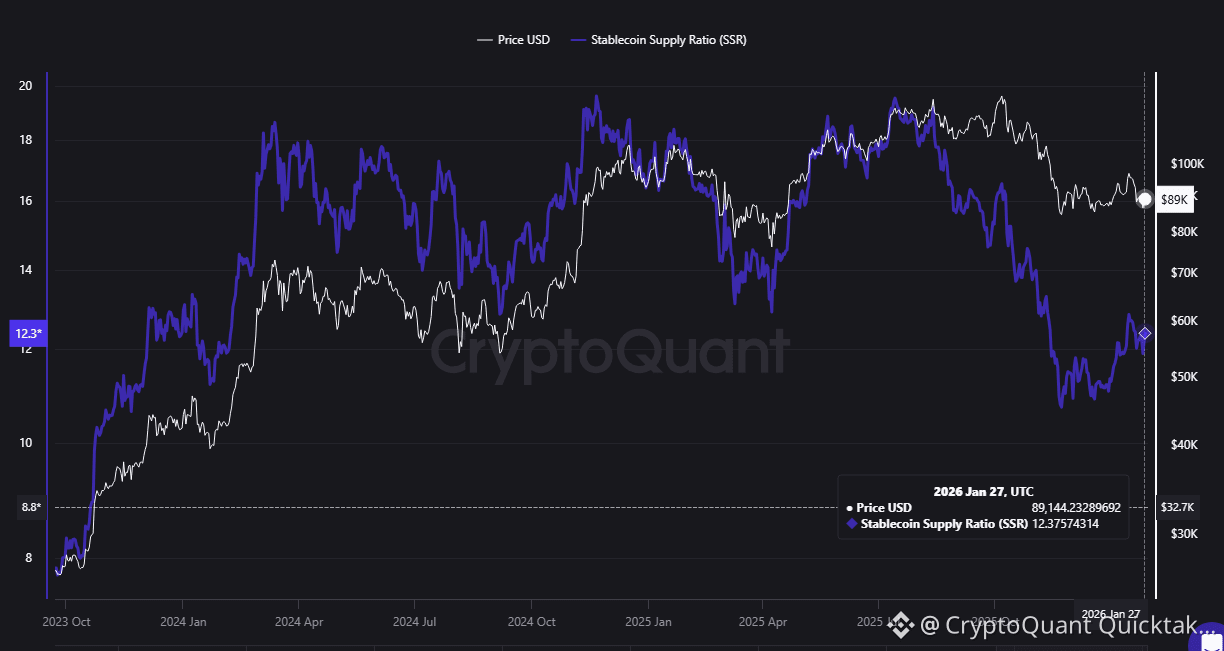
The Stablecoin Supply Ratio (SSR) indicates that capital is not leaving the crypto ecosystem, but remains in liquidity, waiting for opportunities to enter Bitcoin.
What Does the Stablecoin Supply Ratio Measure?
The SSR measures the purchasing power of stablecoins relative to Bitcoin.
A lower SSR reflects higher latent purchasing power, while a higher SSR means liquidity has already been deployed into BTC.
Key SSR Levels
Historically, the SSR has moved within clear ranges:
Above 15–16: low stablecoin purchasing power, liquidity deployed.
Between 10 and 15: neutral zone, often linked to consolidation.
Below 10–11: high latent purchasing power, often preceding bullish phases.
These levels provide structural context, not timing signals.
Reading the Current Context
The SSR stands at 12.57, down from recent highs in the 18–19 range.
This reflects a shift from deployed liquidity to liquidity on hold.
Bitcoin’s price remains structurally stable, indicating that capital is not exiting, but waiting.
Diversification, Not Rotation from Bitcoin to Gold
The gold rally should not be interpreted as a direct result of Bitcoin selling.
Large capital allocators follow multi-asset diversification strategies, holding exposure to equities, precious metals, digital assets, and stablecoins.
The lower SSR confirms that capital is not rotating from Bitcoin into gold, but diversifying while keeping liquidity within the crypto ecosystem.
Conclusion
Bitcoin is not financing the gold rally.
Liquidity is waiting, not fleeing.
The Stablecoin Supply Ratio shows that capital remains sidelined in stablecoins, ready to re-enter Bitcoin. With the SSR at 12.57, the market is in a pause phase that has historically preceded clearer directional moves.
by Carmelo Alemán, On Chain Analist at Cryptoquant
Written by Carmelo_Alemán