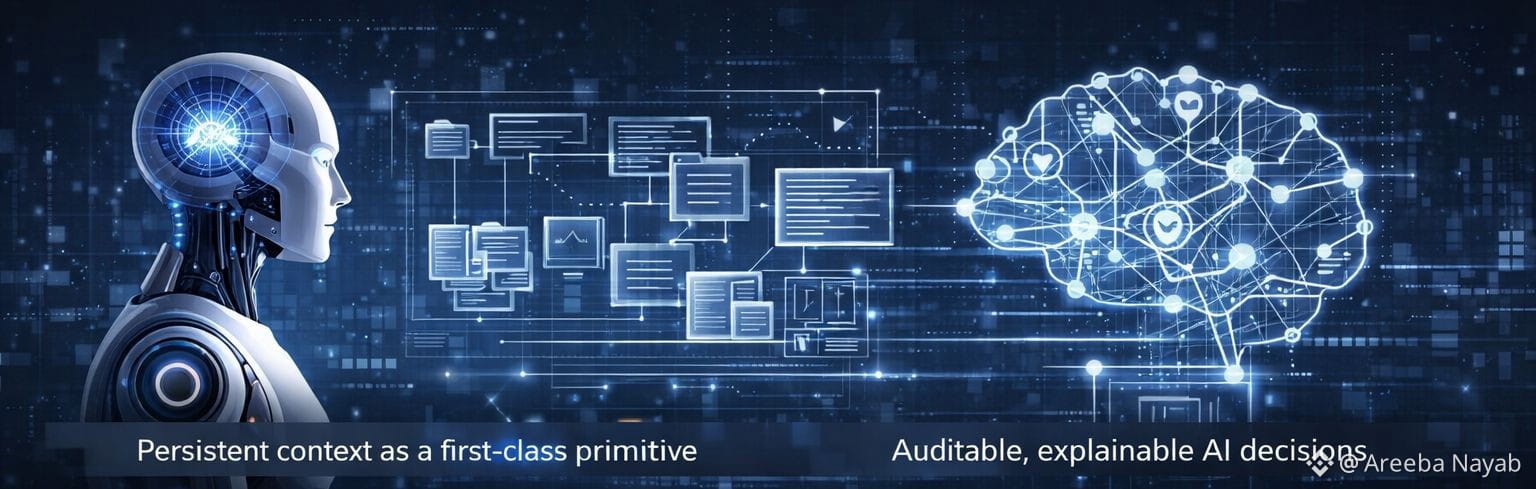
Most blockchains were designed for humans.
Plasma is designed for intelligence.
As artificial intelligence moves from tools to autonomous agents, the demands on infrastructure change completely. Speed alone is no longer enough. What’s required is memory, reasoning, automation, and most importantly — economic settlement that works without human intervention. Plasma positions itself exactly at this intersection.
From TPS Obsession to Intelligence Infrastructure
Traditional L1 competition revolved around throughput and fees. Plasma shifts the conversation toward AI readiness.
AI systems do not simply send transactions. They store context, reason over history, execute conditional logic, and act continuously. Plasma is structured to support these requirements at the infrastructure layer rather than bolting them on as applications.
This is the foundation that differentiates Plasma from general-purpose chains.
Semantic Memory as a First-Class Primitive
One of Plasma’s defining innovations is myNeutron — infrastructure-level semantic memory.
Instead of treating data as disposable transactions, Plasma allows AI systems to retain persistent context. This enables agents to remember prior interactions, adapt over time, and operate with continuity. Memory is no longer external or centralized — it becomes native to the chain.
This marks a shift from stateless execution to intelligent persistence.
On-Chain Reasoning and Explainability
With Kayon, Plasma introduces reasoning directly into the blockchain stack.
AI outputs are only valuable if they can be understood, verified, and trusted. Kayon enables structured reasoning and explainability at the protocol level, ensuring that decisions made by AI agents can be audited and validated.
This is essential for enterprise adoption, compliance, and real-world integration.
From Intelligence to Action
Intelligence without execution is incomplete.
Flows allow Plasma-based AI systems to move from reasoning into controlled, automated action. Transactions, workflows, and multi-step logic can be executed safely without constant human approval.
This enables real autonomy — not demos, not experiments, but operational AI.
Why Payments Complete the Stack
AI agents do not use wallets or interfaces.
They require silent, global, compliant settlement rails.
Plasma recognizes payments as a core infrastructure requirement, not a peripheral feature. $XPL underpins economic activity across memory, reasoning, and execution — ensuring value accrual aligns with actual usage.
This positions Plasma for real economies, not speculative narratives.
Cross-Chain Availability and Scale
AI-first infrastructure cannot remain isolated.
By expanding cross-chain availability, Plasma unlocks access to broader ecosystems, developers, and users. This ensures intelligence can operate wherever demand exists, while $XPL remains central to settlement and usage.
$XPL: Readiness Over Narrative
Plasma does not compete on hype cycles.
It competes on preparedness.
As AI systems transition from experimentation to production, infrastructure that was designed for intelligence from day one will dominate. $XPL represents exposure to that future — grounded in live products, real use cases, and long-term value accrual.
Plasma is not building for today’s market.
It’s building for what comes next.