When I try to understand a blockchain like Vanar, I don’t start with the technology diagram. I start with a simple question: if my friend who plays mobile games every day, or a brand manager running a digital campaign, used this system without knowing anything about crypto… would it just work?
That’s the lens I use, because real-world adoption isn’t about technical elegance alone. It’s about whether something behaves reliably when normal people interact with it.
Vanar is a Layer 1 blockchain, which means it isn’t built on top of another chain. It sets its own rules for how transactions are processed, how the network is secured, and how applications run. That independence matters, but what feels more important to me is why it was designed that way. The team behind it has experience in gaming, entertainment, and brand ecosystems—industries where users don’t tolerate friction for long.
If you’ve ever played an online game and experienced lag during a critical moment, you know how quickly frustration builds. Now imagine that lag isn’t just graphics—it’s ownership. You buy an in-game item, but it takes 30 seconds to confirm. Or worse, it fails and you don’t know why. That kind of unpredictability breaks trust fast.
So when I look at something like the VGN games network running on Vanar, I don’t see “blockchain gaming” as a buzzword. I see a performance requirement. Transactions have to settle quickly. Fees have to be predictable. The system can’t buckle when thousands of players act at once. It has to feel boring in the best possible way—stable, steady, dependable.
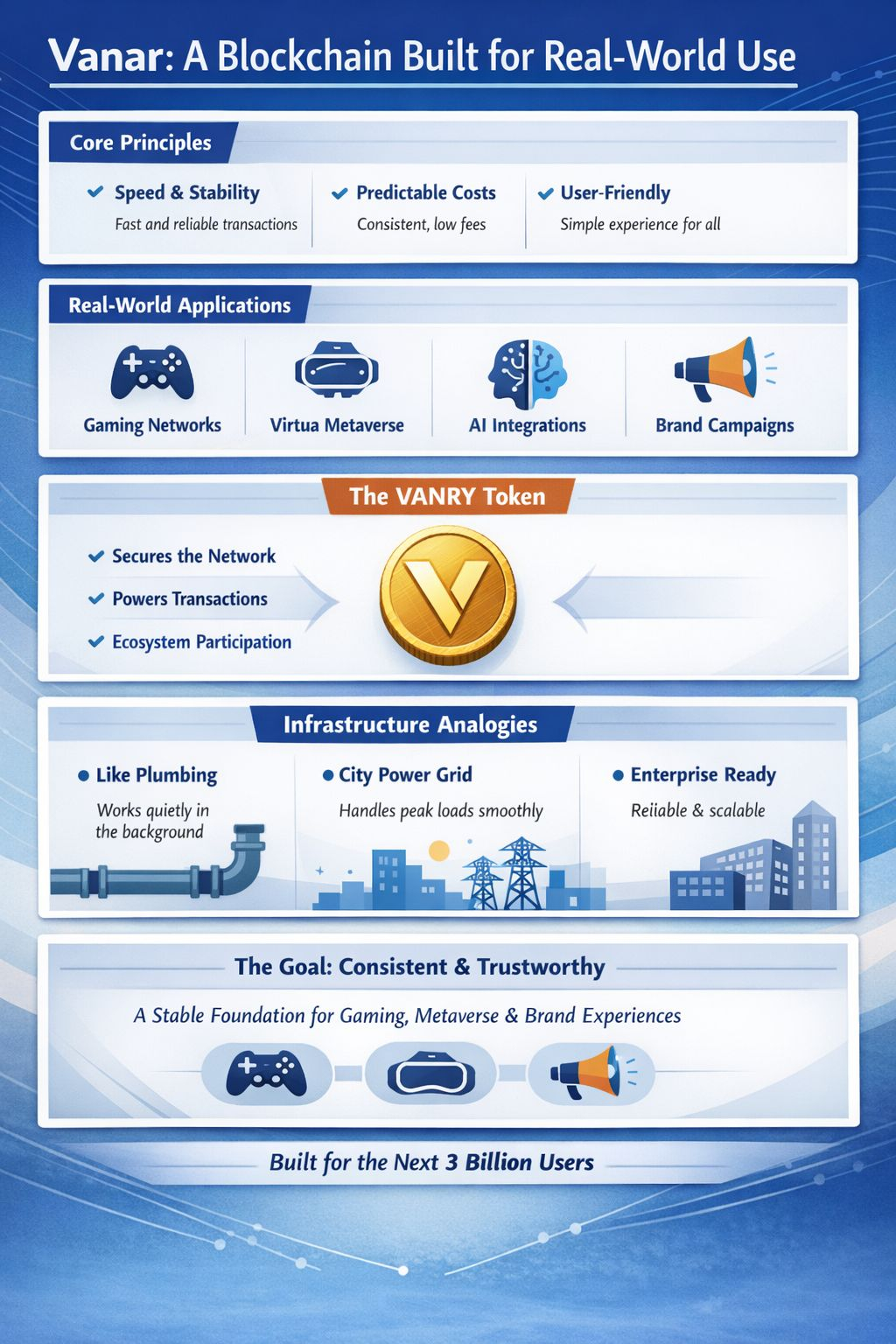
I often think of infrastructure like plumbing. Nobody compliments good plumbing. But the moment it stops working, everyone notices. A Layer 1 that wants to support games, metaverse experiences like Virtua, AI integrations, and brand activations has to be invisible in that same way. It shouldn’t demand attention. It should quietly handle the load.
Virtua Metaverse is a good example of where this matters. A metaverse isn’t just a marketplace—it’s an ongoing digital space where people own assets, build environments, attend events, and interact with brands. That means ownership records can’t be fragile. If someone invests time or money into a digital collectible or virtual space, they need confidence that it won’t disappear because the network hiccupped.
And this is where I start thinking about trade-offs. In blockchain design, you’re always balancing things: speed, decentralization, security, cost. Push too hard on one, and you risk weakening another. For something aiming at mainstream adoption, extreme positions don’t usually win. What wins is balance.
The VANRY token sits at the center of this balancing act. It powers transactions, secures the network through staking, and supports ecosystem participation. But in practical terms, it also has to behave in a way that doesn’t create chaos for users. If transaction costs swing wildly, developers struggle to plan. If fees are unpredictable, brands hesitate. So token design isn’t just about incentives—it’s about stability.
I try to imagine a brand launching a limited digital collectible inside Virtua. There’s marketing build-up, a specific launch time, and thousands of users waiting. If the blockchain clogs or fees spike, it’s not just a technical issue—it becomes a reputational one. Enterprises think in terms of reliability. They care about service levels, predictable costs, and risk management. So the underlying chain has to act more like enterprise infrastructure than an experimental lab.
What I appreciate in Vanar’s approach is the focus on practical integration across verticals—gaming, AI, eco initiatives, brand solutions. But that integration also creates complexity. Different use cases stress the system in different ways. Gaming creates burst traffic. AI-related interactions may require high-frequency micro-transactions or verifiable data logs. Environmental solutions depend on trustworthy timestamps and records.
When all of that shares one base layer, consistency becomes everything. It’s like a city power grid. Homes, offices, factories, and streetlights all pull electricity in different patterns. If the grid is designed only for average demand, it will fail during peaks. Good infrastructure plans for those peaks quietly, long before users feel them.
I think a lot about the everyday user in all of this. Most people don’t want to manage private keys or think about gas fees. They want to click a button and see a result. The more the blockchain fades into the background, the more likely adoption becomes. That doesn’t mean compromising security; it means designing the system so complexity doesn’t leak into the user experience.
In many ways, this reminds me of early online banking. At first, people were skeptical. Over time, they adopted it not because of flashy promises, but because it consistently worked. Balances updated accurately. Transfers went through. Systems stayed online. Trust grew through repetition.
I suspect the same principle applies here. If players on VGN consistently receive rewards on time, if metaverse transactions finalize quickly, if digital assets remain accessible year after year, users will stop thinking about the underlying chain. That’s when adoption starts to feel natural.
For me, the interesting question isn’t whether Vanar can support multiple industries. It’s whether it can do so simultaneously, without sacrificing predictability. Can it handle a surge in gaming traffic while a brand campaign runs and AI-driven processes operate in the background? Real-world systems aren’t tested one feature at a time—they’re tested all at once.
Ambition is easy to communicate. Operational discipline is harder. It shows up in uptime statistics, stable fees, clear developer documentation, and the absence of surprises. It shows up when things don’t break during peak demand.
When I step back, I don’t see Vanar primarily as a collection of products like Virtua or VGN. I see it as an attempt to build a dependable digital foundation for experiences people already understand—games, brands, entertainment—and make ownership native to those experiences.
And maybe that’s the real measure of whether something is ready for the “next 3 billion” users. Not whether it feels revolutionary, but whether it feels normal. Whether it works on a random Wednesday night just as well as it does during a high-profile launch.
In the end, I’m less interested in bold predictions and more interested in consistency. If a system can quietly deliver, day after day, without drama, people will build on it. And if they build on it long enough, adoption stops being a goal and simply becomes a result of things working the way they’re supposed to