In traditional companies, decisions are controlled by executives and boards.
In crypto, many projects flip this model completely by using governance tokens.
Governance tokens give users real power — allowing communities, not corporations, to decide how a blockchain project evolves.
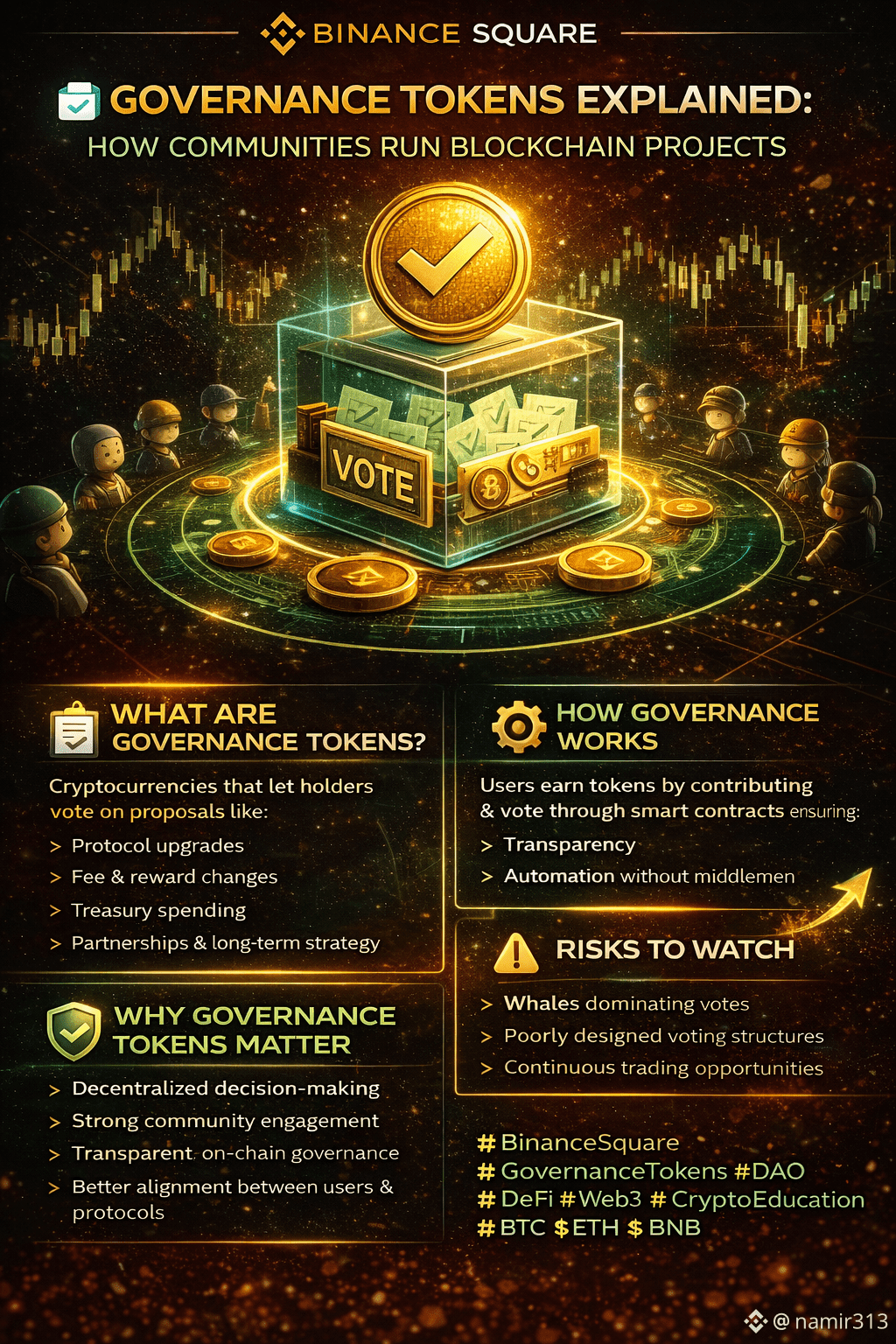
🔍 What Are Governance Tokens?
Governance tokens are cryptocurrencies that allow holders to vote on proposals such as: • Protocol upgrades
• Fee and reward changes
• Treasury spending
• Partnerships and long-term strategy
In most systems, one token equals one vote, aligning decision-making with ownership.
⚙️ How Governance Works
Users earn governance tokens by actively participating — lending, staking, providing liquidity, or contributing to the ecosystem.
Votes are executed through smart contracts, ensuring transparency and automation without intermediaries.
📌 Real Examples:
• MakerDAO (MKR): Governs the DAI stablecoin through on-chain voting
• Compound (COMP): Fully decentralized lending protocol governed by its users
• Uniswap (UNI): Community-led decisions for the world’s largest DEX
🌐 Why Governance Tokens Matter ✅ Decentralized decision-making
✅ Stronger community engagement
✅ Transparent and on-chain governance
✅ Better alignment between users and protocols
⚠️ Risks to Watch
Large holders (“whales”) can dominate votes, and majority decisions don’t always guarantee long-term success. Designing fair and balanced governance remains a key challenge.
🔮 The Future of Governance
New models like delegation, reputation-based voting, and DAO frameworks aim to improve participation and reduce centralization. Governance tokens will continue shaping the future of DeFi, DAOs, and Web3.
✨ Final Thought:
Governance tokens turn users into owners, not just participants — making decentralization real, not just a promise.
#BinanceSquare #GovernanceTokens #DAO #DeFi #Web3 #CryptoEducation$BTC