Capital markets don’t just dislike total transparency—they can’t actually function with it. That’s the real reason they need a privacy‑first L1 like @Dusk , not a generic public chain. Institutions have to protect client confidentiality, keep their strategies under wraps, and shield regulated data. At the same time, they need to prove to regulators that everything’s legit. On a fully transparent ledger, there’s just no way to strike that balance.
Radical transparency doesn’t fit the way institutions work
If you’ve ever used a block explorer, you know: public chains lay out every transfer, balance, and interaction for the whole world to see. For asset managers, banks, and broker-dealers, that’s a disaster. Their strategies, liquidity needs, even client behaviors—everything becomes public, breaking internal risk controls and running straight into rules like GDPR in Europe. Sure, addresses are pseudonymous, but analytics can cluster them, revealing who’s behind what. Suddenly, what looks like “transparency” turns into a giant information leak—something compliance teams just can’t sign off on.
Traditional markets go out of their way to hide this stuff. They keep order books partially hidden, use dark pools, and settle trades through intermediaries for a reason: nobody wants to broadcast their trading intent. When a big fund rebalances, only a handful of people know the details. Public chains tear that apart. Now, every move is out in the open, and that means front-running risk, a big disadvantage for institutions, and a direct clash with privacy rules baked into financial regulation.
“Add-on privacy” doesn’t cut it
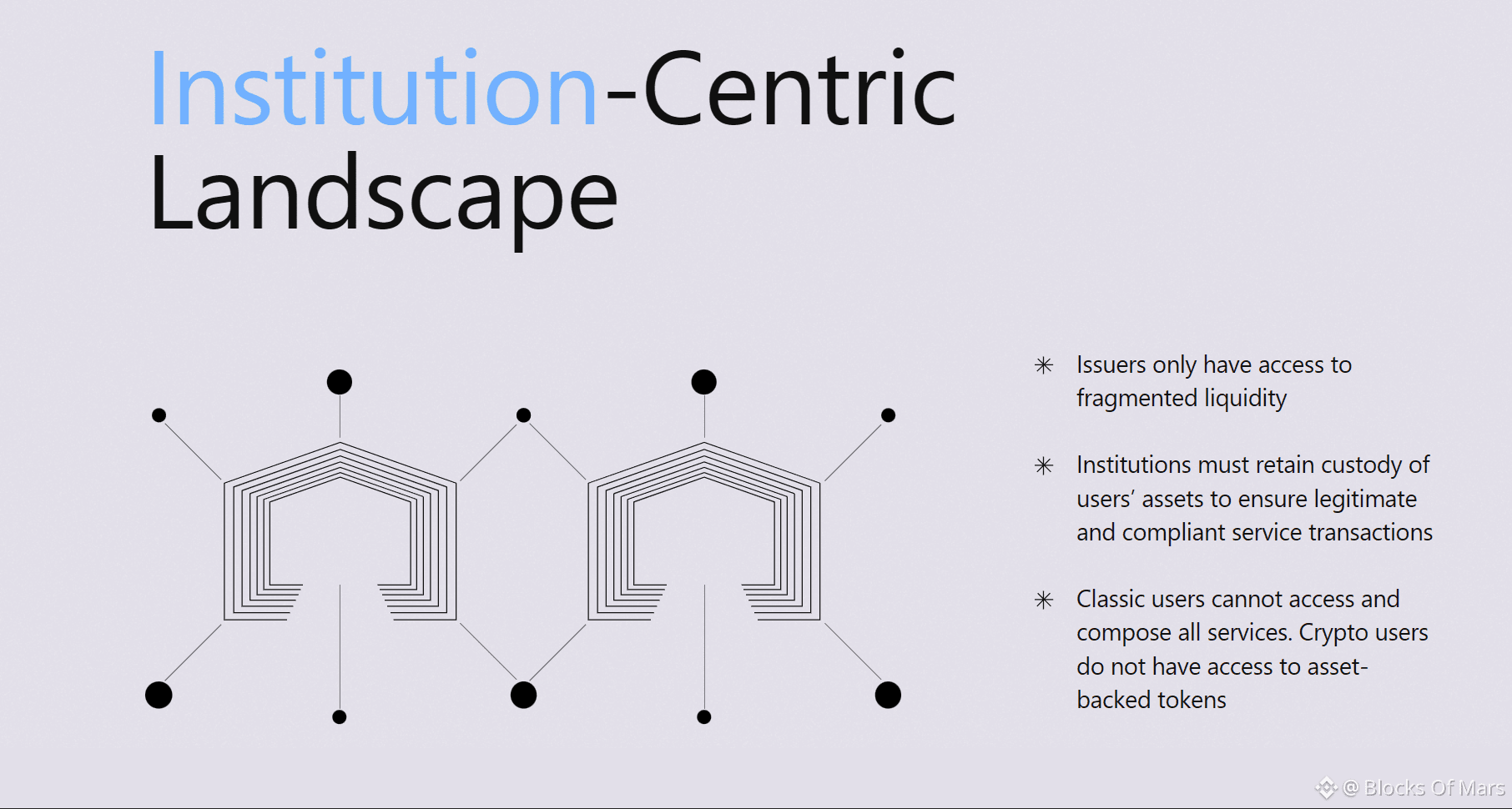
Some projects try to patch things up with mixers, sidechains, or half-private layers on top of transparent L1s. The problem? That just splits the market between compliant and non-compliant users. Regulators usually don’t trust mixers—they see them as a way to hide dirty money, not just sensitive business info. Plus, these tools break how everything connects, so institutions have to pick between keeping secrets and accessing liquidity. That’s not a real choice.
For capital markets, privacy has to come built into the core protocol. The chain needs to support private-by-default transactions, finality you can count on, and compliance tools that regulators can actually understand and audit. And it needs to do all of this without making institutions rely on tools that look like they’re hiding something. That’s exactly where @Dusk comes in: native privacy, but with real support for on‑chain oversight.
How Dusk actually solves the problem
Dusk doesn’t treat privacy and compliance as trade-offs—they’re both built into the protocol. It uses zero-knowledge proofs and confidential transaction schemes, so things like amounts, counterparties, and balances stay private, but still get mathematically verified. At the same time, Dusk offers “programmable privacy,” letting issuers and venues give regulators controlled access to specific information using viewing keys or selective disclosure. This way, trading strategies and client details stay private, but supervisors can still do their jobs and keep markets honest.
Since Dusk was designed from the start for digital securities, it can bake regulatory rules right into token standards and smart contracts. That means things like investor eligibility, where tokens can be traded, lockups, and reporting—these all get enforced on-chain, not pushed off to lawyers and paperwork. Combine that with confidential settlement, and institutions finally get something the public chains can’t offer: a market that acts like a regulated venue, with all the necessary controls, but still protects sensitive info.
Keeping up with modern regulations
Laws like GDPR, MiCA, and new digital-asset rules in Europe treat privacy as a right, not a bonus. A system that broadcasts every transaction detail just doesn’t fit, no matter how good it is at settling trades. Dusk is built as a direct answer to that problem. The only way institutions will ever bring real-world assets on‑chain is if the base layer is built for compliance and privacy from the start. That’s the point—and that’s the gap Dusk fills.
@Dusk brings confidential issuance, private settlement, and on-chain corporate governance together on one privacy-first L1. That means exchanges, brokers, and issuers can finally move to blockchain without worrying about breaking the rules or losing their edge. Sure, public chains are great for open experiments and retail DeFi, but real capital markets have rules—lots of them. They need strict privacy and compliance. For them, a privacy-first L1 like Dusk isn’t just a nice upgrade. It’s the only way in. $DUSK #Dusk