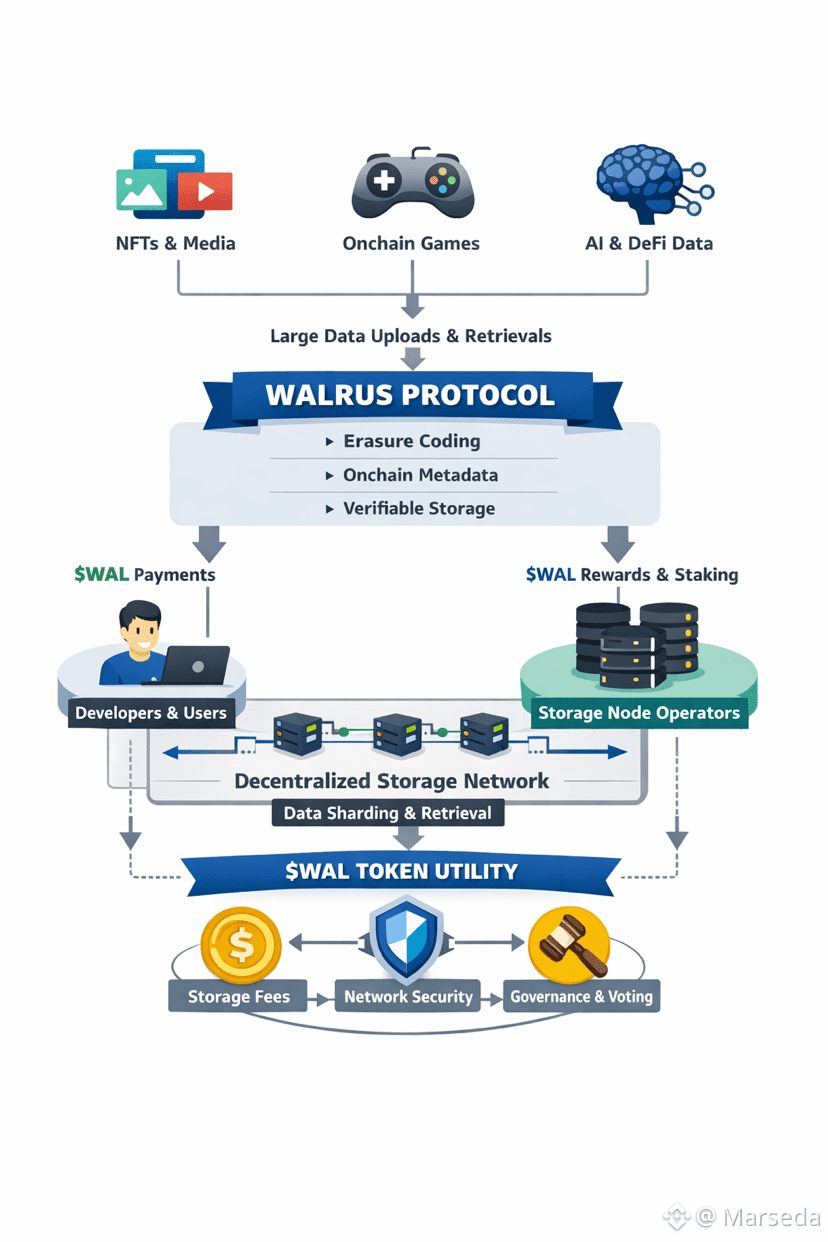
As the Web3 stack evolves, every major innovation eventually exposes a structural bottleneck. For years, execution layers and smart contracts grabbed all the attention — but the next frontier isn’t computing power: it’s where data lives and how it’s served.
@@Walrus 🦭/acc is not another IPFS clone or archival storage play. It’s a programmable, decentralised data availability and storage network designed to handle “blobs” — large unstructured data like videos, AI datasets, NFT media, and game assets — in a secure, scalable, and cryptographically verifiable way. This matters because traditional on-chain storage is prohibitively expensive and centralised cloud storage is antithetical to Web3’s ethos.
Technical foundations matter. Walrus uses advanced erasure-coding (Red Stuff) to split files into fragments and distribute them across a network of decentralised storage nodes. This approach drastically reduces replication overhead compared to naive full copies, improving cost efficiency while maintaining resilience — even if many nodes go offline, data remains reconstructible.
A critical advantage for builders is programmability: stored data isn’t just static. It’s represented as on-chain objects and metadata on the Sui blockchain, allowing developers to reference, verify, and integrate data directly into smart contracts and on-chain logic. This opens doors to more dynamic dApps, decentralised web hosting (Walrus Sites), and interoperable storage solutions across ecosystems.
A strong real-world signal is adoption at an infrastructure level. Major data network Chain base has integrated Walrus as a decentralised storage layer for large datasets, forging trust-less data pipelines for DeFi, AI, and Web3 applications — a meaningful step toward real usage beyond speculative hype.
From a market and utility perspective, $WAL serves multiple roles:
Native payment token for storage fees
Staking asset that secures the network via delegated proof-of-stake
Governance token influencing network parameters like pricing and penalties
Walrus’s growth isn’t just about trader speculation — it’s about creating economic utility for builders and users alike.
In a future where NFTs, AI models, on-chain games, and large media archives become commonplace, data must be decentralised, verifiable, and cost-effective. Walrus is architected for exactly that — and projects plugging into it today may be the first movers in tomorrow’s data-centric Web3 economy.
Bottom line: $WAL isn’t just a token — it’s a bet on decentralised data infrastructure that applications’ survival depends on.