
Web3 often sells the idea of freedom as speed. Faster launches, faster narratives, faster reactions to market moods. But freedom without trust rarely scales beyond a small circle. As the industry matures, a quieter realization is setting in: decentralization alone is not enough. Systems need credibility, clarity, and resilience to survive outside experimental bubbles. This shift in thinking is where @dusk_foundation steadily places its work.
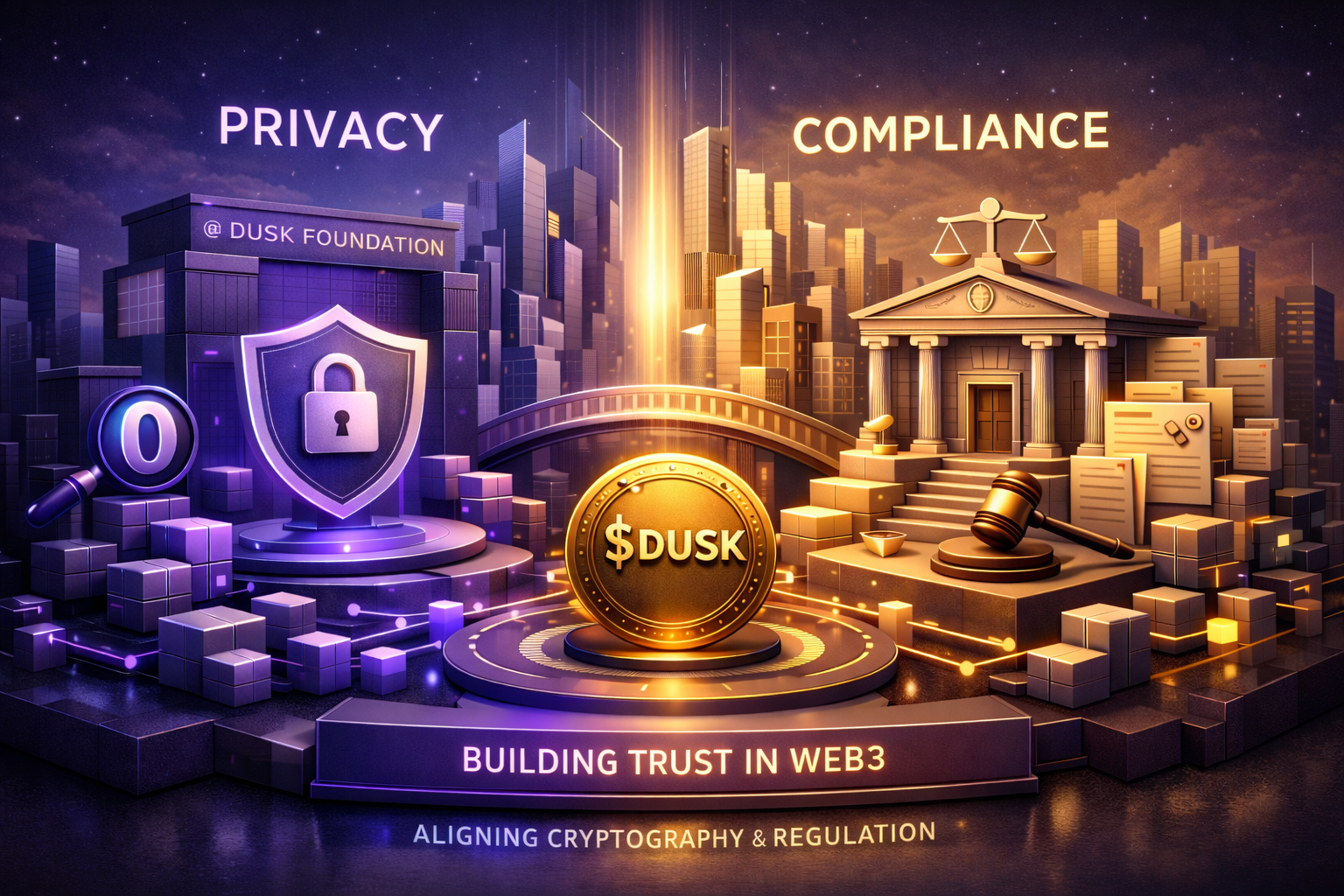
Instead of competing for attention, Dusk focuses on alignment. Alignment between privacy and accountability. Alignment between cryptography and regulation. Alignment between long-term infrastructure and real economic use. These are not easy goals, and they rarely produce instant applause. But they do produce systems that can exist in the real world without collapsing under pressure.
Why is trust harder to build than technology?
Technology can be written, forked, and deployed quickly. Trust cannot. Trust emerges when systems behave predictably under stress. Dusk understands this difference and designs accordingly.
In traditional finance, trust is enforced through institutions. In early crypto, trust was often replaced with blind belief in code. Dusk takes a middle path by using cryptography to verify actions without exposing sensitive information. Zero-knowledge proofs allow participants to prove correctness without surrendering privacy. This turns trust into a measurable property, not an assumption.
How does privacy support legitimacy instead of avoiding it?
Privacy is often misunderstood as secrecy. But secrecy avoids scrutiny, while privacy manages it. Dusk treats privacy as a tool that allows participation without unnecessary exposure.
Consider everyday life. You do not show your entire bank statement to buy groceries. You simply prove you can pay. Dusk applies this same logic to digital finance. Information is shared only when needed, and only to the degree required. This approach respects users while still enabling systems to function transparently where it matters.
What role does compliance play in long-term survival?
Many Web3 projects see compliance as a future problem. Dusk treats it as a present reality. Instead of building first and adjusting later, Dusk integrates regulatory awareness directly into protocol design.
This does not mean surrendering decentralization. It means acknowledging that real economies operate within legal frameworks. By designing systems that can coexist with regulation, Dusk enables institutions to participate without fear of instability. This expands the potential user base from niche communities to global markets.
Why does infrastructure matter more than headlines?
Headlines reward novelty. Infrastructure rewards discipline. Dusk focuses on the layers that make applications possible, even if those layers are rarely visible.
Like roads beneath a city, blockchain infrastructure determines how far innovation can travel. Poorly built foundations limit growth. Strong foundations enable it quietly. By prioritizing correctness, privacy, and composability, Dusk gives developers the confidence to build without constantly working around protocol limitations.
What does DUSK represent in this context?
DUSK is not just an asset that reflects market sentiment. It represents participation in a network designed around responsibility. Responsibility to users who need privacy. Responsibility to institutions that require clarity. Responsibility to an ecosystem that cannot afford fragile systems.
In a market where many tokens exist without purpose beyond speculation, DUSK stands for a more grounded vision of value creation. One where utility grows alongside trust, not at its expense.
Closing reflections
Web3 is moving from experimentation toward expectation. Users, regulators, and institutions are no longer satisfied with promises. They want systems that work reliably, even when conditions are difficult.
Dusk’s approach may seem slow compared to louder projects, but speed without structure often leads to collapse. The networks that endure are the ones that accept complexity early instead of postponing it.
Final statement
If Web3 is to become a dependable layer of the global digital economy, it will require builders who prioritize trust as much as innovation. @Dusk and DUSK reflect a belief that privacy, compliance, and decentralization can reinforce each other, shaping a future that is not just open, but sustainable. #dusk
