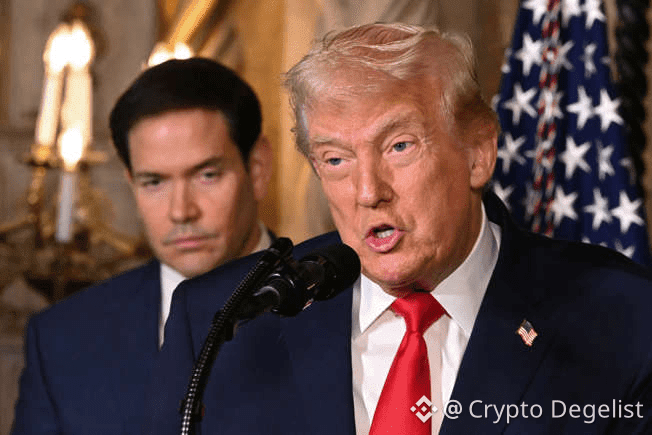
A bombshell statement from President Trump in 2025 questioned the very foundation of the U.S. national debt, suggesting some payments "might not count" due to fraud.
While officials clarified he was likely referring to contractor payments, not Treasury bonds, it spotlighted a staggering, undeniable reality.
The U.S. owes nearly $9.2 trillion directly to foreign nations and investors.
For crypto investors, this isn't just a political headline—it's a fundamental driver of the very market you're trading in.
Let's break down what this debt means, who holds it, and why it's a central pillar of the crypto investment thesis.
🇺🇸 The Unshakeable Creditor: A Global Ledger of U.S. Debt
First, let's look at the raw numbers.
The total U.S. national debt has surpassed $38 trillion, a record high when compared to the size of the economy.
The portion held by the public—meaning investors both domestic and foreign—is $29 trillion.
Foreign entities, including foreign governments and private investors, hold roughly one-third of this public debt.
This means the U.S. government is sending hundreds of billions in interest payments abroad every year, including nearly a quarter of all its interest payments to foreign nations.
Who are the biggest creditors? The list reads like a who's who of geopolitics, but the concentration is key.
Just three countries—Japan, the United Kingdom, and China—hold over $2.7 trillion in U.S. Treasury securities. This creates a web of financial and political dependency.
Top Foreign Creditors to the U.S. (As of Oct 2025) Holdings (in Billions USD) Japan $1,200.0 United Kingdom $877.9 China, Mainland $688.7 Belgium $468.4 🌍 A World Drowning in Debt: The Bigger Picture
The U.S. is far from alone. This is a global phenomenon of epic proportions. Global public debt reached a record $102 trillion in 2024.
The situation is particularly dire for developing nations, whose interest payments have exploded, forcing 61 countries to spend over 10% of their government revenues just on interest.
In many places, more money goes to creditors than to health or education. This systemic stress heightens the risk of "cross-border shocks," where a debt crisis in one region can trigger global market turmoil.
⚡ The Crypto Connection: Why Debt Matters for Your Portfolio
So, what does a spreadsheet of global IOUs have to do with $BTC and $ETH ? Everything. This debt landscape creates several powerful, structural tailwinds for cryptocurrencies.
The Debasement & De-Dollarization Hedge: To manage its debt, the U.S. faces immense pressure to keep interest rates lower than inflation would dictate (a policy known as "fiscal dominance").
This, combined with massive ongoing deficits, debases the value of the dollar over time. Meanwhile, global trust in the U.S.-centric financial system is eroding, partly due to the weaponization of sanctions. Nations and institutions are actively seeking alternatives, a trend known as de-dollarization. Crypto, especially Bitcoin with its fixed supply, is engineered to be the perfect hedge against this exact scenario—a hedge against currency debasement and a neutral, global alternative store of value.
The "Unstoppable" Debt Spiral and the Search for Real Assets: Leading analysts argue the rise in government debt, especially in the U.S., is now "almost unstoppable". The consequence? Structurally higher inflation and a weaker dollar. In such an environment, investors urgently flee to "real assets" and "alternative hedges". Cryptocurrencies, particularly those with clear scarcity and utility, are increasingly viewed not as speculative tech stocks, but as a new digital asset class for this exact purpose. The recent U.S. move to back stablecoins 100% with government debt directly links the crypto and Treasury markets, making crypto's role in this system even more critical.
Systemic Risk and Network Resilience: The IMF warns that high debt levels have increased global financial stability risks and could lead to "sharp and sudden corrections" in overvalued traditional assets. When confidence in the traditional, debt-based financial system wavers, capital flows toward systems perceived as more resilient. The decentralized, transparent, and globally accessible nature of major blockchain networks presents a stark contrast to opaque, debt-laden central bank ledgers.
💎 The Analyst's Verdict
While the U.S. has reduced crippling debt before—as after World War II—the path now requires either politically impossible austerity or historically unprecedented economic growth. In the meantime, the debt machine rolls on.
For the crypto investor, this is not a short-term trading signal. It is a long-term, foundational thesis. The trillions owed by the U.S. and other nations are not an abstract problem; they are the engine of monetary policy that directly undermines fiat currency credibility. This systemic pressure fuels the demand for decentralized, sound money and a new financial architecture.
The #1 portfolio hedge against a world of unchecked sovereign debt is the asset class built precisely to escape it. Stay sharp, think macro, and recognize that every new trillion on the national ledger is another brick in the foundation for crypto's future.