@Dusk ’s focus on European securities and regulated venues is not a marketing afterthought; it is the product of years spent watching how EU regulation, privacy law, and capital‑market structure collide—and then building a chain that fits that reality. The partnership with Dutch exchange NPEX and the work around EU rules like MiCA show how deliberately @Dusk has anchored itself in Europe’s regulated securities landscape.
Europe: strict rules, big opportunity
The European Union is rolling out some of the world’s most comprehensive crypto and digital‑asset regulations, including MiCA and travel‑rule style requirements that force exchanges and wallet providers to capture identities and transactional metadata. At the same time, leaked proposals have targeted “anonymity‑enhancing coins,” making it difficult for institutions to hold or interact with classic privacy coins while still complying with EU law. @Dusk ’s team recognized early that if blockchains were ever going to host serious securities in Europe, they would have to satisfy both capital‑markets rules and strict privacy and data‑protection standards at the same time.
Instead of trying to avoid these rules, @Dusk embraced them by designing a protocol where KYC and compliance are mandatory, but executed through zero‑knowledge cryptography so that data remains confidential. That places the project in a unique niche: it is not a generic privacy coin, but a regulated‑finance platform that uses privacy tools to implement European rules mathematically rather than fighting them.
Why NPEX and Dutch securities came first
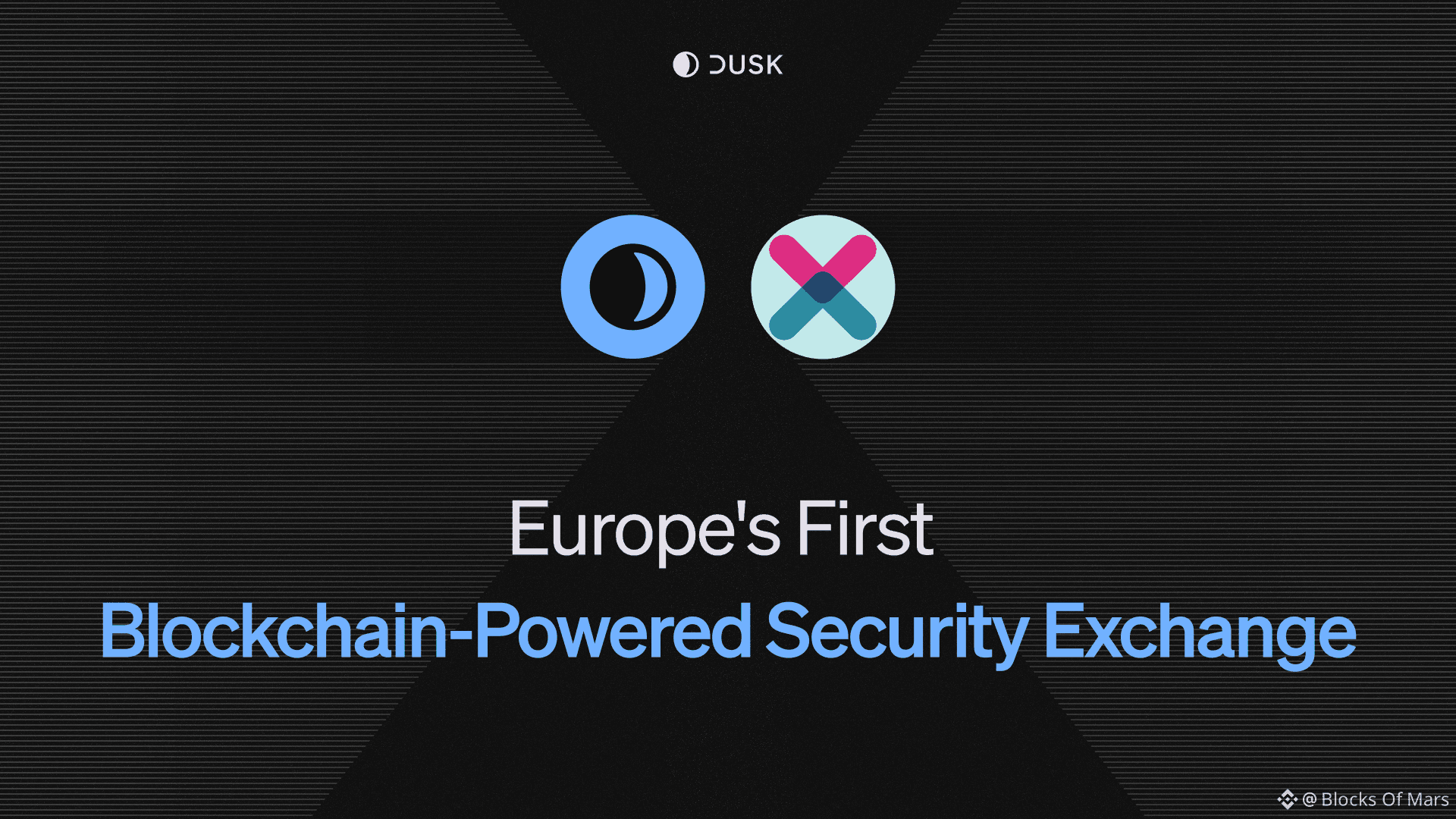
This European orientation crystallized in @Dusk ’s commercial partnership with NPEX, a licensed stock exchange in the Netherlands operating a multilateral trading facility (MTF). NPEX already lists and trades SME shares and other securities under Dutch and EU law, which makes it an ideal bridge between traditional markets and a blockchain purpose‑built for compliant tokenization. Together, @Dusk and NPEX are building what they describe as one of Europe’s first blockchain‑powered security exchanges—DuskTrade—where issuance, secondary trading, and settlement of regulated instruments all happen on Dusk’s infrastructure.
The choice of a European MTF is strategic. EU markets are fragmented but highly regulated, and MTFs are core venues for small and mid‑cap securities that often struggle with liquidity and complex post‑trade processes. By targeting that layer first, @Dusk can demonstrate how on‑chain settlement, programmable compliance, and privacy‑preserving identity can reduce costs and expand access for real companies, not just synthetic DeFi projects. It also lets @Dusk prove, in a live regulatory environment, that its privacy and identity stack is acceptable to supervisors who must sign off on NPEX’s operations.
Protocol design shaped by EU regulation
The EU’s approach to privacy and crypto directly influenced @Dusk ’s core architecture. In a policy analysis on proposed EU rules for privacy‑enhancing coins, Dusk’s team emphasized that they are “not specifically a privacy‑enhancing coin” in the regulatory sense; instead they use zero‑knowledge proofs to keep transactions private while ensuring every action is compliant by design. Users KYC once, keep that KYC data private, and then transact in ways that are mathematically restricted to permitted counterparties and instruments—if sanctions bar a certain country, the protocol simply makes those transfers impossible.
To satisfy requirements that names of senders and recipients can be recorded or retrieved when needed, @Dusk uses provable encryption and digital identity via Citadel, aligning itself with the EU’s emerging European Digital Identity (EUDI) framework. This means each transaction can be audited by the right authority even though ordinary observers see only commitments and proofs, a balance that fits Europe’s simultaneous insistence on financial traceability and data minimization. In short, European rules didn’t just influence Dusk’s legal strategy—they literally shaped how the chain encodes and reveals information.
Building a template for on‑chain European securities
The combination of NPEX, EU‑aligned identity, and built‑in compliance is gradually turning @Dusk into a template for how European securities might live on‑chain. @Dusk and NPEX are already extending this framework with partners like Chainlink to handle verified market data and cross‑chain settlement for European securities, ensuring that tokenized assets on DuskEVM can interact securely with the wider crypto ecosystem. This marriage of licensed venues, privacy‑first infrastructure, and interoperable data standards is aimed squarely at institutions who want to modernize their European operations without stepping outside regulatory comfort zones.
@Dusk ’s story, then, is not just about a blockchain choosing a region; it is about a protocol that grew up around Europe’s specific blend of strict securities law and strong privacy rights. By making European securities and regulated venues its first proving ground, Dusk is betting that the hardest regulatory environment will also be the most powerful showcase for its technology—and a launchpad for similar regulated markets worldwide. $DUSK #Dusk