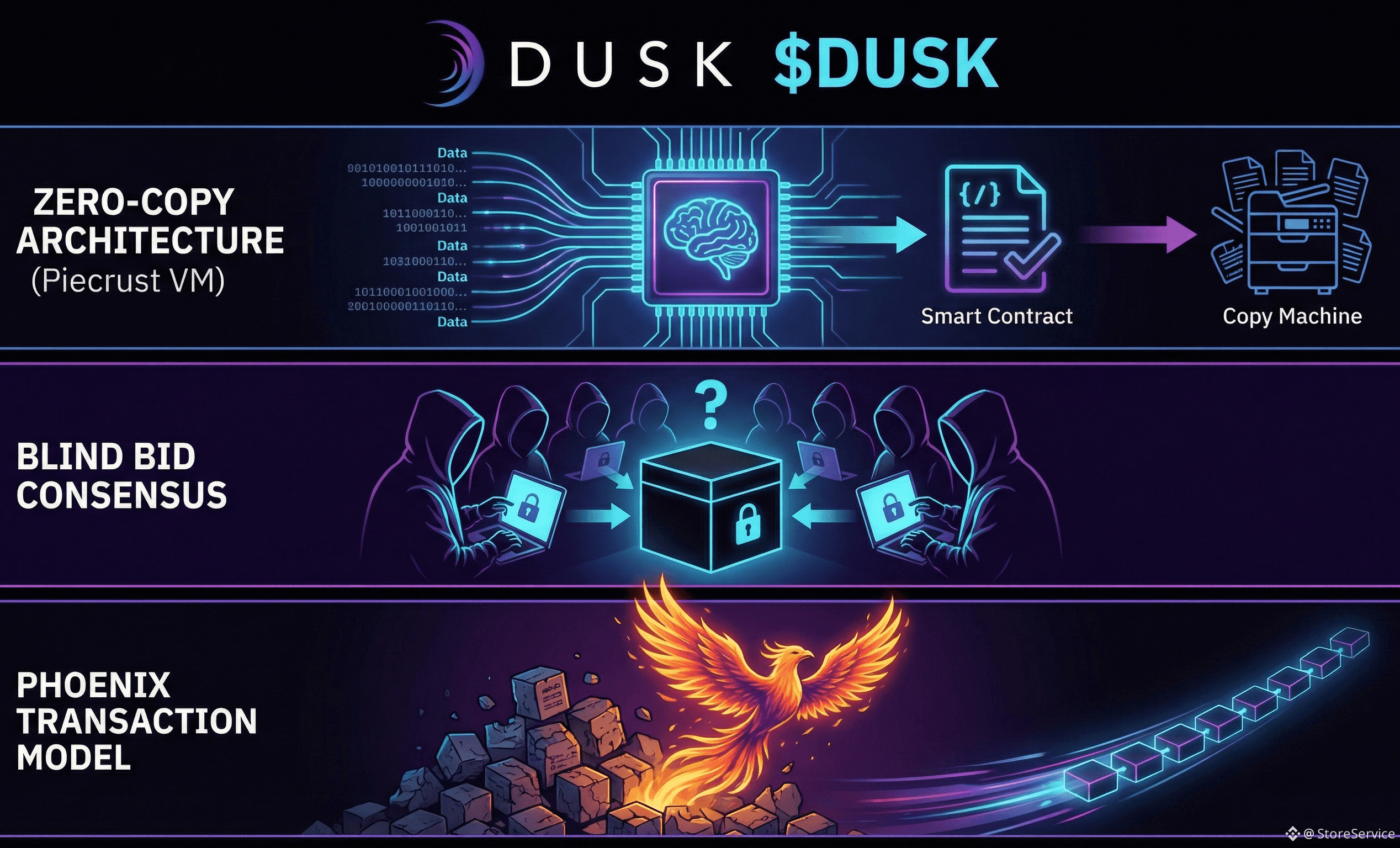
We are used to judging crypto by green candles. But the real "alpha" hides in the code. @Dusk Network is not just another blockchain. The developers employed several unconventional engineering tricks to bypass limitations that have held back Ethereum and Monero for years.
Let's look under the hood and analyze the "magic" that makes this project unique for the RWA sector.
Trick #1: Zero-Copy Architecture
The Standard Problem:
Imagine you are a librarian. When someone asks for a book, instead of simply handing it over, you go to a xerox machine, copy 500 pages, and hand over the copy. Then you burn it. This is how most Virtual Machines (EVM) work—they constantly copy data in memory to process a transaction. It’s slow and expensive.
The Dusk Hack (Piecrust VM):
They utilized the Zero-Copy principle. A smart contract in Dusk reads data directly from where it resides in memory without creating duplicates.
The Effect: This allows processing "heavy" ZK-transactions (which usually take minutes) in milliseconds. This is the "hidden engine" that will allow banks to execute thousands of operations per second.
Trick #2: Blind Bid
The Standard Problem:
In PoS networks (like Ethereum), everyone knows who the validators are. This makes them targets for DDoS attacks or collusion. If you know "Bob" is creating the next block, you can try to bribe Bob or crash his server.
The #dusk Hack:
Dusk uses the Blind Bid mechanism.
To participate in consensus, you "stake" your coins, but this bid is fully encrypted.
No one knows who is participating in the lottery for the right to create a block.
The winner is revealed only at the moment the block is created.
The Effect: A hacker cannot attack the validator because, until the very last second, they don't know who to attack. This makes the network incredibly resilient even with fewer nodes.
Trick #3: Phoenix — Transactions Rising from Ashes
The Standard Problem:
Private coins often suffer from "blockchain bloat." Storing the history of all anonymous outputs (UTXO) becomes increasingly difficult, causing wallets to lag over time.
The Dusk Hack:
The Phoenix transaction model.
This is a unique hybrid model that allows spending encrypted notes (money) while automatically pruning old data that is no longer needed for verification.
The Effect: The blockchain remains "lightweight," and client wallets run fast even on mobile phones. This solves the privacy scaling issue that projects like Monero struggle with.
Conclusion: Why is this a "Smart Money Play"?
Most investors buy the narrative ("it's #RWA ," "it's ZK"). But big players buy the technological advantage.
Dusk Network implemented Piecrust VM and Phoenix not because it's trendy, but because it is the only way to make real assets (stocks, bonds) work on blockchain efficiently.
While the market sleeps, Dusk's technology is ready for loads that would crash most competitors.
⚠️ Disclaimer: This content is for educational purposes only and does not constitute financial advice. Each trader makes decisions independently, considering their own risk.
$DUSK #blockchain #RWA #BinanceSquare