
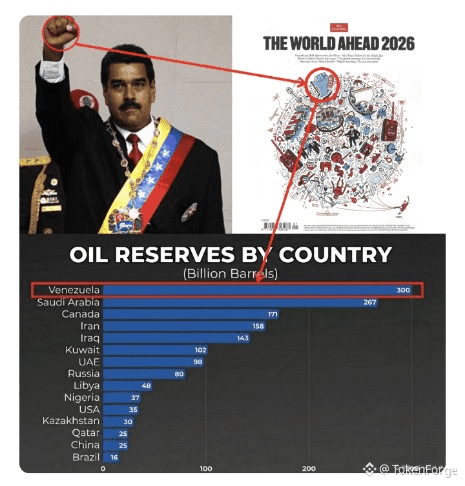
Venezuela isn’t just “a country with a lot of oil” — it holds the largest proven crude oil reserves on Earth. According to the latest energy data, Venezuela’s reserves stand at roughly 300+ billion barrels — about 17% of global proven crude oil reserves, making it larger than Saudi Arabia’s reported reserves. �
Wikipedia +1
At current crude prices (~$50–$60/barrel), that translates to a theoretical value of more than $15–$18 TRILLION on paper. �
But theory is not reality — and here’s where the truth gets striking.
El Economista
🛢️ Why Venezuela’s Oil Isn’t Instantly a Cash Windfall
Despite having massive reserves:
❌ Production Is Tiny Compared to Potential
Venezuela produces only ~1 million barrels per day, roughly ~1% of global oil supply. �
Dinero en Imagen +1
⚠️ Severe Structural Issues
Years of underinvestment, corruption, and sanctions have devastated infrastructure, meaning:
Output is far below historical highs (3m+ bpd in earlier decades). �
Dinero en Imagen
Heavy and extra‑heavy crude dominates (more expensive to refine). �
Dinero en Imagen
💰 Huge Investment Needed to Rebuild
Analysts estimate tens to over $100 billion would be required over many years just to begin restoring capacity — not something that happens overnight. �
chathamhouse.org
🇺🇸 What the United States Is Doing Now
Recent political and military developments have shifted the spotlight:
🪖 U.S. Seizure and Control Moves
The U.S. government has seized Venezuelan and linked oil tankers and is asserting broad control over oil sales tied to Venezuela. �
AP News
The White House says it intends to control Venezuelan oil sales “indefinitely.” �
The Guardian
🧾 Trump’s Executive Actions
President Trump signed an executive order aimed at protecting Venezuelan oil revenue held in U.S. Treasury accounts from creditors and legal seizure — effectively keeping the funds under U.S. control for diplomatic and strategic policy goals. �
Reuters
⛽ Oil Shipments to the U.S.
Trump has publicly stated that Venezuela will turn over between 30–50 million barrels to the U.S., with proceeds overseen by Washington. �
However — that volume equates to only a tiny fraction of global daily oil flow, and not a transformational shift in supply. �
The Guardian +1
opb
Other sanction‑related news suggests the U.S. may ease some restrictions soon to facilitate oil exports and economic engagement, indicating shifting policy dynamics. �
Reuters
🧠 The Reality Check Between Reserves and Revenue
👉 Paper value ≠ liquid cash:
A $15T+ oil reserve valuation looks huge only if that oil is producible at scale and reliably exported — neither of which is currently true with Venezuelan production. �
infobae
👉 Production ≠ Reserves:
Market prices respond to actual output, global demand, and export capability, not just reserve statistics — and Venezuela’s output is tiny relative to markets like the U.S., Saudi Arabia, or Russia. �
infobae
👉 Geopolitical risk is massive:
Control over Venezuelan oil is a geopolitical flashpoint involving:
U.S. policy and sanctions strategy
Global energy security conversations
Foreign investment hesitancy due to political risk
📊 Macro Implications That Actually Move Markets
✔ Venezuela’s oil story is not just about reserves — it’s about:
How political control influences global supply narratives.
How production constraints keep real output low.
How sanctions and infrastructure decay restrict export capacity.
✔ Oil futures, FX markets, and emerging market risk assets will be affected by how this situation evolves — not by theoretical reserves alone.
🧩 Bottom Line
Yes — Venezuela has the world’s largest crude oil reserves.
Yes — that reserve wealth could be worth trillions on paper.
But that’s only part of the story — converting those reserves into actual global influence and revenue will be slow, expensive, and politically fraught.
Stay tuned — because the global energy narrative is shifting right in front of us.





#VenezuelaOil #OilReserves #EnergyGeopolitics #USPolicy #EnergyMarkets