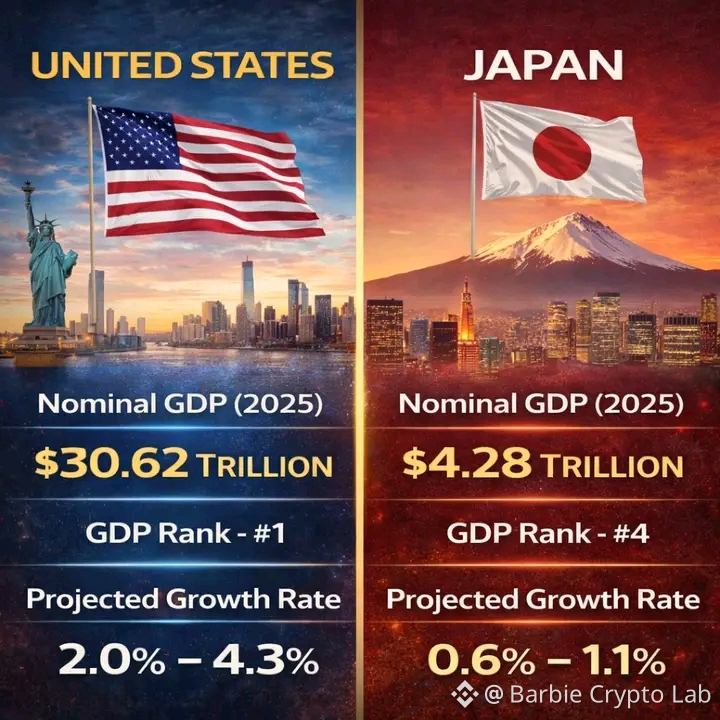
🔥Economic strength is a key indicator of a country’s global influence, standard of living, and ability to invest in development and security. One of the main measures of economic strength is nominal gross domestic product (GDP), which represents the total market value of all goods and services produced in a country within a year. In 2025, the United States and Japan are two of the most important economies in the world, though their size and global roles differ significantly.
The United States is projected to have a nominal GDP of 30.62 trillion dollars in 2025, making it the largest economy globally and holding the first rank in total output. The size of the US economy reflects its diverse industrial base, technological innovation, and consumer-driven market. The country benefits from strong sectors such as technology, finance, healthcare, and energy, which together drive growth and economic stability. A high GDP allows the United States to maintain a high standard of living for its citizens while also exerting influence internationally through trade, investment, and development initiatives. It provides the government with resources to fund essential services, research and development, and defense, ensuring long-term national competitiveness.
Japan, on the other hand, has a projected nominal GDP of 4.28 trillion dollars in 2025, ranking it as the fourth largest economy in the world. Despite being smaller than the United States in absolute terms, Japan remains a global economic powerhouse. Its economy is driven by advanced manufacturing, technology, and exports. Japan excels in automobiles, electronics, robotics, and precision machinery, which support its strong position in global trade. The country’s economy is heavily export-oriented, maintaining strong trade relationships with countries across Asia, Europe, and North America. While Japan’s nominal GDP is lower than that of the United States, its per capita GDP is high, reflecting a high standard of living, modern infrastructure, and efficient public services.
Comparing the United States and Japan highlights how different economies achieve global influence. The United States relies on a combination of domestic market size, innovation, and global investments to maintain its leading position. Japan, though smaller in total GDP, leverages technology, quality manufacturing, and trade to sustain economic strength and international relevance. Both countries demonstrate the importance of economic power in shaping national security, technological leadership, and global partnerships.
A strong economy allows countries to invest in health, education, infrastructure, and defense, which in turn strengthens stability and resilience. Economic size and productivity also influence geopolitical strategy, as nations with larger GDPs can wield more influence in global decision-making and international negotiations. Understanding the differences in the US and Japanese economies helps explain why economic policies, trade relations, and innovation strategies are central to national growth,
#USJobsData #BTCVSGOLD #CPIWatch #WriteToEarnUpgrade #Binance